 English

Views: 0 Author: Site Editor Publish Time: 2026-09-07 Origin: Site


Mismatching packaging materials with sealing technology directly leads to micro-leaks, aesthetic defects, and unacceptable downtime. You cannot simply squeeze a product into a tube and hope the seal holds under pressure. It requires precise mechanical alignment between the container and the machine.
Production environments are shifting rapidly across industries today. Whether you are scaling a cosmetic cream line or upgrading a pharmaceutical paste operation, the physical properties of your tubes dictate your mechanical requirements. Overlooking these material constraints will compromise product integrity and derail your production schedules.
This guide provides a strict, evidence-based framework for evaluating equipment based on tube material, operational constraints, and industry compliance. We will explore how material behavior influences machinery choices and highlight critical evaluation criteria. You will learn exactly how to align your packaging strategy with the right automation technology.
Material dictates mechanics: Plastic relies on thermal/ultrasonic fusion; aluminum relies on precise mechanical deformation (folding).
Technology matching: An ultrasonic plastic tube filling machine excels for products that contaminate the seal area, while hot-air remains the high-volume standard.
Capital allocation: Dedicated single-material machines offer higher reliability and speed compared to "combi-machines," which often hide hidden costs in tooling changeovers.
Compliance first: Pharmaceutical and cosmetic applications require strict assessment of sanitary design, void-free filling, and verifiable seal integrity.
Manufacturers often make a critical error early in the procurement process. They prioritize machine speed over material compatibility. This disconnect inevitably causes severe production bottlenecks. You must understand the fundamental physical behaviors of your packaging before reviewing equipment specifications.
Plastic and laminate tubes exhibit a unique structural characteristic known as the "memory effect." When you squeeze them, they try to return to their original cylindrical shape. This constant outward pressure demands structural fusion at the tail end. You must melt the polymer layers together to overcome this resistance permanently.
Aluminum behaves entirely differently. It possesses "dead-fold" characteristics. Once you bend aluminum, it stays bent. It does not try to expand back into its previous shape. Therefore, processing metal containers requires precision folding mechanisms. You must deform the metal mechanically without fracturing its structure.
Utilizing inappropriate sealing heads creates disastrous financial consequences. If you apply intense mechanical pressure to plastics, they will split. If you apply excessive heat to polymers, you get scorched packaging and ruined aesthetics. Conversely, using poorly calibrated crimping jaws on metal can crack the internal epoxy linings. This exposes the raw metal to your product, immediately compromising the barrier and leading to recalls.
High scrap rates drain profitability quickly. Beyond wasted materials, misaligned machinery forces operators to pause lines constantly. Unplanned downtime destroys operational efficiency.
Buyers must establish a strict baseline requirement before contacting vendors. You need to define three critical parameters:
Dominant Material: Identify whether your facility runs 80% plastic or 80% aluminum.
Viscosity Profile: Determine if your product is a thick paste, an aerated gel, or a thin liquid.
Daily Throughput: Calculate your required units per minute during peak production shifts.
Once you define these factors, you can effectively match your operational reality to the correct mechanical solutions.
Processing polymers demands high thermal control. Your core challenge is achieving a hermetic, aesthetically clean seal without degrading the tube's outer artwork or inner barrier layers. If the temperature fluctuates, you risk weak seams or melted plastic sticking to the machine jaws.
Hot-air sealing represents the industry standard for high-volume polymer processing. It is highly reliable for consistent production runs.
How it works: The machine inserts internal nozzles directly into the open end of the tube. These nozzles blast hot air, heating the plastic wall from the inside out. Once the interior reaches a molten state, external chilled jaws clamp the ends shut. The cold jaws instantly set the plastic, creating a solid fusion.
Best for: This method works beautifully for high-speed cosmetic and personal care lines. It delivers clean, uniform crimps. Hot-air systems dominate facilities producing shampoos, lotions, and standard creams.
Certain products render hot-air methods ineffective. When handling difficult formulations, you must pivot to specialized technology. Implementing an ultrasonic plastic tube filling machine solves many complex packaging challenges.
How it works: Unlike hot-air systems, ultrasonic technology relies on high-frequency mechanical vibrations. An acoustic tool, called a horn, presses against the plastic. The friction generates localized heat exactly at the seal line. It melts the material instantly without requiring external heating elements.
Evaluation criteria: This approach excels when dealing with heavily viscous products, pastes, or thin liquids that risk splashing. If a product splashes onto the seal zone during dosing, hot-air jaws will fail to fuse the contaminated plastic. Ultrasonic friction physically vibrates the contaminants out of the seal area before melting the polymer. Furthermore, it operates at lower ambient temperatures. This protects heat-sensitive product formulations from degrading during the final closure process.
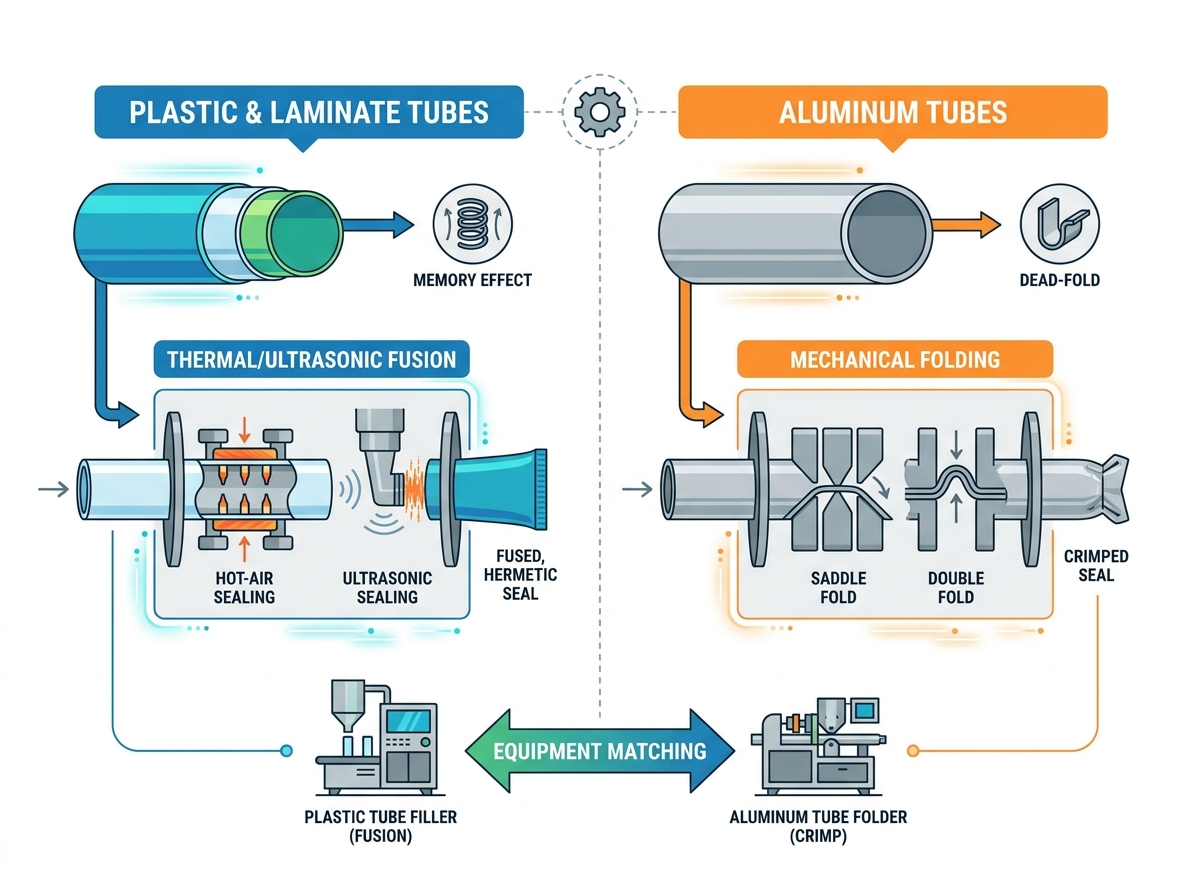
Metal packaging requires an entirely different mechanical philosophy. Your core challenge shifts from thermal control to mechanical force. You must create a secure mechanical lock without stressing the metal or damaging internal protective coatings.
You cannot heat-seal metal containers. Instead, you need heavy-duty forming stations. A dedicated aluminum tube filling machine provides the immense physical rigidity required to bend metal cleanly.
Types of folds: You must evaluate equipment based on its folding capabilities. Different products require different barrier strengths. Typical folding patterns include:
Saddle Fold: A basic over-and-under crimp suitable for standard consumer goods.
Double Fold: A tighter, more secure wrap used for everyday cosmetics and paints.
Triple Fold: The most secure mechanical lock available. It involves three distinct bends.
Industry application: The triple fold dominates pharmaceutical ointments, harsh chemicals, and industrial adhesives. These reactive products require absolute oxygen and moisture barriers. A flawless triple fold guarantees product stability over a long shelf life.
Aluminum processing leaves no room for calibration errors. Highlight the necessity of precise coding and crimping jaws. If the jaws feature sharp edges or misaligned teeth, they will puncture the material. Even a microscopic tear ruins the container.
These machines require much higher mechanical rigidity in the folding stations compared to plastic sealers. If the machine frame flexes during the folding process, the crimp will be uneven. Uneven crimps lead directly to catastrophic leaks during transport.
Once you match the core technology to your material, you must evaluate the broader operational features. Assessing commercial tube filling and sealing machines involves analyzing automation levels, pump dynamics, and compliance standards.
You need to assess semi-automatic versus fully automatic options based on labor constraints and volume needs. Semi-automatic models require manual tube loading. An operator physically places empty containers into the pucks. This works well for pilot runs or specialized small batches.
Fully automatic systems utilize robotic feeding mechanisms. They feature hoppers, orientation sensors, and auto-loaders. They run at much higher speeds and eliminate human error. If your labor costs are high, full automation provides rapid operational returns.
Table: Equipment Automation Comparison
Feature | Semi-Automatic Machines | Fully Automatic Machines |
|---|---|---|
Tube Loading | Manual operator placement | Robotic hopper feeding |
Orientation | Manual adjustment needed | Photoelectric auto-alignment |
Typical Speed | 10 to 30 units per minute | 60 to 120+ units per minute |
Labor Intensity | High (requires dedicated operator) | Low (requires occasional monitoring) |
Best Application | Startup lines, seasonal batches | High-volume continuous production |
Your product's rheology dictates the pump selection. You must ensure the machine's pump system matches the product perfectly. Using the wrong pump causes tailing, where product drips onto the seal area. It also introduces air bubbles into the formulation.
For thick pastes and heavy ointments, piston pumps provide exceptional volumetric accuracy. They push dense materials forcefully. For aerated creams or thin liquids, rotary valve pumps or gear pumps offer smoother dosing. Accurate dosing prevents product waste and keeps the sealing zone clean.
For pharmaceutical and high-end cosmetic manufacturing, sanitary design is non-negotiable. You must evaluate the machine's Good Manufacturing Practice (GMP) readiness. Look for 316L stainless steel contact parts.
Assess the Clean-In-Place (CIP) and Sterilize-In-Place (SIP) capabilities. The internal piping must drain completely. Inspect the blueprints for dead legs or microbial catch-points. If a machine traps residue, it will cause cross-contamination between batches.
Modern production requires robust quality control sensors. Scrutinize the inclusion of mark-registration sensors. These sensors read the printed eye-mark on the tube, ensuring the artwork faces the correct direction before sealing.
Additionally, demand automated rejection systems. If a sensor detects a misaligned container, an open seal, or an incorrect fill weight, the machine must auto-eject the unit. It should divert bad units to a reject bin without stopping the entire production line.
Equipment manufacturers frequently market hybrid systems. These machines promise to handle both plastic heating and aluminum folding on a single frame. While appealing in theory, they present significant operational hurdles.
You should address the temptation to buy these versatile platforms carefully. Combi-machines sound like a perfect compromise. However, they force compromises in both mechanical rigidity and thermal precision. The frame must accommodate bulky folding stations and complex hot-air manifolds simultaneously. This often results in a cramped mechanical footprint that is difficult to maintain.
You must acknowledge the reality of changeover times. Swapping a line from plastic to aluminum takes hours. Technicians must remove the hot-air nozzles. They must install and calibrate heavy mechanical folding stations. They must re-align all the crimping jaws.
Furthermore, consider the cost of secondary tooling. You need different transport pucks for different tube diameters and materials. Storing, maintaining, and swapping these heavy parts drains labor resources. Frequent changeovers drastically reduce your effective daily throughput.
Multi-format setups demand higher facility resources. Hot-air stations require substantial electrical loads for the heating elements. They also require robust air compression systems to drive the nozzles and cooling jaws. Your facility must support these peak loads. Moreover, operator training curves steepen dramatically. Your staff must master two entirely different sealing philosophies.
Follow a strict rule of thumb. If your production schedule is 80% or more dedicated to one material, buy dedicated single-material equipment. A dedicated machine runs faster, breaks down less, and requires minimal changeover.
You should only pursue combi-machines for contract manufacturing or co-packing environments. In those specific scenarios, extreme flexibility and the ability to win diverse client contracts outweigh the need for maximum sustained throughput.
Choosing the correct equipment bridges the physical limits of your packaging with the viscosity of your formulation. It aligns mechanical capabilities with the strict compliance demands of your industry. Plastic requires precise thermal management or ultrasonic fusion. Aluminum demands rigid, flawless mechanical deformation.
Take these actionable next steps before finalizing any procurement:
Audit your materials: Document your primary packaging substrates and strictly define your target production speeds.
Analyze your viscosity: Match your fluid dynamics to the correct piston or rotary pump technology to avoid dosing errors.
Demand a Factory Acceptance Test (FAT): Never purchase a machine based on a brochure. Require the vendor to run your exact empty containers and bulk product at their facility.
Verify compliance: Ensure all contact parts meet your specific industry regulations regarding CIP/SIP cleanability.
A: Yes, combi-machines exist. However, they require significant changeover downtime to swap hot-air heating elements for mechanical folding jaws. They also demand extensive secondary tooling and custom pucks. We recommend them only for contract packagers needing extreme flexibility, not for dedicated, high-volume production lines.
A: Hot-air sealing is the best method for most cosmetic creams. It provides high line speeds and beautiful, uniform crimps. However, if your cream is highly viscous and risks splashing onto the seal area, ultrasonic sealing is superior because it vibrates contaminants away before fusion.
A: Viscosity directly dictates the pump system you need. Thick pastes and heavy ointments require robust piston pumps to push the dense material accurately. Conversely, thin fluids or aerated gels process better through gear pumps or rotary valves, which prevent aeration and product tailing.
A: Aluminum folders require strict, frequent alignment calibration. You must regularly inspect the crimping jaws for metal fatigue, sharp edges, or excessive wear. Misaligned or worn jaws will puncture the metal or crack the internal epoxy lining, compromising the product's barrier.


