 English

Views: 0 Author: Site Editor Publish Time: 2026-10-04 Origin: Site


Tube seal failure represents much more than a minor mechanical nuisance. You lose critical revenue every time a tube leaks on the line or in transit. Unreliable seals trigger high scrap rates, retail chargebacks, compromised product integrity, and severe brand damage.
We must face the reality of daily production. Even top-tier production lines experience drift over time. Environmental factors, subtle material batch variations, and operator inconsistencies all contribute to sudden failure rates.
This guide provides plant managers and packaging engineers a structured diagnostic checklist. You will learn to identify exact root causes of leaks on the floor. We establish clear criteria helping you decide when to calibrate existing equipment and when an upgrade makes sense.
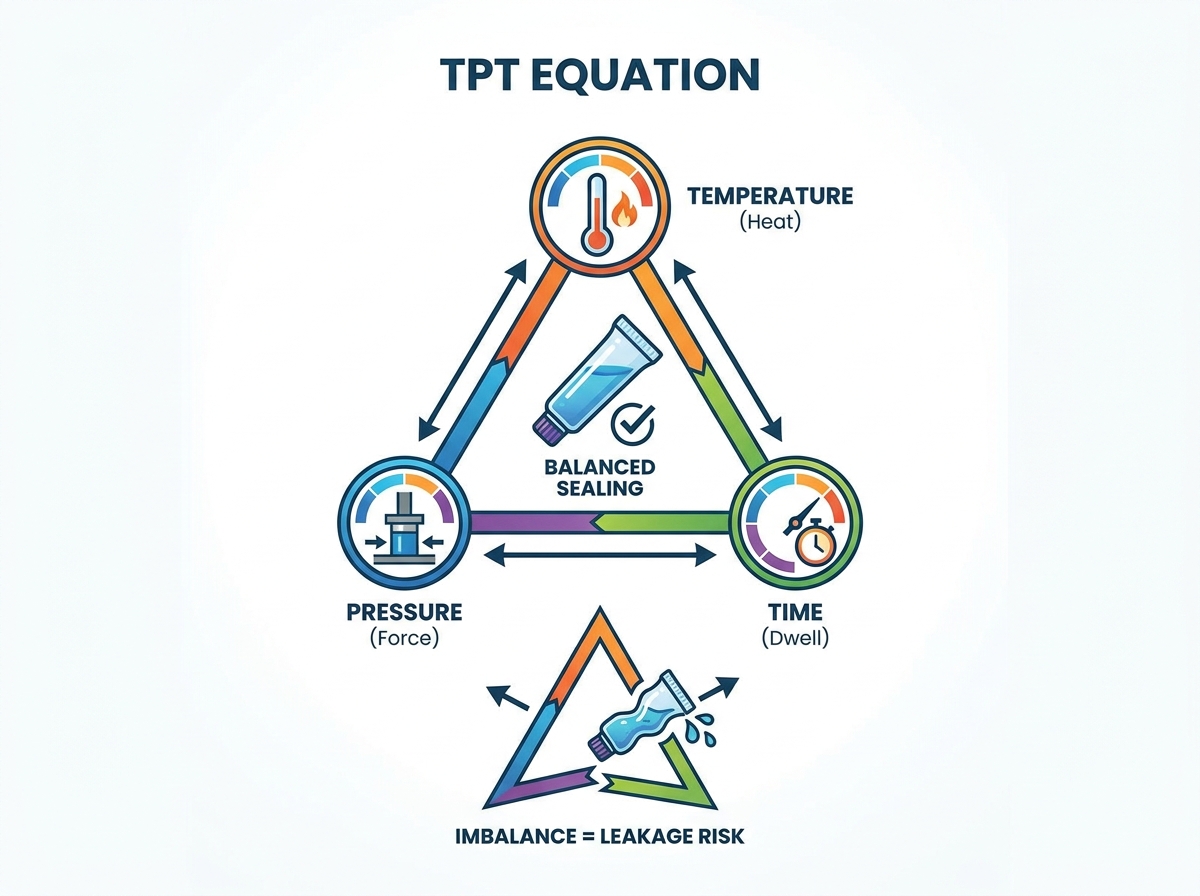
Most tail seal leaks stem from an imbalance in the Temperature-Pressure-Time (TPT) equation or a fundamental mismatch between tube material and sealing technology.
A structured "Detect-Prevent-Correct" (DPC) audit minimizes diagnostic downtime and standardizes operator responses.
Legacy equipment often struggles to maintain the tight tolerances required for modern laminate tubes, making the evaluation of alternative tube sealing methods a necessary step for scaling operations.
Upgrading to advanced technologies requires weighing the upfront capital expenditure against long-term OEE (Overall Equipment Effectiveness) gains and reduced scrap.
Operators must treat visual symptoms as diagnostic clues. A failed seal rarely happens randomly. It leaves physical evidence behind. You can read this evidence to determine exactly which mechanical parameter drifted out of spec. Implementing a "Detect-Prevent-Correct" (DPC) methodology starts right here on the line.
Below are the four most common visual defects. We outline what each symptom tells you about your machine settings.
Burn Marks or Blistering: This defect looks like brown scorching or bubbling on the plastic surface. It indicates excessive heat or prolonged dwell time. The plastic polymer degrades instead of melting cleanly. This symptom often points to outdated thermal controls on legacy equipment. Older thermostats fail to regulate temperature spikes effectively.
Incomplete or "Cold" Seals (Easy Peel): Operators can easily pull these seals apart by hand. The inner layers never bonded. This points to insufficient temperature or inadequate jaw pressure. It also happens if line speeds exceed the machine's thermal recovery capacity. The heating element simply cools down too fast between cycles.
Asymmetrical or Wrinkled Crimp: You will see uneven lines or folded plastic in the crimp area. This indicates a mechanical alignment issue rather than a thermal one. It usually stems from improper tube orientation mechanisms. Worn holding cups or uneven sealing jaw pressure also cause wrinkling. The jaws clamp down unevenly, pinching the material out of shape.
Product Trapped in Seal (Contamination): You will notice fluid or paste caught inside the sealed edge. Overfilling the tube often causes this. Improper nozzle height or a failing anti-drip mechanism also leaves product residue on the inner walls. Traditional heat sealing fails immediately if product contaminates the seal area. The oil or water blocks the polymers from fusing.
Train your line operators to recognize these exact defects. They should immediately stop the line when these appear. Guessing at adjustments only increases scrap waste.
Once you identify the visual symptom, you must audit the machine systematically. Modern tube filling and sealing machines rely on precise interplay between several mechanisms. You cannot adjust one variable without affecting the others.
Every successful heat seal requires balance within the Temperature-Pressure-Time (TPT) triangle. If you lower the temperature, you usually must increase dwell time or pressure to achieve the same bond. You should systematically audit these three critical parameters.
First, verify the actual temperature at the jaw surface using an external pyrometer. Do not just trust the digital readout on the control panel. Second, measure the pressure applied by the pneumatic cylinders. Finally, check the dwell time. Dwell time is the exact fraction of a second the jaws remain closed. Ensure it matches the material manufacturer's specifications.
Many facilities ignore the cooling cycle. This is a common mistake. The cooling phase sets the plastic memory. If you release the tube before the polymer resolidifies, the seal will warp or pop open under stress.
You must verify the entire cooling loop. Check water flow rates through the cooling block. Verify the chiller temperatures remain consistent during peak summer months. Ensure the cooling jaws make full, flat contact with the hot tube tail.
Consumable parts degrade slowly. Operators often compensate by turning up the heat or pressure, which masks the real problem. Run through this mini-checklist weekly:
Inspect heating elements for cold spots using a thermal camera.
Check thermocouple accuracy by calibrating it against a certified external probe.
Assess pneumatic cylinder pressure drops. Listen for air leaks around the valves.
Examine the silicone or Teflon coatings on the sealing jaws for tears or buildup.
Manual recalibration heavily depends on operator skill. Some operators possess a "feel" for the machine. However, this tribal knowledge harms long-term consistency. If recalibration is required daily, the equipment lacks the necessary stability for reliable production. Constant tweaking means the mechanical baselines have drifted beyond repair.
Sometimes the machine works perfectly. The problem lies in the materials. You cannot force an incompatible method to seal a complex material perfectly. Evaluating alternative tube sealing methods becomes necessary when your packaging specs change.
Different materials absorb heat differently. Laminates behave differently than mono-layer plastics. You must align your hardware with your packaging.
Material to Technology Mapping Matrix
Tube Material | Optimal Sealing Technology | Known Risks & Challenges |
|---|---|---|
Mono-layer PE (Polyethylene) | Hot Air Sealing | Prone to blistering if airflow is too slow. |
PBL (Plastic Barrier Laminate) | Hot Air or Ultrasonic | Requires precise temp control to prevent delamination. |
ABL (Aluminum Barrier Laminate) | High-Frequency / Hot Jaws | Radiant heat can easily damage outer cosmetic prints. |
Pure Aluminum | Mechanical Fold and Crimp | Metal fatigue. Cannot be heat-sealed. |
Hot air sealing represents the industry standard for most mono-layer plastics. It relies on internal nozzle heating. A blast of hot air melts the inside of the tube just before the jaws clamp it shut. This method is highly effective but highly sensitive to ambient temperature. It requires precise airflow control. If factory humidity or temperature fluctuates, you must adjust the air pressure.
Hot jaws offer a more traditional approach. Solid metal jaws heat up and press directly against the outside of the tube. The heat travels through the tube wall to melt the inner layer. However, this radiant heat carries a major risk. It can easily damage sensitive formulations inside the tube. It also routinely melts or smears cosmetic finishes on the tube exterior.
Many companies suffer sudden leak spikes without changing their machine settings. Why? They transitioned to sustainable or thinner laminate tubes without updating their sealing hardware. Eco-friendly plastics have notoriously narrow melting windows. A legacy hot jaw system simply cannot react fast enough to seal these modern laminates cleanly. This mismatch generates enormous amounts of waste.
If you constantly fight material mismatches and product contamination, standard thermal methods might be obsolete for your line. It is time to look at advanced alternatives. The ultrasonic tube filling machine solves several persistent headaches found in traditional packaging.
You should frame this upgrade as a solution for specific, high-stakes problems. Do you fill highly viscous products like thick ointments or heavy creams? These fluids often string along the nozzle and contaminate the seal area. Do you process temperature-sensitive formulations like active cosmetics or pharmaceuticals? Hot jaws can degrade these compounds. If you answer yes to these questions, ultrasonic technology becomes highly attractive.
Ultrasonic welding completely ignores the traditional TPT triangle limits. It does not use external radiant heat. Instead, it generates heat via high-frequency molecular friction directly inside the seal area. An acoustic tool (the horn) vibrates against an anvil thousands of times per second.
This internal friction melts the plastic layers together in milliseconds. Because it vibrates so intensely, it actually pushes exterior contaminants like pastes or oils out of the seal zone before the plastic fuses. Furthermore, it requires absolutely no warm-up time. You turn it on, and it works instantly.
When assessing scalability, look at the impact on overall line speed. Ultrasonic machines seal much faster than hot air units because they eliminate thermal recovery times. Energy consumption drops significantly since you do not maintain constantly heated elements. Most importantly, scrap reduction directly boosts your margins. Clean, cold-exterior seals look better on retail shelves.
You must acknowledge the risks before upgrading. Advanced equipment carries a noticeable upfront cost premium. Furthermore, ultrasonic systems require specific tooling. You need custom horns and anvils for different tube diameters. If your facility runs 15 different tube sizes daily, changeover costs and tooling inventory require careful ROI calculation. Evaluate your production volume carefully before committing.
Fixing the machine represents only half the battle. You must prove the fix holds over thousands of cycles. A standardized verification program prevents small drifts from becoming massive recalls. Quality assurance must shift from reactive guessing to proactive testing.
You must detail standard compliance tests to implement on the floor. Visual checks alone fail to catch micro-leaks. Implement these physical tests:
Vacuum Chamber Leak Testing: Submerge sealed tubes in a water-filled vacuum chamber. Draw a vacuum. If bubbles escape from the tail, you have a micro-leak. This is the most reliable floor test available.
Burst Pressure Testing: Inject compressed air into the tube until it explodes. The tube body should rupture before the tail seal gives way. If the seal splits first, your bond strength is too weak.
Manual Peel Tests: Cut a strip from the seal and pull it apart. The plastic should stretch and tear rather than peel cleanly away.
Record your batch parameters diligently. Note the exact temperature, pressure, and line speed for every run. Traceability shows its value during a failure investigation. Data logging isolates whether a leak was caused by slow machine drift over a week or a bad batch of empty tubes from your supplier. Without data, suppliers will always blame your equipment.
Move away from "tribal knowledge." Document every setting in Standard Operating Procedures (SOPs). Establish strict thresholds for adjustments. For example, an operator may adjust the air pressure by 5 PSI. If that fails to fix the issue, they must stop. They cannot keep turning dials. Establish clear rules dictating exactly when an operator must stop the line and call maintenance to intervene.
Resolving unexpected leaks is a distinct two-path process. You must begin with rigorous calibration of your current hardware. If meticulous adjustments fail to provide stability, you must consider strategic replacement. Do not hold onto outdated technology if it no longer aligns with your modern production goals.
Next-Step Actions:
Perform the visual and mechanical DPC audit on your very next production shift.
Calibrate your TPT triangle using external measurement tools, not just panel readouts.
Catalog your current tube materials to identify any mismatches with your sealing hardware.
Download a technical specifications sheet to evaluate ultrasonic options if you struggle with product contamination.
A: Micro-leaks almost always result from cold spots in the heating elements or slight pressure imbalances in the sealing jaws. Even a microscopic gap in jaw alignment allows a tiny channel to form in the melted plastic, creating an invisible leak path.
A: You should validate sealing parameters at the start of every shift and immediately post-changeover. Additionally, perform periodic interval testing, such as vacuum chamber checks every two hours, to ensure compliance with rigid industry quality standards.
A: No. Ultrasonic technology relies on molecular friction to melt polymers. It is primarily designed for plastics and laminate structures. Pure metal tubes cannot be welded this way; they require traditional mechanical fold-and-crimp sealing methods.


