 English
Views: 0 Author: Site Editor Publish Time: 2026-08-26 Origin: Site


Increasing regulatory scrutiny, stringent child-resistant mandates, and the demand for extended shelf-life force drug manufacturers to rigorously defend their solid-dose packaging strategies. Selecting between blister packs and bottles directly dictates capital expenditure, cleanroom production footprints, cold-chain logistics, and the chemical stability of the underlying formulation. A misstep in format selection can lead to compromised active pharmaceutical ingredients, product recalls, or inefficient line operations.
This guide provides an evidence-based, technical comparison of blister and bottle formats. It helps operations, formulation, and quality assurance teams determine the optimal architecture for specific tablet and capsule drug products. By evaluating barrier properties, production throughput, and patient adherence metrics, manufacturers can align their equipment investments with long-term commercial objectives and strict compliance standards.
Formulation Stability: Blister packaging provides superior, isolated unit-dose protection against moisture and oxygen, whereas bottles rely on bulk environmental control (desiccants) that is permanently compromised upon first opening.
Cost and Throughput: A high-speed tablet and capsule bottling line generally delivers a lower cost-per-dose and higher throughput efficiency for stable, high-volume bulk prescriptions and over-the-counter (OTC) medications.
Compliance & Safety: Comparative packaging studies indicate blister packaging can be up to 65% more effective at preventing accidental pediatric ingestion compared to traditional child-resistant (CR) bottles, while inherently providing unit-level tamper evidence.
CapEx Considerations: Equipment selection requires weighing the specialized, tooling-dependent precision of pharmaceutical blister packing machines against the high-speed flexibility of integrated bottling lines.
Modern packaging lines must meet strict regulatory and operational benchmarks. The FDA enforces rigorous standards under 21 CFR Parts 211.132 and 133 regarding tamper evidence and child resistance. European Medicines Agency guidelines similarly demand senior-friendly accessibility without compromising pediatric safety. Manufacturers must balance these compliance mandates with operational efficiency on the plant floor. You cannot sacrifice line speed for compliance if a mechanical workaround exists.
Product physical and chemical stability drives the primary material selection. Formulation teams evaluate the required barrier properties against moisture vapor transmission rate, oxygen transmission rate, and UV light. Highly sensitive active ingredients require robust barriers to prevent degradation during the stated shelf-life. We often see formulations fail stability testing simply because the packaging engineers underestimated the ambient humidity of the target distribution region.
Define the exact moisture and oxygen sensitivity of the formulation before selecting materials.
Map the regulatory requirements of the target distribution regions, specifically regarding child resistance.
Evaluate the physical fragility of the tablet or capsule to determine mechanical protection needs.
Assess the target demographic to ensure the packaging format supports patient adherence.
Packaging design heavily influences patient adherence. Complex titration schedules or multi-drug regimens benefit from formats that visually guide the patient through their daily dosing requirements. When patients can clearly see whether they took their Tuesday morning dose, adherence rates climb. This reduces hospital readmissions and improves overall therapeutic outcomes.
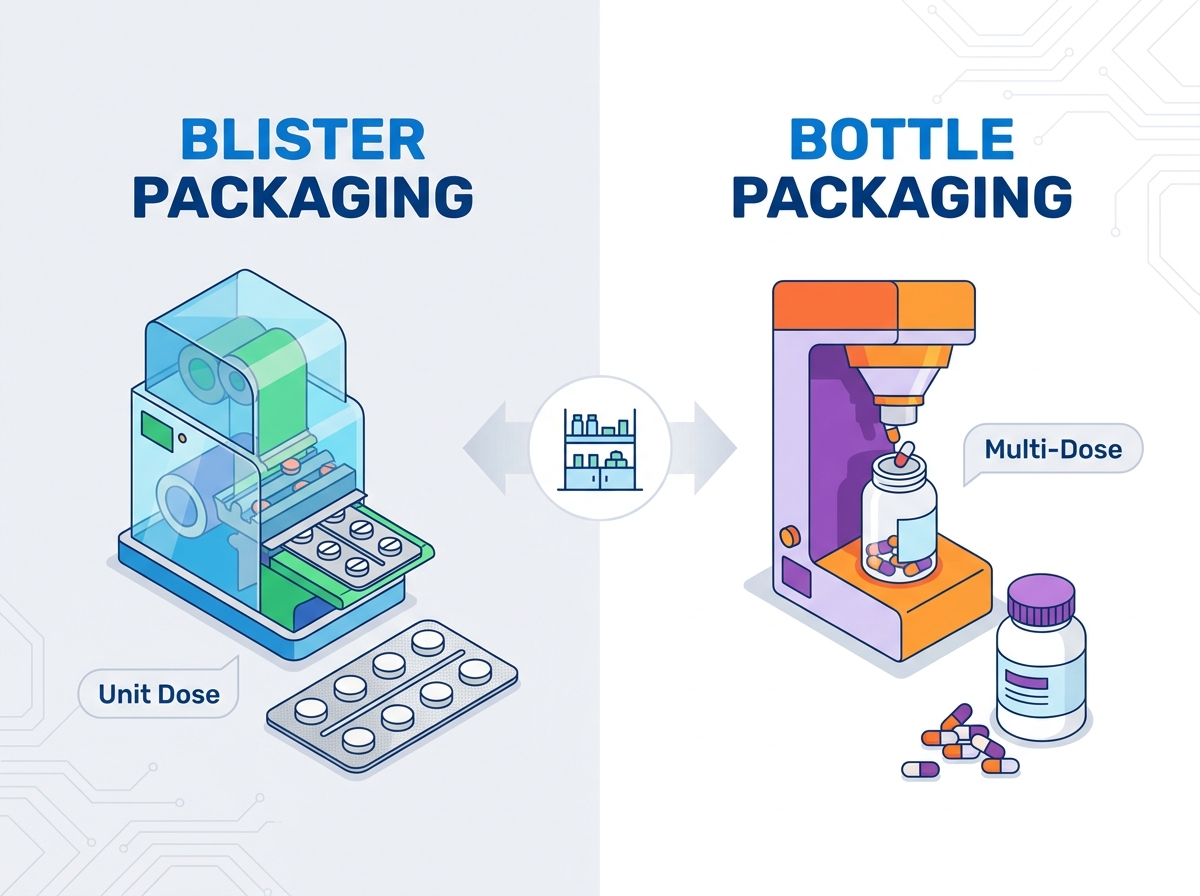
Blister formats excel at isolation mechanics. Individual cavity sealing utilizes Alu-Alu, PVC/PVDC, or Aclar laminates to prevent cross-contamination and ambient exposure. This micro-environment protects each dose independently. Contour-formed cavities offer mechanical protection. They prevent capsule friction, chipping, or breakage by keeping doses immobilized and separate until the exact moment of use. This snug cavity fit is critical for fragile formulations that cannot withstand the tumbling action inside a bulk container.
Hygroscopic formulations benefit immensely from this format. The critical advantage lies in maintaining barrier integrity for the remaining doses in a blister card after the patient extracts a single tablet. Unlike bulk containers, the unextracted doses remain completely sealed against atmospheric moisture and oxygen. We rely on this isolation to guarantee the final dose in a 30-day supply is just as potent as the first.
Material Type | Moisture Barrier | Oxygen Barrier | Forming Method |
|---|---|---|---|
PVC/PVDC | Moderate to High | Moderate | Thermoforming |
Aclar Laminates | Very High | Moderate | Thermoforming |
Alu-Alu (Cold Form) | Absolute | Absolute | Cold Forming |
Mechanical tamper-evidence is an inherent feature. The push-through foil backing requires deliberate physical force to break the seal. This leaves irreversible visual evidence of access. Implementation of peel-push, tear-notch, or slide-and-press lidding films consistently outperforms standard child-resistant bottles in pediatric lock tests. These features ensure safety while remaining accessible to older adults who may struggle with push-and-turn caps.
Adherence tracking is another significant benefit. Manufacturers can print calendar days, dosing schedules, or smart-sensor electronics directly on the blister card backing. This visual cue improves patient compliance, reducing missed doses and improving therapeutic outcomes. We frequently implement calendarized layouts for oral contraceptives and complex antibiotic regimens.
Operating pharmaceutical blister packing machines involves specific operational realities. Specialized format part costs and changeover downtime occur when switching between blister sizes, cavity layouts, or forming materials. Thermoforming and cold-forming processes require distinct tooling sets. Space requirements for forming, filling, sealing, and inline printing stations demand significant cleanroom footprints. Integration with downstream cartoning equipment adds to the line complexity.
Managing material yield and waste is an ongoing challenge. Operators must control the environmental impact of web trim, foil waste, and rejects during forming cycles. Efficient machine calibration minimizes these losses, but they remain a factor in overall production efficiency. You have to monitor the web tension constantly to prevent micro-fractures in the forming film.
Bottles offer distinct material economics. They provide a lower packaging material cost per unit for high-volume, chemically stable formulations. Standard HDPE, PP, or PET resins are widely available and economical. Supply chain simplicity is a major advantage. Standardization of bottle sizes and neck finishes reduces inventory complexity. It also minimizes warehousing space and storage requirements for empty components.
When running millions of standard generic tablets, the bulk format is unbeatable for raw output. You can fill a 100-count bottle in a fraction of the time it takes to form, fill, seal, and carton ten 10-count blister cards. This speed directly translates to lower operational overhead per batch.
Bulk moisture management relies on dropped or inserted silica gel or molecular sieve desiccants. Polyester coils and induction heat sealing maintain the internal micro-environment during transit and storage. However, this creates an in-use vulnerability. A cumulative degradation risk is introduced to the entire remaining batch once the induction seal is broken. Every time the patient opens the bottle, ambient humidity and oxygen enter the container.
We mitigate this by sizing the desiccant payload to account for the estimated number of openings during the product's in-use lifespan. However, you cannot control the environment where the patient stores the bottle. A bathroom medicine cabinet exposes the open bottle to extreme humidity spikes daily.
A modern tablet and capsule bottling line delivers massive throughput and scalability. High-speed mechanical counting, filling, and capping capabilities outpace blister lines for bulk counts. Format flexibility is high. Operators can easily adjust electronic multi-channel counters, guide rails, and capping chucks for different tablet sizes without requiring expensive, proprietary tooling.
Line complexity involves integrating multiple automated stations. A complete setup includes bottle unscramblers, cottoners, desiccant inserters, electronic tablet counters, capping machines, retorquers, and induction sealers. Synchronizing these units requires precise line control logic. If the unscrambler jams, the entire line backs up within seconds.
Ensure the unscrambler is properly sized for the largest bottle in your portfolio.
Calibrate the electronic counting sensors daily to prevent overfills or underfills.
Verify the induction sealer parameters (power and time) for each specific cap and liner combination.
Implement a retorquer after the induction sealer to ensure the cap remains tight after the liner melts.
Comparing the upfront investment requires analyzing the fully integrated bottling line versus a specialized blister line and cartoner combo. Bottling lines often feature modular components that can be upgraded independently. Ongoing operational variables include consumables like laminates versus resins and closures. Energy consumption for thermoforming stations is typically higher than standard counting and filling operations. Routine maintenance of rotary or flatbed sealing plates requires skilled technicians.
You must account for the cost of format parts. A new blister layout requires custom heating plates, forming tools, feeding channels, and sealing dies. A new bottle size might only require adjusting a few guide rails and swapping a star wheel. This makes bottling inherently more agile for contract manufacturers handling diverse product portfolios.
Volume adaptability differs significantly. Bottling lines offer rapid scaling for commercial generic production and bulk distribution. Blister lines are often preferred for clinical trials, hospital-use unit dosing, and high-value specialty drugs. Transport density is another factor. Analyzing the volumetric shipping efficiency of flat blister cartons versus cylindrical bottles helps avoid the cost of shipping empty air.
Bottles inherently contain a lot of void space, especially if the tablet count is low relative to the container size. Blister cards pack flat and dense. When shipping temperature-controlled biologics or high-value solid doses globally, the volumetric efficiency of the secondary carton becomes a major logistical calculation.
Recyclability currently favors mono-material rigid plastic bottles in municipal recycling streams. However, blister packs utilize localized material optimization. They use only the precise volume of polymer or foil needed to keep capsules intact, reducing overall material weight. The industry is shifting toward sustainable, mono-material blister films. Recycle-ready PP or PET blister structures are beginning to replace complex, non-recyclable multi-layer laminates.
We are seeing a massive push from procurement teams to eliminate PVC from the supply chain. Transitioning to PET or PP blisters requires careful re-validation of the forming temperatures and sealing dwell times, as these materials behave very differently on the machine compared to traditional PVC.
Excessive production downtime during format changes is a primary risk. Switching cavity layouts or forming materials halts production. Specifying servo-driven equipment mitigates this issue. Tool-less changeover technology, pre-set digital recipe management, and quick-clamp forming stations drastically reduce transition times. We aim for sub-30-minute changeovers on modern lines.
Training operators on standardized changeover procedures is critical. Color-coding format parts and utilizing shadow boards ensures the right tool is used at the right station. You cannot afford to have a line sitting idle for four hours while a technician hunts for a specific sealing die.
Micro-leaks in blister cavities compromise stability. Miscounts in bottles lead to product recalls and regulatory action. Implementing inline vision inspection systems verifies cavity fill accuracy. Automated vacuum-decay leak detection ensures seal integrity. Advanced 3D counting sensors on the bottling line guarantee precise dose counts.
Never rely solely on manual inspection. Human eyes fatigue quickly when watching hundreds of bottles or blister cards pass per minute. High-speed camera systems tied directly to the machine's reject mechanism provide reliable, objective quality assurance. We validate these vision systems using intentionally defective challenge samples at the start of every shift.
Shortages of specialized barrier films or specific closures can halt production. Dual-sourcing critical materials is essential. Validating secondary suppliers ensures continuous operation. Standardizing container closure systems across pharmaceutical packaging product lines simplifies procurement where formulation stability allows.
If you only have one validated supplier for your Alu-Alu foil, you are carrying massive operational risk. Qualify at least two suppliers for every critical contact material during the initial validation phase. It costs more upfront but saves millions when global supply chains bottleneck.
Choosing between blister and bottle packaging is not simply a decision between two container formats—it is a strategic choice that affects product stability, manufacturing efficiency, regulatory compliance, and patient experience.
Blister packaging provides excellent unit-dose protection, strong barrier performance, and built-in adherence support, making it especially valuable for moisture-sensitive formulations, specialty medicines, and products requiring strict dose tracking. Bottle packaging remains highly competitive for large-volume, stable tablet and capsule products where production speed, flexibility, and cost efficiency are the primary priorities.
The right packaging solution depends on the interaction between formulation sensitivity, target market requirements, production capabilities, logistics conditions, and long-term commercial goals. Rather than selecting a format based only on initial cost, manufacturers should evaluate the complete lifecycle impact of each option.
A: Yes, generally. Blister formats require specialized laminates, foils, and dedicated tooling for each cavity shape. The material cost per dose is typically higher than bulk HDPE or PET bottles, especially for high-volume runs.
A: They utilize specialized lidding materials. Peel-push, tear-notch, or multi-layer foil laminates are applied during the sealing phase. These require specific cognitive and physical actions to open, passing rigorous pediatric lock tests.
A: A well-maintained line can operate efficiently for 15 to 20 years. Maintenance schedules require daily sensor cleaning, weekly lubrication of moving parts, and quarterly calibration of electronic counting heads and capping chucks.
A: It isolates each dose, providing visual evidence of consumption. Calendar printing on the foil backing helps patients track their daily intake, reducing accidental double-dosing or missed medications.
A: Yes. Many contract manufacturing organizations operate parallel lines. However, they require separate cleanroom suites and distinct downstream equipment, such as cartoners for blisters and labelers for bottles.
A: Mandates are driving a shift away from multi-layer PVC laminates. Manufacturers are adopting mono-material, recycle-ready PET or PP blister films and increasing the use of post-consumer recycled plastics in bulk bottles.


