 English

Views: 0 Author: Site Editor Publish Time: 2026-10-17 Origin: Site


Purchasing secondary packaging equipment often stalls right during the initial specification phase. A severe mismatch between your packaging design assumptions and actual machine capabilities regularly leads to inaccurate quotes, timeline delays, and compromised Overall Equipment Effectiveness. Digital CAD files alone simply do not reflect real-world material behavior on the fast-paced production floor. To accurately specify customized tooling, verify automated changeover times, and guarantee sustained production speeds, equipment suppliers require specific physical evidence. This article provides a clear, engineering-aligned checklist detailing the exact digital dielines, flat carton blanks, and fully populated product samples you need. You will discover how to properly evaluate these elements and engineer a highly reliable packaging solution. Mastering this handover process helps you launch lines faster, streamline engineering efforts, and avoid frustrating post-installation redesigns. Ultimately, this proactive approach bridges the gap between theoretical packaging concepts and practical manufacturing success.
Digital dielines establish baseline dimensions, but physical samples reveal critical material behaviors like score-line memory and board porosity.
Procuring an automatic cartoning machine requires providing hundreds of production-grade samples for Factory Acceptance Testing (FAT).
Small variances in carton thickness or glued seams can dictate whether a vertical or horizontal loading mechanism is required.
Accurate sample submissions prevent expensive post-installation re-tooling and protect long-term line OEE.
Engineering teams often assume digital specifications provide everything a supplier needs. However, relying solely on theoretical measurements introduces massive production risks. Digital dielines in CAD or PDF formats effectively communicate baseline dimensions like length, width, and depth. They clearly outline the geometric layout of the blank. Yet, they completely fail to communicate critical physical attributes. A digital file cannot demonstrate paperboard grain direction. It cannot reveal inherent material stiffness. It also hides surface properties like coating friction.
To grasp why physical samples matter, you must understand cartoning machine fundamentals. The equipment relies on precise physical interactions to function smoothly at high speeds. For example, vacuum suction cups physically engage the carton surface. These cups extract flat blanks from a magazine and erect them into three-dimensional shapes. If the paperboard surface has high porosity, standard suction cups will lose vacuum pressure. The machine will repeatedly drop blanks, causing severe downtime. Engineers must physically test the board to select the correct vacuum pump size and cup material.
Tucking mechanisms face similar physical constraints. Whether your design uses simple tuck-in flaps, hot-melt glue closures, or complex crash-lock bottoms, the machine must overcome inherent material resistance. We call this score-line memory. If a carton resists folding too aggressively, it acts like a spring. The tucking mechanism might struggle to close the flap securely. Physical samples allow engineers to measure this resistance and adjust robotic arms or guide rails accordingly.
From an engineering perspective, machine builders design feeding magazines based on actual physical stackability. Theoretical dimensions assume every carton sits perfectly flat. Real-world packaging runs almost always feature slight bowing, warping, or uneven glue seams. When hundreds of warped blanks stack tightly together, they behave unpredictably. They might wedge against the magazine walls or double-feed into the machine. Evaluating physical samples ensures builders design custom magazine angles, vibration modules, and retaining clips tailored exactly to your material.
Common Mistake: Relying on an outdated CAD file while the procurement team silently changes the paperboard supplier. Even if dimensions remain identical, a new supplier's board might possess different stiffness or grain direction, instantly causing machine jams.
Suppliers cannot engineer a multi-million-dollar production line based on a handful of generic boxes. They require a highly specific progression of physical evidence. Providing the correct volume and type of samples at each project phase determines the ultimate success of your machinery investment.
You must clearly distinguish between prototype samples and true production samples. Packaging designers often cut prototype blanks on a flatbed plotter table. Plotters use oscillating knives and scoring wheels. This process gently crushes the paper fibers. It creates a very loose, easy-to-fold score line.
Conversely, commercial die-cut presses stamp out true production samples at high speeds. Steel rules forcefully strike the board, creating much stiffer, highly resistant score lines. If you submit plotter-cut prototypes for machine calibration, the equipment will fail when it encounters the stiffer production-grade boxes. Always provide commercial die-cut samples for final engineering evaluations.
Procuring an automatic cartoning machine happens in distinct phases. Each phase demands a different volume of physical materials.
Initial Quoting Phase: During early discussions, suppliers need 20 to 50 flat blanks. They also require 5 to 10 primary product samples. This small batch helps engineers determine the basic machine footprint. It allows them to choose the optimal magazine style and propose the most effective loading approach.
Engineering & FAT Phase: Once you sign the purchase order, requirements scale up dramatically. For a Factory Acceptance Test (FAT), suppliers need 1,000 to 5,000+ continuous production-grade blanks. This volume allows engineers to run the machine at full operational speed for 15 to 30 minutes. Extended runs expose hidden jam rates, reveal micro-frictions, and prove sustained OEE capabilities.
Cartons do not travel empty. Suppliers urgently need the actual primary product going inside the box. This includes blister packs, glass bottles, or flexible pouches. Engineers must account for primary product tolerance variations. A glass bottle might have a slightly wider tolerance than a precision-machined metal part. The loading mechanism must accommodate these subtle shifts without crushing the product.
Furthermore, you must provide all secondary inserts. If your pharmaceutical package requires a folded informational leaflet, the machine must physically push both the bottle and the leaflet into the carton simultaneously. The internal clearance requirements change drastically when you add inserts. Providing the complete, fully populated payload ensures engineers design custom loading buckets perfectly matched to your specific cargo.
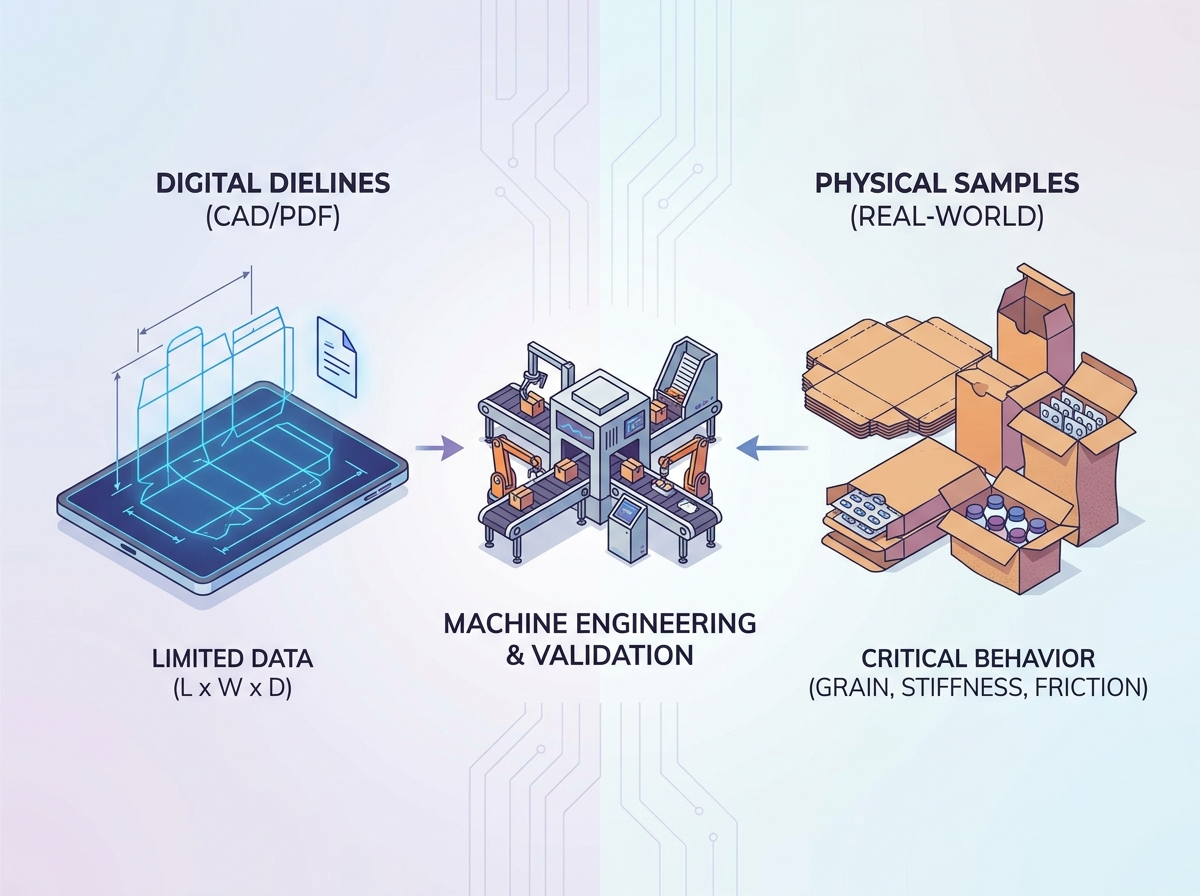
The physical characteristics of your samples directly dictate the fundamental architecture of the machinery. Machine builders do not simply pull standard models off a shelf. They configure the entire feeding, erecting, and loading logic based on how your specific materials behave.
The most critical decision involves choosing the loading orientation. Sample characteristics drive this choice entirely.
Horizontal Loaders: These systems push products laterally into the carton. They work best for highly stable products. Examples include blister-to-carton integration lines, large frozen food trays, or rigid plastic bottles. If your product can withstand a horizontal push without tipping over or jamming against the carton flap, engineers will typically recommend this high-speed configuration.
Vertical Loaders: These systems drop products downward into erected cartons using gravity. They become strictly required for loose, bulk products like wrapped candies or hardware screws. Vertical loading also protects highly fragile items and accommodates multi-component kits where several loose parts must drop into the same box sequentially.
Highly regulated sectors require even tighter sample evaluation. In the pharmaceutical industry, Good Manufacturing Practice (GMP) standards dominate equipment design. Samples must demonstrate adequate internal clearance. Automated leaflet folding and insertion mechanisms require exact dimensional spacing to operate smoothly.
Additionally, modern compliance demands robust track-and-trace coding. Whether utilizing mechanical embossing or laser inkjet systems, engineers must test how the paperboard absorbs ink or reacts to pressure. Vision rejection systems also need physical samples to establish baseline camera parameters. Cameras must differentiate between a correctly printed barcode and a smudged anomaly. You must provide diverse samples covering these edge cases.
Modern production facilities rarely run a single product size forever. Evaluating physical samples across multiple different SKUs allows engineers to design quick-changeover tooling. By physically comparing your smallest carton to your largest, builders can integrate recipe-driven automation. Servo motors can automatically adjust guide rails and magazine widths based on saved recipes, vastly reducing manual changeover times between runs.
Best Practice: Always send the absolute maximum and minimum carton sizes you intend to run, even if the extreme sizes are for future product launches. Establishing the mechanical range upfront prevents expensive aftermarket retrofits.
Failing to provide accurate physical samples creates a cascade of expensive failures. When actual production materials deviate from the initial engineering samples, the financial impact extends far beyond simple delays.
Consider the impact of material thickness, also known as board caliper. If your final production cartons arrive just 2 millimeters thicker than the initial digital dielines provided, disaster strikes. Custom flights, holding buckets, and precisely machined guide rails will suddenly become too narrow. The cartons will jam instantly. The supplier must remove these metal components, re-machine them in a CNC facility, and reinstall them. This tooling redesign causes massive delays and drastically inflating project budgets.
Unexpected material friction frequently forces plant operators to de-rate machine speeds. Suppose your marketing team decides to add a high-gloss UV coating to the carton just before launch. They do not inform the engineering team. The glossy coating creates immense static and friction inside the feeding magazine. The automatic equipment cannot separate the blanks quickly enough.
To prevent constant jamming, operators must turn down the dial, running the machine at 60 cartons per minute instead of the targeted 100. This drastic speed reduction destroys projected ROI and bottlenecks the entire upstream production line.
To prevent these failures, cross-functional teams must establish a strict "frozen specification" milestone. Once the machine builder receives and validates the physical samples, the specification locks. Any subsequent change to the carton supplier, the paperboard grade, or the dieline geometry requires formal re-evaluation. The machine builder must test new physical samples to confirm the equipment can still handle the variations.
Table: Implementation Risks and Mitigation Strategies
Risk Factor | Potential Operational Impact | Required Mitigation Strategy |
|---|---|---|
Inaccurate Board Caliper | Cartons jam inside customized buckets and flights. | Supply commercial die-cut blanks matching exact final production specs. |
Unexpected Surface Friction | Vacuum cups drop blanks; magazines fail to feed. | Test all final coatings (UV, aqueous) during early FAT phases. |
Variable Primary Payload | Loading pushers crush products or tear carton flaps. | Submit fully populated samples including all product tolerance extremes. |
Inconsistent Glued Seams | Stacking instability; warped cartons double-feed into machine. | Establish strict QA agreements with the folding carton converter. |
A well-prepared procurement package dramatically accelerates the engineering timeline. It eliminates guesswork and allows suppliers to provide highly accurate, binding quotes. When evaluating cartoning machines, you must treat your physical samples as the foundation of your contract.
Compile the following materials before engaging equipment builders. Treating this checklist as mandatory prevents endless back-and-forth communication delays.
Finalized Vector Dielines: Submit clean DXF or PDF files. Ensure they clearly specify the exact fold types, whether you use straight tuck, reverse tuck, or complex crash-lock bottoms.
Material Specifications: Provide documentation detailing board caliper (thickness), board material type (e.g., SBS, CCNB), inherent grain direction, and all applied surface coatings.
Production-Grade Flat Blanks: Supply unfolded and unglued blanks directly from the commercial die-cutting press. Provide the exact quantities requested for both initial quoting and final FAT stages.
Fully Populated Primary Product Samples: Deliver the actual items going inside. Ensure they are weighted accurately and reflect real-world dimensional tolerances. Include all secondary components like leaflets or plastic inserts.
You must hold suppliers accountable for performance. Require them to provide a video proof-of-concept during the early engineering phases. This video should clearly show your specific physical samples running through their proposed magazine and erecting mechanism.
Furthermore, demand a mechanical guarantee based strictly on the tested physical samples. The contract should state the machine will achieve a specific throughput rate using the exact materials provided. Establishing this baseline accountability ensures confidence before you issue a final Purchase Order.
Procuring reliable packaging automation requires far more than exchanging digital files. Although modern equipment sits on standardized frames, the tooling interfacing with your product remains a highly customized asset. The functional accuracy and long-term reliability of the machine are directly proportional to the accuracy of the physical samples you provide during the evaluation stage.
By understanding material behaviors like score-line resistance and surface friction, you empower engineers to design robust, jam-free systems. Prioritizing commercial-grade samples over plotter-cut prototypes protects your capital investment and secures your projected throughput speeds. Your immediate next step is clear. Consult directly with your packaging engineers and material converters. Finalize all board grades, coatings, and dimensional tolerances before you initiate the RFQ process with equipment suppliers. Doing so guarantees a smooth engineering handover and a highly successful installation.
A: The exact volume varies by machine speed, but suppliers typically require enough samples for a 15-to-30-minute continuous run. For standard equipment, this often means providing 2,000 to 5,000+ pieces to accurately expose jam rates and verify sustained reliability.
A: Yes, they can handle multiple dielines through adjustable tooling and recipe management software. However, you must submit all unique dielines and physical samples during the initial engineering phase to correctly calculate the minimum and maximum mechanical range.
A: Grain direction heavily affects the carton's structural rigidity and how it bows while stacked inside the machine magazine. This bowing directly impacts the reliability and accuracy of the rotary or reciprocating pick-and-place mechanism trying to extract the blank.
A: Variations in scoring pressure, glue application, or board caliper from a new supplier can instantly cause jamming. Re-qualification of the new supplier's samples on the existing machine is strongly recommended to adjust guide rails and vacuum settings.


