 English

Views: 0 Author: Site Editor Publish Time: 2026-09-27 Origin: Site


Upgrading or installing new production equipment carries inherent risk. You might think machinery failure causes most commissioning delays, but that is rarely true. The most common cause of delayed commissioning is unforeseen incompatibilities between containers, closures, and the equipment. Assuming standard bottles and caps run seamlessly on standard machinery is a costly operational oversight. Slight variances in resin, thread pitch, or bottle rigidity dramatically impact line efficiency over time. Before finalizing procurement for liquid filling lines, plant managers and engineers must execute rigorous container compatibility checks. They should also mandate specific performance tolerances during vendor evaluation. In this guide, you will learn how to align neck geometries with valve clearances effectively. We will cover how to specify proper torque controls to prevent leakage. Finally, you will discover how to structure foolproof vendor validation tests before signing any purchase orders.
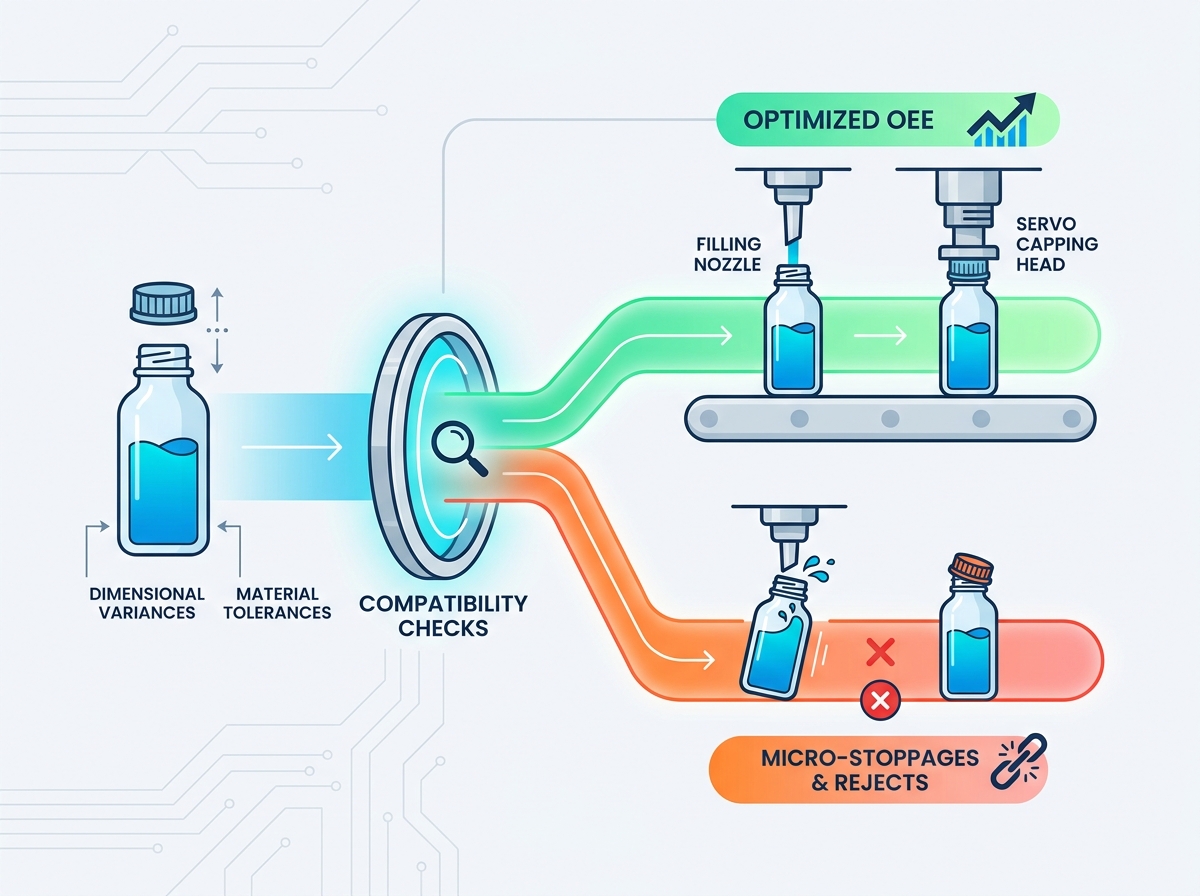
Minor dimensional variances in bottles and caps directly degrade Overall Equipment Effectiveness (OEE) through micro-stoppages and cross-threading.
Liquid characteristics (foaming, viscosity) must dictate the relationship between bottle neck geometry and filling valve selection.
Precision torque control is non-negotiable; integrating a servo bottle capping machine mitigates risks associated with variable cap thread friction.
Mandating structured compatibility testing via custom filling line services before PO signature ensures accountability and validates real-world throughput limits.
Packaging incompatibility directly impacts the bottom line. Unverified bottles and caps lead to high scrap rates. They also cause product leakage during transit. These issues compromise seal integrity and ruin brand reputation. You cannot simply trust generic component specifications. Even standard packaging lots feature microscopic differences across mold cavities. These differences create jams and misalignment on high-speed conveyors. You face excessive downtime when operators must constantly clear cross-threaded caps or crushed bottles. Over time, these brief interruptions destroy your daily production quotas.
A successful equipment specification requires clear, measurable metrics. You must achieve your target Containers Per Minute (CPM) consistently. Simultaneously, you must maintain a reject rate below the accepted industry baseline. This baseline is typically less than 0.5 percent. Reaching these targets demands precision handling. Every container must pass through the filler, capper, and labeler without hesitation. If a machine requires frequent manual recalibration to hit these numbers, the specification has failed.
Evaluating single components statically is a massive scalability risk. You might test one bottle under a stationary filling nozzle and deem it acceptable. However, this ignores continuous dynamic behavior. Automated machines operate under continuous vibration. They experience line back-pressure and thermal shifts. A bottle might remain stable on a desk but wobble on a moving conveyor. You must observe how containers behave under actual line conditions. Ignoring these dynamic interactions leads to catastrophic scalability failures during full production runs.
The critical ratio between the inner diameter of the bottle neck and the outer diameter of the filling nozzle dictates filling success. Tight clearances restrict air displacement. When liquid enters the bottle, the displaced air needs a clear escape route. If the nozzle occupies too much space, the escaping air forces liquid back up the neck. This causes blowback and excessive foaming. You must engineer adequate venting space around the nozzle. This spacing ensures smooth, rapid fills without unnecessary splashing.
Different materials react uniquely to temperature and pressure. You must evaluate how PET, HDPE, or glass responds to the liquid being filled. Hot-fill applications often cause paneling in lightweight PET bottles. The plastic expands during the hot fill and contracts during cooling. This contraction creates inward deformation. Glass bottles handle heat well but remain vulnerable to thermal shock. You must match the container material to the specific gravity and temperature profile of your product. This prevents structural failure on the production line.
High-viscosity liquids dictate specific valve types. Suspended solids also heavily influence your valve selection. Thin liquids like water work perfectly with gravity or flow meter valves. Thick sauces or creams require robust piston valves. You must carefully pair these valves with your chosen bottle shape. A wide-mouth jar accepts a large piston nozzle easily. A narrow-neck bottle requires a diving nozzle to prevent bridging at the opening. Proper alignment prevents dripping between cycles.
Table 1: Valve Selection and Container Compatibility
Liquid Type | Ideal Valve Type | Container Requirement | Common Risk Factor |
|---|---|---|---|
Low Viscosity (Water, Spirits) | Gravity / Flow Meter | Standard narrow or wide neck | Splashing and blowback |
Medium Viscosity (Syrups, Oils) | Piston / Gear Pump | Moderate neck opening | Stringing or dripping |
High Viscosity / Particulates (Sauces) | Large Piston | Wide-mouth jars | Bridging at the bottle opening |
Caps appear identical to the naked eye, but their internal anatomy varies wildly. You must analyze thread starts, pitch angles, and cap skirt rigidity. Recognizing these details is crucial for line success. Standard closures carry varying tolerances depending on the mold and the manufacturer. A cap from Supplier A might engage perfectly. A visually identical cap from Supplier B might bind halfway down the neck. You must scrutinize these dimensional tolerances before choosing your closure equipment.
Applying consistent torque is incredibly difficult under high-speed conditions. Environmental factors heavily influence thread friction. Temperature changes can make plastic threads rigid or pliable. These friction inconsistencies lead to serious quality issues. Here are the most common challenges you will face:
Over-torquing: Strips the plastic threads, destroying the seal completely.
Under-torquing: Leaves a loose fit, resulting in immediate product leaks.
Cross-threading: Occurs when caps enter the chuck at an improper angle.
Scuffing: Aggressive tightening mechanisms damage the outer aesthetic of the closure.
Specifying a servo bottle capping machine is critical for high-liability products. Pneumatic cappers rely on air pressure, which fluctuates constantly. Servo motors eliminate this unpredictability. They use advanced feedback loops to control both speed and torque independently. If a cap features slight resin variations, the servo system detects the resistance change instantly. It adapts to these minor cap variations in real-time. This guarantees perfect application torque on every single bottle, protecting your product from leaks and tampering.
Modern packaging trends favor lightweighting to save material costs. Unfortunately, lightweight containers cause massive headaches on the production floor. You must assess the container's center of gravity. Tall, narrow, or lightweight empty bottles are highly unstable. They are prone to tipping over during sudden conveyor stops. Line back-pressure easily crushes flimsy plastic bottles. You must calculate the structural integrity of the empty container to ensure it survives the journey from the unscrambler to the filling station.
Deciding how to move your bottles is a major engineering choice. You must choose between stabilizing pucks and direct-to-conveyor handling. Follow this decision framework:
Assess Container Base: If the bottle has an uneven or extremely narrow base, you must use a puck system.
Evaluate Line Speed: High-speed outputs often require pucks to prevent tipping during rapid acceleration.
Review Changeover Needs: Direct conveying is cheaper and requires fewer change parts if you run uniform cylindrical bottles.
Analyze Material Strength: Pucks protect ultra-thin bottles from being crushed under line accumulation pressure.
Choose direct conveying only when the container proves completely stable under your target output speeds.
A production line is only as strong as its transition points. Ensuring seamless transfer tolerances between stations is mandatory. Bottles must move from the filling station to the capper without sloshing. They must transition to the labeling and case packing equipment smoothly. You cannot rely on custom, non-repeatable operator adjustments to fix poor handoffs. Guide rails, star wheels, and timing screws must feature precise, locked positions. This eliminates human error and guarantees steady container flow across the entire layout.
Theoretical designs look flawless on a screen. However, you should never sign equipment contracts based solely on theoretical CAD models. Virtual simulations cannot predict minor friction issues or static electricity buildup. You must demand physical testing of your specific packaging materials. Send actual production samples to the manufacturer. Refuse any guarantees made without empirical validation. This rigid stance mitigates implementation risk and forces the vendor to prove their engineering claims.
Utilize OEM integration teams to conduct comprehensive capability studies. Engaging in custom filling line services allows engineers to identify weak links in your container design early. They might discover your bottle neck requires a slightly longer diving nozzle. They might suggest modifying machine tooling prior to the build phase. This proactive collaboration prevents costly retrofits later. It ensures the final machine design perfectly mirrors your specific operational demands.
A rigorous FAT is your final safety net. You must establish concrete, transparent assumptions for this test in your initial contract. Specify the exact volume of bottles and caps required for the test. Do not accept a quick ten-minute sprint. Mandate a continuous run lasting several hours to prove true OEE. This extended duration ensures the equipment handles the natural variance found in standard packaging lots. If the machine jams during the FAT, the vendor must resolve it before shipment.
Specifying a reliable production line is not about buying individual machines. It requires treating the bottle, the cap, the liquid, and the equipment as a single, interdependent system. A failure in one component cascades rapidly through the entire operation. You must respect the physics of liquid dynamics and the realities of plastic variances.
Your immediate next step is to lock down your packaging designs completely. Do not change bottle molds mid-project. Request a formal compatibility engineering review from your shortlisted vendors. Execute this review before moving to the final pricing negotiation phase. This logical sequence guarantees you purchase a system capable of delivering profitable, uninterrupted production for years.
A: Avoid sending single-digit samples. We recommend providing thousands of bottles and caps from multiple manufacturing lots. Suppliers often use different molds. Large sample sizes expose these natural tooling variations, ensuring the machine handles real-world production tolerances perfectly.
A: Changing suppliers alters thread pitch and material rigidity. You must emphasize flexible, tool-less changeover systems during your initial purchase. A new supplier requires re-baselining your equipment parameters. You will need to adjust torque settings, guide rails, and nozzle depths to accommodate the new specifications.
A: Sorters interact directly with cap finishes. Vibratory sorters bounce caps, while centrifugal sorters spin them. Delicate or high-gloss caps require specific bowl coatings or gentle handling angles. Failing to match the sorter to the cap material results in severe scuffing and aesthetic damage before application.


