 English

Views: 0 Author: Site Editor Publish Time: 2026-10-10 Origin: Site


Incorrect film sizing on packaging equipment directly inflates your operating expenses. Material waste piles up rapidly during high-speed production runs. Elevated scrap rates and compromised seal integrity ruin your long-term profitability. Before evaluating specific vendor capabilities or requesting quotes, procurement and engineering teams must act. You need to lock in your precise product envelope metrics early in the process. Guessing these critical dimensions often leads to disastrous equipment mismatches.
This article serves as a comprehensive technical blueprint for calculating exact film dimensions. We will explore how to ensure accurate equipment specification from the very beginning. You will learn proven methods to minimize unnecessary machine downtime. Finally, we will show you how to maintain compliance-grade sealing across your entire operation. By following these steps, you protect your margins and optimize your packaging workflows.
Web Width Formula: Total Film Width = (Product Width × 2) + (Product Height × 2) + Fin Seal Allowance + Machine Clearance.
Cut Length Formula: Total Cut Length = Product Length + Product Height + End Seal Width + Machine Clearance.
Operational Impact: Oversizing film increases consumable costs annually; undersizing causes product jams and weak seals.
Machine Selection: Specific cut lengths and film widths dictate whether a rotary jaw or box-motion sealing mechanism is required.
Operating expenses spiral out of control when you miscalculate film dimensions. A minor overcalculation seems harmless at first glance. Adding just 10mm of unnecessary film width might feel like a safe buffer. However, this small error compounds into massive financial loss. Over one million cycles, that 10mm error equates to 10,000 meters of wasted material. You end up paying for thousands of meters of film you never actually needed. Integrating precision into your automatic flow wrapping lines stops this daily bleed of resources.
Seal integrity presents another major financial and regulatory risk. Inadequate film sizing creates immense tension around the product. This tension stretches the substrate and weakens the seal structure. Weak seals lead directly to channel leaks and poor barrier protection. In food and pharmaceutical applications, failed leak tests trigger mandatory product recalls. Regulators demand compliance-grade sealing to prevent contamination. You cannot achieve this standard if your film dimensions stretch too tightly across the product envelope.
Equipment compatibility relies entirely on accurate sizing metrics. Every packaging machine features strict physical limitations. They have a defined maximum and minimum film web width. They also operate within specific cutoff length parameters. Guessing these dimensions leads you to purchase incompatible equipment. You might buy a machine incapable of wrapping your largest product sku. Conversely, you might invest in oversized equipment that struggles to run your smallest items efficiently. Precision prevents these costly procurement disasters.
Relying on supplier estimates instead of physical product measurements.
Ignoring the natural variance in baked or irregular goods.
Failing to account for the physical width of the sealing jaws.
Overlooking the clearance required for product movement through the forming tube.
Calculating your required film web width demands a strict mathematical approach. You cannot estimate this metric. We rely on an industry-standard formula to determine the exact material requirement. The core equation is: Film Width = (Product Width × 2) + (Product Height × 2) + Fin Seal Width + Clearance. This formula accounts for the entire circumference of your product, plus the material needed to join the edges.
The fin seal, often called the back seal, requires specific material allocations. Standard fin seals consume roughly 25mm to 30mm of film. However, this variable changes based on your sealing wheel configuration. Cold seal applications rely entirely on pressure and specialized adhesives. Heat seal systems require thermal energy and sufficient dwell time. Heat seal configurations sometimes demand a slightly wider fin seal allowance to prevent the film from scorching near the product. Always verify your specific sealing wheel design before finalizing the fin seal variable.
Clearance margins prevent catastrophic jams inside the forming box. You must add a 10mm to 20mm clearance buffer to your total calculation. This buffer reduces product friction inside the forming tube. Without it, products drag against the film and stall the machine. Irregular products require much higher tolerances. A chocolate chip cookie, for example, has varying heights and uneven edges. You must measure the absolute widest point of your most irregular item and increase the clearance buffer accordingly.
Select ten random samples of your specific product from the production line.
Use precision digital calipers to measure the widest point on each sample.
Measure the tallest point on each sample, paying attention to crowns or peaks.
Record the largest width and height values found among the ten samples.
Apply these maximum values to the core film width formula.
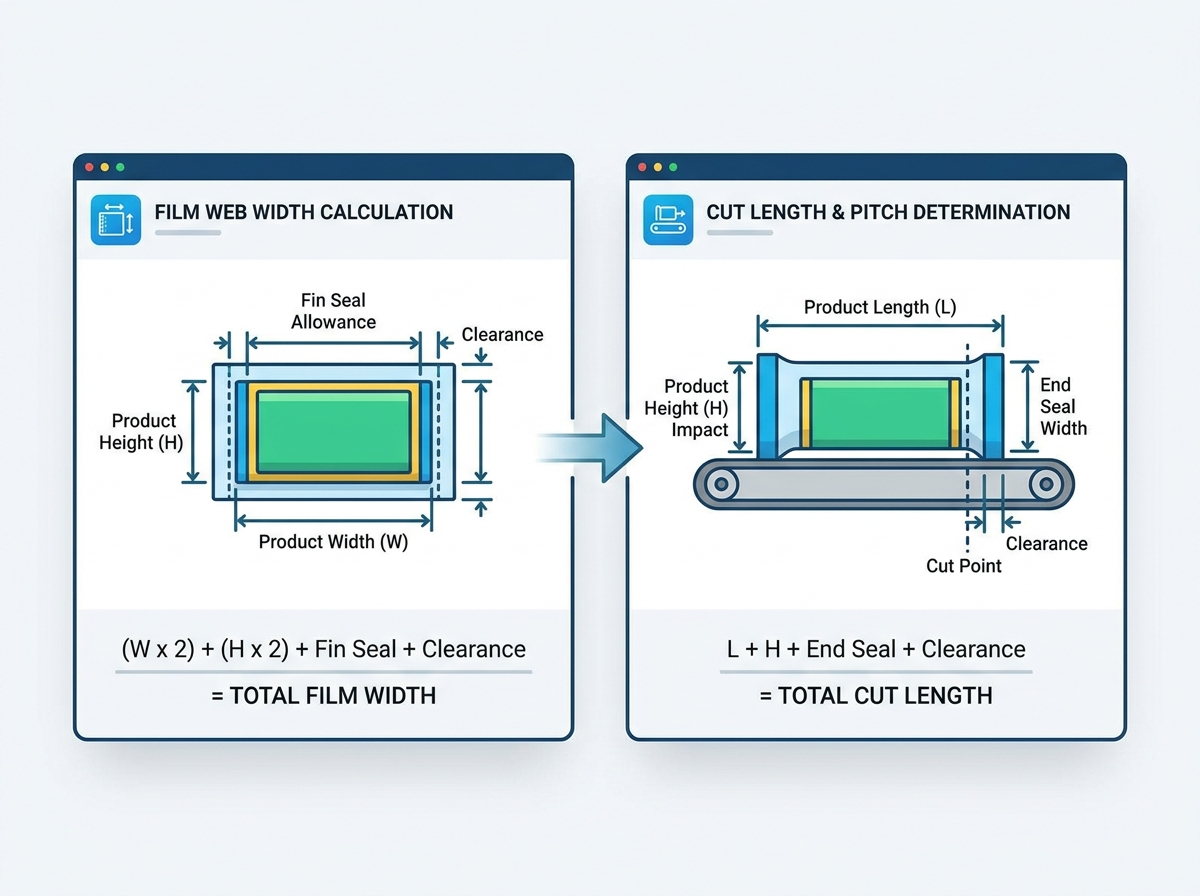
Cut length dictates how much film you pull for each individual package. Much like the web width, we use a strict formula here. The core equation is: Cut Length = Product Length + Product Height + End Seal Width + Clearance. This formula ensures the packaging machine pulls enough film to enclose the product and create secure end seals on both sides.
Understanding end seals is vital for accurate cut length calculations. You must factor the crimper width into your equation. The sealing jaw usually requires 15mm to 30mm per side to create a hermetic seal. Because every package has a front seal and a back seal, you must double this crimper allowance in your overall cut length calculation. Failing to account for both sides results in the jaws crushing the physical product.
Product height directly impacts your total cut length. Many operators forget this crucial variable. The film must travel downward from the top of your product to the center point of the sealing jaw. Taller products force the film to travel a longer vertical distance. If you ignore the product height, the machine will cut the film too short. This stretches the packaging tightly over the product ends, causing the seals to pop open during transit.
Print registration introduces strict cutoff pitches to the operation. Unprinted film allows for slight variations in cut length. Printed film demands absolute precision. Packaging uses eye-marks (small printed rectangles) to trigger the cutting mechanism. The distance between these eye-marks is the pitch. Your calculated cut length must match this pitch exactly. If your cut length deviates from the eye-mark tolerance, the graphics will drift off-center. You must synchronize the film feed speed with the sealing jaw rotation to maintain perfect registration.
Standard flat packages follow straightforward rules. However, complex packaging formats require you to move beyond pillow packing machine basics. Gusseted bags present an immediate mathematical challenge. Adding side gussets tucks the film inward, creating a block-bottom appearance. This process alters your baseline formulas completely. You must widen the initial film web to accommodate the extra folded material. Furthermore, gusseted packages require a completely different forming box architecture equipped with mechanical tuckers.
Film gauge and substrate materials drastically impact physical sizing. Thick laminates do not behave like thin mono-materials. Material type affects how much the film stretches under mechanical tension. Biaxially Oriented Polypropylene (BOPP) stretches differently than complex foil laminates. If you use a highly elastic film, you might need to slightly reduce your cutoff length to prevent loose packaging. Thicker films (measured in mil or microns) require wider fin seal allowances because the material resists tight folding inside the forming tube.
Multi-packs and rigid trays demand tighter clearances. Wrapping a single, soft bakery item allows for generous buffer zones. Wrapping three items inside a rigid plastic tray changes the dynamic entirely. If your film web is too loose, the tray will shift wildly during transit. You must calculate a tighter clearance to lock the tray in place. However, you must carefully balance this tension to ensure the rigid corners of the tray do not puncture the film web.
BOPP (Polypropylene): Standard stretch rate; requires moderate tension control.
Foil Laminates: Highly rigid; requires larger forming boxes to prevent creasing.
Mono-materials: Sustainable but sensitive to heat; requires precise dwell time tracking.
Your calculated dimensions dictate the exact machinery you need to purchase. You use these numbers to evaluate flow wrapping machines and shortlist appropriate vendors. Forming box configurations represent the first major decision. You must choose between fixed forming boxes and adjustable forming boxes. Fixed forming boxes suit high-volume, single-product runs. They offer superior consistency and rarely jam. Adjustable forming boxes provide flexibility. They are necessary for contract packagers who run varying film widths on the same line. However, adjustable boxes require highly skilled operators to tune them correctly.
Sealing jaw architecture is heavily dependent on your cut length and product height. Rotary jaws spin in a continuous circle. They are ideal for standard cut lengths and very high speeds. Box-motion jaws move in a rectangular path. They follow the product for a brief moment before releasing. Box-motion jaws are absolutely required for very tall products. They are also necessary for items requiring extended seal dwell times, such as gas-flushed products needing strict hermetic seals.
Vendor validation ensures the OEM can actually meet your specifications. You must demand proof before signing a purchase order. Request a detailed film sizing chart for the specific machine model. Force the vendor to conduct a Factory Acceptance Testing (FAT) using your actual physical product samples, not generic wooden blocks. Obtain a written guarantee covering the maximum and minimum web limits.
Forming Box and Sealing Jaw Comparison
Component Type | Best Application | Speed Profile | Product Height Limits |
|---|---|---|---|
Fixed Forming Box | Dedicated, high-volume single SKUs | Very High | Strictly limited to box size |
Adjustable Forming Box | Contract packaging, variable SKUs | Moderate to High | Flexible within max web limit |
Rotary Sealing Jaws | Standard flat products, bakery items | Extremely Fast | Low to Medium height |
Box-Motion Sealing Jaws | Hermetic sealing, MAP gas flushing | Moderate | Excellent for very tall products |
Required Validation Steps During Procurement
Validation Step | Why You Need It | Acceptable Proof |
|---|---|---|
Verify Web Width Limits | Ensures machine can handle your largest package. | OEM specification sheet and engineering drawings. |
Factory Acceptance Test (FAT) | Proves the machine works with your exact product. | Video evidence and physical sealed samples mailed to you. |
Print Registration Test | Prevents graphic drift on printed films. | A continuous run of 500+ items showing zero eye-mark drift. |
Film width and cut length represent far more than minor operational details. They are the foundational metrics that dictate machine suitability, govern production speeds, and determine your long-term return on investment. If you skip the mathematical groundwork, you invite frequent jams, costly material waste, and weak seals into your facility. Precision calculations protect your product and your profit margins.
Your next steps dictate the success of your procurement process. First, document your full product matrix. Measure the absolute minimum and maximum sizes for every item you intend to package. Next, run these dimensions through the core formulas to establish your required film envelopes. Finally, consult directly with a qualified packaging engineer to validate your calculations. Complete these actions before finalizing any equipment request for proposal (RFP).
A: Excess film causes the material to fold over itself inside the forming tube. This folding misaligns the back seals completely. The extra material creates massive friction, leading to severe jams in the pulling wheels and sealing jaws. You will experience immediate material waste and frequent machine stoppages.
A: Yes. Your calculated cut length must match the exact distance between the printed eye-marks, known as the pitch. Printed film requires precise synchronization between the film feed rollers and the sealing jaws. If the cut length deviates from this pitch, your graphics will drift off-center on the package.
A: You can, but it involves significant operational trade-offs. Using a "one-size-fits-all" film width for varying products creates aesthetic drawbacks. Smaller products will have loose, wrinkled packaging. More importantly, you waste money by wrapping small products in unnecessarily wide, expensive film material.


