 English
Views: 0 Author: Site Editor Publish Time: 2026-08-16 Origin: Site


Aseptic liquid packaging operates under a high-stakes reality. Minor deviations in dosing accuracy or prolonged format changeovers directly result in expensive product yield loss and compromised batch integrity. When processing high-value biologics or sensitive vaccines, a fraction of a milliliter overfilled drains profitability. Underfilling triggers batch rejections. Engineering and procurement teams face a constant operational tension. You must maximize throughput and maintain strict regulatory compliance while managing increasingly diverse container formats.
Selecting the right equipment requires a rigorous technical evaluation framework. You need to assess machine capabilities, mitigate implementation risks, and align the technology with your specific production scale. Whether you operate a dedicated high-speed line or a flexible multi-product cleanroom, the right pharmaceutical vial filling machine ensures seamless integration with your environmental constraints and validation requirements.
Accuracy Dictates Yield: Industry-standard dosing accuracy must fall between ±0.3% and ±1%; selecting the right pump technology (e.g., peristaltic vs. piston) is critical based on fluid viscosity, fill volume, and batch value.
Changeover Determines OEE: Tool-less format changes, recipe-driven automation, and integrated CIP/SIP (Clean-in-Place/Sterilize-in-Place) systems are mandatory for multi-product facilities to maintain high Overall Equipment Effectiveness (OEE).
Annex 1 Compliance is Non-Negotiable: Modern equipment must seamlessly integrate with RABS (Restricted Access Barrier Systems) or Isolators, maintaining absolute control over qualified environmental variables and first-air principles.
Combo Systems Offer Strategic Flexibility: Transitioning from dedicated single-format lines to modular, multi-use platforms (processing vials, syringes, and cartridges) addresses the market shift toward small-batch, personalized medicine.
Complete Line Integration Mitigates Bottlenecks: True output performance relies on continuous, synchronized flow from upstream washing and depyrogenation to downstream stoppering, capping, and labeling units.
Establishing operational baselines is the first step in equipment selection. Production volume, liquid characteristics, and container sizes dictate baseline requirements. You must analyze fluid viscosity, foaming tendencies, shear sensitivity, and surface tension. A highly viscous suspension requires entirely different pump mechanics than a shear-sensitive aqueous biologic. Container sizes also dictate the mechanical handling approach. Processing 2mL vials at high speeds demands precise star wheels to prevent glass-to-glass contact. Handling 100mL bottles might utilize walking beams.
Evaluating machines through the lens of EU GMP Annex 1 is mandatory. Modern aseptic processing demands strict adherence to first-air principles. The machine design must integrate viable and non-viable environmental monitoring systems directly into the critical zone. You must mitigate aseptic interventions through automated systems. Automated glove-port integrity testing and robotic handling reduce human interaction. Human operators remain the primary source of cleanroom contamination.
The Design Qualification (DQ) phase must define and lock down critical process parameters (CPPs). Absolute batch control requires precise management of nitrogen purging pre-fill and post-fill. Headspace oxygen levels must remain within strict tolerances to prevent product degradation. Stopper seating force must be continuously monitored to ensure container closure integrity (CCI) before the vials exit the sterile zone.
Facilities often face a conceptual trade-off between speed and flexibility. Dedicated high-speed lines maximize output for single blockbuster products. These systems run continuously with minimal format changes. Flexible, small-batch, or nested-vial systems prioritize rapid changeover. These modular platforms serve clinical trials or personalized medicine. Processing different container types on the same shift is more valuable than sheer throughput in these environments.
Production Strategy | Primary Advantage | Ideal Application | Equipment Focus |
|---|---|---|---|
Dedicated High-Speed | Maximum throughput and lowest cost per unit | Commercial blockbuster drugs, large volume vaccines | Rotary piston pumps, continuous motion star wheels |
Flexible Small-Batch | Rapid changeover and multi-format processing | Clinical trials, personalized medicine, CDMOs | Peristaltic pumps, robotic nest handling, combo platforms |
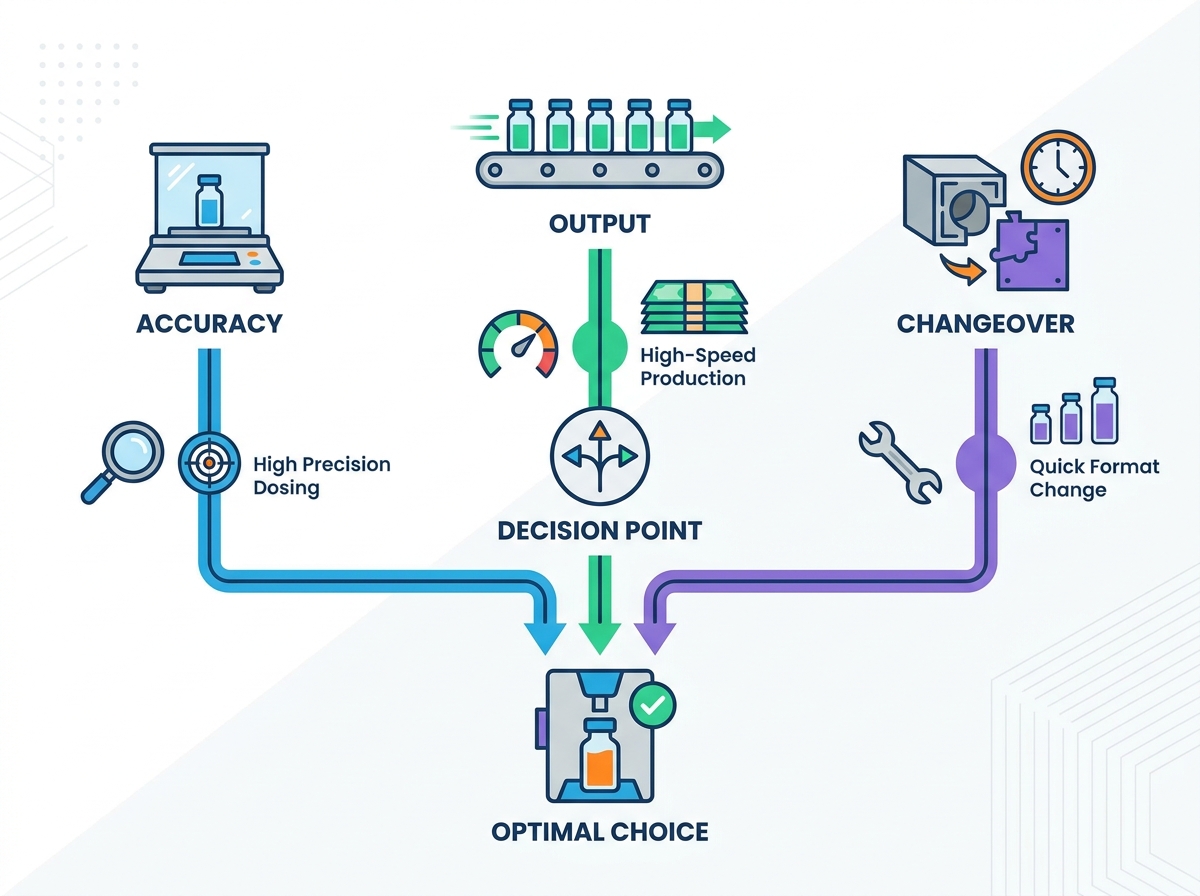
Acceptable tolerance ranges for liquid dosing typically fall between ±0.3% and ±1%. This depends heavily on the target fill volume. Larger volumes generally achieve tighter percentage tolerances. Micro-dosing under 1mL presents a specific engineering challenge. In biologics manufacturing, maintaining a ±0.5% accuracy threshold is mandatory. These processes handle extremely high-value active pharmaceutical ingredients (APIs). Even microscopic deviations impact efficacy and profitability.
The financial impact of dosing deviations is severe. Overfilling results in the giveaway of expensive bulk product. This erodes profit margins over a production campaign. Underfilling leads to regulatory rejection and batch failure. Precision dosing systems eliminate these risks by maintaining tight control over the fluid path from the surge tank to the filling needle.
Peristaltic pumps dominate single-use applications and shear-sensitive biologics. The fluid only contacts the disposable tubing. This ensures zero cross-contamination risks and eliminates complex cleaning validation. Peristaltic systems face limitations in high-viscosity accuracy. Tubing wear over long production runs impacts dosing consistency. You must implement automated calibration checks.
Rotary piston pumps excel in high-speed, high-viscosity applications. They deliver robust, repeatable volumes for suspensions and dense liquids. The trade-off involves more complex cleaning validation protocols. Engineers must monitor potential particle generation caused by metal-on-metal or ceramic friction within the pump housing.
Time-pressure systems suit continuous flow applications and bulk manufacturing. These systems rely on highly precise fluid path pressure regulation and temperature control to dispense accurate volumes. They lack moving parts within the fluid path. This makes them gentle on products. They require sophisticated sensor integration to maintain accuracy as tank levels fluctuate.
Modern filling lines require 100% or statistical Tare/Gross weighing systems. Implementing these systems involves specific operational steps:
The IPC load cell weighs the empty vial (Tare weight) before it enters the filling station.
The dosing nozzle dispenses the programmed liquid volume into the vial.
A second load cell weighs the filled vial (Gross weight) immediately after dosing.
The PLC calculates the exact net weight of the dispensed liquid and compares it to the target specification.
The automated feedback loop adjusts the pump stroke or dispensing time for subsequent vials if the trend approaches control limits.
Automated feedback loops prevent out-of-specification (OOS) deviations without halting the filling line. This maximizes both yield and uptime. For high-value products, 100% IPC ensures every single container meets specification.
Output tiers dictate the mechanical architecture of the machine. Lab and clinical scale systems process under 50 vials per minute. They focus on precision and rapid changeover. Mid-scale machines handle 50 to 200 vials per minute. They balance throughput with format flexibility. High-speed commercial lines output 600 or more vials per minute. They are engineered for continuous, dedicated production runs.
Mechanical handling mechanisms heavily impact vial stability at these varying speeds. Star wheels and scroll feeds manage high-speed continuous motion. They risk glass-to-glass contact if not perfectly synchronized. Walking beams provide intermittent motion suitable for precise dosing but limit overall throughput. Robotic nest-handling systems lift and position entire arrays of vials. This eliminates friction and maximizes stability for sensitive glass containers.
Semi-automatic vial loading relies on operators to manually position trays or nests. This introduces human-error variables and elevates contamination risks. The labor required offsets the lower initial equipment investment. Semi-automatic systems suit very early-stage clinical manufacturing but struggle to scale for commercial production.
Fully automated systems utilize unscrambling tables, robotic de-nesting, and continuous-feed accumulation tables. These mechanisms remove human operators from the critical zone. Automation ensures consistent infeed rates. It reduces particle generation and maintains strict aseptic conditions throughout the process.
A filling machine cannot operate in isolation. You must evaluate the critical physical and PLC hand-offs between upstream washing machines, depyrogenation tunnels, and the sterile entry point. Vials must transfer smoothly from the cooling zone of the tunnel directly into the Class A filling environment without accumulating or jamming.
Downstream integration carries equal risks. Transferring filled vials to stoppering stations requires precision. The system must handle full insertion for liquid products or partial insertion for lyophilization. Alu-capping stations must manage particle generation. They often utilize localized extraction to keep aluminum dust away from the sterile zone. Automated labeling must keep pace with the filler.
Line bottlenecking occurs if the filling machine's output exceeds downstream labeling, secondary packaging, or cartoning capacities. Accumulation tables provide buffer zones. A truly optimized line synchronizes the speed of every unit operation from glass washing to final palletizing.
Changeover downtime severely impacts operational efficiency in multi-product facilities. Contract Manufacturing Organizations (CMOs) cannot afford lines sitting idle for days between product runs. Rapid changeover directly increases available production hours and overall facility output.
Tool-less changeover systems utilize quick-release mechanisms instead of bolts and screws. Color-coded change parts help operators quickly identify the correct components for specific vial sizes. Recipe-driven HMI adjustments automatically reposition conveyor widths, pump stroke lengths, and nozzle heights at the push of a button. This eliminates manual calibration errors.
Handling diverse container sizes on a single machine requires robust engineering. A system processing both 2mL and 100mL vials needs adjustable handling parts and interchangeable dosing pumps. The transport mechanism must secure tiny, unstable vials just as effectively as large, heavy bottles.
The multi-use combo platform trend addresses the need for extreme flexibility. Modular machines process nested vials, syringes, and cartridges on the same platform. Operators swap out minimal, rapid changeover components to switch formats. This design maximizes asset utilization for facilities handling diverse, low-volume product portfolios.
Automated Clean-in-Place (CIP) and Sterilize-in-Place (SIP) capabilities eliminate manual intervention risks. Operators no longer need to break the sterile boundary to dismantle and scrub fluid paths. Automated cycles circulate cleaning agents, WFI (Water for Injection), and pure steam through the system. This ensures repeatable, validated sterility.
Minimize dead legs where fluid can stagnate during the cleaning cycle.
Utilize 316L stainless steel for all product-contact surfaces.
Ensure crevice-free surfaces and utilize orbital welding on all fluid path connections.
Implement proper sloping to allow the system to drain completely by gravity.
Sanitary design principles accelerate cleaning validation protocols, such as riboflavin testing. Ensuring that CIP fluids effectively reach and clean every internal surface is mandatory for regulatory compliance.
Installation involves strict physical realities. Floor space limitations often dictate machine selection. You must integrate the equipment with existing HVAC and laminar flow systems to maintain proper air velocity and pressure cascades. Retrofitting new barrier systems, such as RABS or Isolators, into existing ISO 5 or Class A environments requires precise engineering. You must avoid disrupting established airflow patterns.
The machine footprint must allow for ergonomic operator access and maintenance clearances. Exhaust systems for depyrogenation tunnels and extraction for capping stations must route efficiently through the facility infrastructure. Space planning ensures the equipment fits the cleanroom rather than forcing the cleanroom to adapt to the equipment.
Prolonged validation phases pose significant implementation risks. Design Qualification (DQ), Factory Acceptance Testing (FAT), Site Acceptance Testing (SAT), and IQ/OQ/PQ protocols demand rigorous documentation and execution. Delays in any of these phases push back commercial launch dates.
Selecting vendors with robust local service networks mitigates downtime. Remote diagnostics capabilities allow engineers to troubleshoot PLC logic without traveling to the site. Comprehensive documentation packages, including GAMP 5 compliance and 21 CFR Part 11 software audit trails, streamline the regulatory approval process.
To ensure a successful equipment acquisition and implementation, follow these immediate steps:
Compile a detailed User Requirement Specification (URS) outlining your exact fluid characteristics, container formats, and throughput requirements.
Request product-specific fluid dosing trials from vendors to verify pump accuracy with your actual liquids before making a purchasing decision.
Schedule comprehensive Factory Acceptance Tests (FAT) with shortlisted equipment manufacturers to validate mechanical performance and automation logic prior to site delivery.
Audit the vendor's local service network and remote diagnostic capabilities to guarantee long-term operational support and minimize future downtime.
A: The standard accuracy range is typically ±0.5% to ±1%. High-precision systems can achieve up to ±0.3%. Accuracy depends heavily on the target fill volume, the liquid's viscosity, and the specific pump technology utilized during the dosing process.
A: Viscosity dictates pump selection. Peristaltic pumps work best for aqueous, shear-sensitive liquids like biologics. Rotary piston pumps provide the mechanical force necessary to accurately dose high-viscosity suspensions and dense liquids without clogging or losing precision.
A: EU GMP Annex 1 mandates strict contamination control strategies. Filling machines must integrate with RABS or Isolators, maintain first-air principles over open vials, and utilize automated systems to minimize human interventions, ensuring absolute sterility during processing.
A: Combo platforms process multiple container types, such as vials, syringes, and cartridges, on a single machine. They utilize modular change parts, allowing facilities to rapidly switch formats, maximizing equipment utilization for small-batch and personalized medicine production.
A: IPC systems use load cells to weigh empty vials and filled vials. The system calculates the exact liquid mass. Automated feedback loops use this data to adjust pump strokes in real-time, preventing out-of-specification fills.
A: RABS provides a physical barrier with glove ports but relies on the surrounding cleanroom for sterility. Isolators are fully sealed, self-contained environments with integrated bio-decontamination systems, offering higher sterility assurance independent of the background room.


