 English

Views: 0 Author: Site Editor Publish Time: 2026-09-20 Origin: Site


Capital equipment procurement hinges on one critical milestone. A successful Factory Acceptance Test (FAT) depends entirely on the test material. The quality and accuracy of your powder dictate the outcome. Evaluating an auger filler requires testing the exact product used in daily operations. Supplying lab-grade samples leads directly to inaccurate tooling specifications. Idealized powders do not behave like bulk production materials. Engineers often underestimate how processing environments alter product behavior.
To ensure equipment performs accurately on your production floor, you must rethink material testing. Engineering and procurement teams must extract representative powder samples carefully. You must package and ship these samples to preserve their physical states. You must account for real-world environmental and physical variables throughout the process. We will explore how to identify representative materials correctly. You will learn to extract them from your active lines safely. Mastering this process guarantees your machine configurations will match actual production demands seamlessly.
Sample Integrity Defines Tooling: Equipment manufacturers rely on your sample to select the correct interchangeable augers, agitation mechanisms, and funnel types.
Volume Matters: Running a meaningful accuracy and speed trial requires production-scale sample volumes, not just a few lab-sized jars.
Combat Transit Degradation: Shipping alters powder characteristics (e.g., compaction, moisture absorption). Samples must be packaged to preserve their native state.
Match Production Conditions: A trial is only valid if the sample reflects the exact bulk density and flowability found at the feed stage of your actual facility.
Sending an idealized powder sample carries massive financial risks. Operational hazards multiply rapidly during the equipment procurement cycle. Many engineers pull pristine samples directly from a controlled lab environment. Lab conditions rarely mirror the harsh realities of a busy factory floor. This disconnect creates severe equipment specification failures. The resulting tooling mismatch cripples production capabilities on day one.
Vendors design equipment based entirely on the provided test material. A sample might appear perfectly dry and uniform in a climate-controlled room. The vendor will then specify standard, free-flowing tooling. However, the actual production powder might bridge or rathole under normal plant humidity. Bridging stops material flow completely. Ratholing creates empty channels above the dosing mechanism. Both issues destroy filling consistency instantly.
You will face serious accuracy fallacies in this scenario. Machine precision guarantees become completely void. The equipment manufacturer bases performance promises on the trial powder alone. If your production material behaves differently, accountability vanishes. You cannot hold the vendor responsible for fluctuating fill weights. Their machine performed perfectly with the lab sample provided.
Discovering these mismatches usually happens late in the project timeline. Teams often identify the problem during Site Acceptance Testing (SAT). At this late stage, fixing the issue causes incredibly costly delays. You must order new augers and adjust agitation parameters. You must retest everything from scratch. Commissioning halts entirely. Production schedules slip backward. You lose valuable time waiting for replacement parts to arrive.
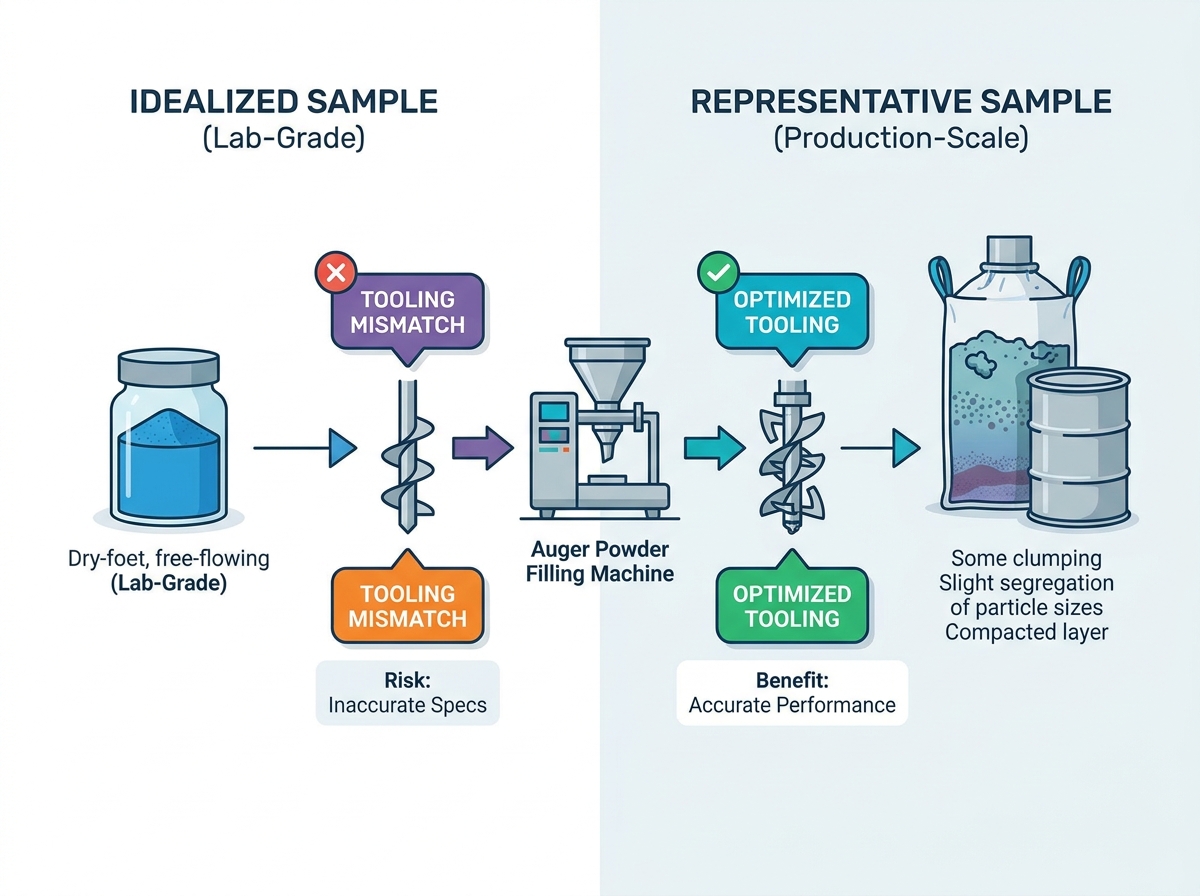
What makes a sample truly representative? You must align physical powder characteristics directly with core auger filling machine principles. The system relies entirely on predictable volumetric displacement. Any physical change in the powder affects this displacement directly. We must evaluate several distinct physical variables to ensure accuracy.
First, consider particle size and segregation risks. Multi-ingredient blends frequently separate during internal factory transport. Finer particles settle at the bottom of bins. Coarser granules rise to the top surface. Your trial sample must contain the exact ratio of fines to coarse particles. An unbalanced sample skews flow rates drastically. It gives the vendor a false impression of product consistency.
Bulk density variations also play a critical role. You must measure and report both aerated and tapped bulk density. Tapped density represents densely compacted material. Aerated density represents loose, highly oxygenated material. The auger fills by volume rather than by weight. If density changes mid-run, the final fill weight fluctuates wildly. The vendor needs to know these density extremes.
Flowability attributes dictate mechanical accessory selection. We categorize powders into free-flowing, semi-free-flowing, and non-free-flowing types. The angle of repose helps determine this category quickly. Sticky materials require specialized agitation mechanisms. Free-flowing items need spinner plates to stop post-fill dripping. Correct classification prevents massive product waste during high-speed runs.
Finally, moisture content and hygroscopicity change behavior constantly. Ambient humidity alters how cohesive a powder becomes. Sticky powders interact poorly with stainless steel contact parts. They cling tightly to hopper walls. They build up on the auger shaft itself. Your trial sample must reflect these moisture realities accurately.
Table 1: Flowability Characteristics and Agitation Requirements
Flowability Type | Typical Angle of Repose | Common Examples | Required Machine Accessories |
|---|---|---|---|
Free-Flowing | Less than 30 degrees | Granulated sugar, table salt | Spinner plates, clam-shell cutoffs |
Semi-Free-Flowing | 30 to 45 degrees | Ground coffee, spices | Standard agitation blades, straight funnels |
Non-Free-Flowing | Greater than 45 degrees | Baking flour, milk powder | Slow-speed agitators, lip funnels |
Extracting a proper sample requires a strict operational framework. You must approach this task highly skeptically. Do not rely on optimized pilot-plant batches for testing. You need material from a standard, everyday production run. Idealized batches hide the flaws normal equipment must overcome.
Timing the sample correctly ensures validity. Pull your sample from the middle of a continuous batch. Start-up and shut-down phases often yield inconsistent mixtures. The middle of the run provides the most stable baseline. This steady-state phase represents the majority of your daily production output.
Compliance-aware practices matter heavily during extraction. Use stratified sampling techniques based on recognized GMP guidelines. Take cross-sectional samples from different levels of your mixers. Sample from the top, middle, and bottom of hoppers. This practice ensures genuine blend uniformity. Surface scooping is a common mistake. It only gathers the lightest particles.
You must also calculate the correct sample volume realistically. A few small jars will not suffice. You need enough powder to thoroughly test the auger powder filling machine under stress. This includes testing its hopper refill mechanisms effectively. Low material levels trigger different machine dynamics than full hoppers.
Identify the steady-state phase of your standard production batch.
Use a specialized powder thief to draw cross-sectional samples.
Combine these various draws into a single large master composite.
Calculate the required trial volume based on continuous run times.
Seal the composite immediately to lock in ambient moisture levels.
Provide at least enough material for a 15-minute continuous run. Calculate this using your target machine speed. High-speed applications require significantly more volume. Starving the machine during a trial invalidates the accuracy data. Always err on the side of providing too much material.
Shipping bulk powders introduces unpredictable physical risks. You must mitigate these risks before sending material to a vendor. The physical realities of freight transport alter material behavior significantly. Proper logistics planning preserves sample integrity across long distances.
The compaction effect is your biggest enemy during transit. Truck and air freight vibrations compact the powder densely. The material settles over hours of continuous shaking. By the time it arrives, it behaves quite differently. Instruct readers to notify the vendor about this specific phenomenon. The testing team can re-aerate the powder before testing. They must agitate it back to normal production density.
Moisture barriers are essential for hygroscopic products. Ordinary cardboard boxes offer zero environmental protection. Changes in weather during transit ruin unprotected samples. Recommend using high-barrier foil liners instead. Double-bagging the material works exceptionally well. Add industrial desiccants between the outer and inner bag layers. This setup prevents the powder from clumping excessively during transit.
Handling hazardous materials requires strict regulatory compliance. Active pharmaceutical ingredients (APIs), toxic chemicals, and combustible dusts need special care. Always provide clear Safety Data Sheets (SDS) with the shipment. Use proper DOT labeling on all outer containers. Inform the testing facility in advance.
Use rigid outer containers to prevent crushing and burst bags.
Expel excess air from inner bags before sealing them shut.
Include a baseline moisture reading document inside the box.
Alert the vendor beforehand if the powder poses inhalation risks.
Label containers with clear "Keep Dry" and "Do Not Freeze" stickers.
Translating trial results into a final purchase requires clear logic. Use the representative sample trial as your primary evaluation tool. It reveals exactly how the equipment performs under mechanical stress. Relying on paper specifications alone is incredibly dangerous.
Testing interchangeable tooling is highly recommended. Advise buyers to request trial runs using different setups. Test various auger sizes during the trial session. Try different spinner plates or cut-off mechanisms. You want to find the optimal balance between speed and precision. Sometimes a smaller auger running faster yields better accuracy. Sometimes a larger auger turning slowly prevents product degradation.
You must also evaluate the control loop during the trial. Observe how the machine integrates with checkweighers. Modern systems rely heavily on continuous feedback loops. They auto-correct for natural density shifts found in the sample. If the feedback loop lags, your reject rates will climb. Ensure the vendor demonstrates this auto-correction feature live.
These steps transition your project smoothly into final procurement. Discovering issues now saves thousands of dollars later. Once the trial meets your standards, you can confidently specify your powder filling lines. Outline your final checklist for FAT sign-off based on these exact trial results.
Confirm the final tooling list matches the most successful trial run.
Verify the specific agitation settings used to achieve target flow.
Document the achieved speeds, fill weights, and standard deviations.
Ensure all required environmental enclosures are documented properly.
The accuracy of an auger filler directly reflects the physical properties of the powder. Idealized samples create a false sense of confidence. Only representative materials reveal true machine capability. Engineers must treat sample preparation as a critical procurement phase.
Be entirely transparent with the equipment manufacturer. Share your powder's worst-case characteristics upfront. Highlight clumping, dusting, or bridging tendencies immediately. Do not hide production difficulties to make the product look better. This honesty yields a much more robust machine configuration. It protects your investment long-term.
Take action on these principles today. Consult with your engineering team to calculate realistic trial volume requirements. Define your facility's baseline environmental conditions clearly. Then, contact your equipment manufacturer to schedule a comprehensive material test. A successful trial paves the way for a flawless factory deployment.
A: It depends heavily on the target fill weight and speed. Generally, vendors request enough material to run the machine continuously for 10 to 30 minutes. This volume tests both steady-state accuracy and hopper-refill dynamics effectively. You will often need 20-50 kg. High-speed applications require significantly more.
A: Yes, placebo powders can be used. Specific grades of salt, sugar, or starch work well. However, they must precisely match the bulk density of the actual product. They must also match flow characteristics and particle size distribution. Any deviation renders the trial data invalid.
A: Send the sample in airtight, moisture-proof packaging immediately after extraction. You must advise the equipment manufacturer of your facility's environmental baseline. Tell them your seasonal humidity ranges. They can simulate those conditions during testing. They may also specify environmental enclosures for the final machine design.


