 English
Views: 0 Author: Site Editor Publish Time: 2026-07-19 Origin: Site


Precise particle size reduction drives drug efficacy, directly impacting active pharmaceutical ingredient (API) bioavailability and dissolution rates. Achieving a strict particle size distribution (PSD) creates tension with maintaining material integrity. Plant operators face the daily challenge of reducing particle size without inducing thermal degradation, generating excessive fines, or compromising powder flowability during downstream tableting.
Solving this requires a rigorous evaluation framework. You must align material characteristics like hardness and heat sensitivity with specific mesh requirements. It also demands a deep understanding of the operational capabilities of modern milling and grinding equipment. By matching the physical properties of the formulation to the correct mechanical forces, you achieve predictable, repeatable batch results.
PSD Dictates Performance: Controlling particle size distribution is critical for optimizing bulk density, specific surface area, and mixing uniformity, which directly govern tableting efficiency and drug release profiles.
Mesh Size Specificity: Pharmaceutical applications typically require screening between 12 and 400 mesh (1,680 to 37 microns), with coarse meshes reserved for granulation sizing and finer meshes for ultrafine API reduction.
Material-Driven Equipment Selection: The choice of milling technology must be dictated by the API’s thermal sensitivity and cohesiveness to prevent degradation and ensure consistent flow.
Compliance and Cleanability: Evaluating equipment requires prioritizing cGMP compliance, focusing on sanitary design, dust containment, and Clean-in-Place/Sterilize-in-Place (CIP/SIP) capabilities to mitigate cross-contamination risks.
A successful milling operation hinges on achieving a narrow, predictable PSD. This baseline requirement dictates how the powder behaves in every subsequent manufacturing step. Wide distributions often lead to unpredictable flow, poor content uniformity, and erratic compression dynamics on the tablet press.
There is a strict inverse relationship between particle size and specific surface area. Smaller particles expose more surface area to solvent mediums. Optimizing this surface area accelerates dissolution rates. This is especially critical for poorly water-soluble APIs, such as those in BCS Class II and IV. When working with compounds like Ibuprofen or certain statins, reducing the particle size to the low micron range is often the only way to achieve the target pharmacokinetic profile. Uniform particle size also increases reaction rates. It ensures chemical stability during formulation by preventing localized concentration gradients that can lead to batch failures.
Particle size and shape heavily influence bulk density and cohesiveness. Irregular or overly fine particles tend to interlock, reducing flowability and causing ratholing in hoppers. You must measure and quantify cohesive powder flow to predict tableting success. Key powder characterization metrics include the Angle of Repose, Carr’s Compressibility Index, and the Hausner Ratio. These metrics evaluate flowability post-grinding.
Flow Character | Angle of Repose (degrees) | Carr's Index (%) | Hausner Ratio |
|---|---|---|---|
Excellent | 25 - 30 | < 10 | 1.00 - 1.11 |
Good | 31 - 35 | 11 - 15 | 1.12 - 1.18 |
Fair | 36 - 40 | 16 - 20 | 1.19 - 1.25 |
Passable | 41 - 45 | 21 - 25 | 1.26 - 1.34 |
Poor | 46 - 55 | 26 - 31 | 1.35 - 1.45 |
A uniform PSD prevents segregation during mixing. It also ensures consistent die filling during high-speed tableting processes, reducing the risk of weight variation in the final dosage form. When running a press at 200,000 tablets per hour, even minor flow inconsistencies will trigger rejection limits.
Effective pharmaceutical powder grinding relies on precise mesh targeting. Operators must understand how standard mesh translates to actual micron sizes to set accurate equipment parameters and select the correct screens for the mill.
The standard pharmaceutical range spans from 12 to 400 U.S. standard mesh. This equates to 1,680 down to 37 microns. Selecting the correct screen determines the upper limit of the particle size. Using a screen with too large an opening allows oversized particles through, while too fine a screen reduces throughput and increases heat generation.
U.S. Standard Mesh | Micron Equivalent (μm) | Typical Pharmaceutical Application |
|---|---|---|
12 Mesh | 1,680 μm | Coarse dry granulation sizing |
20 Mesh | 841 μm | Standard wet/dry granulation |
40 Mesh | 400 μm | Fine granulation, excipient sizing |
100 Mesh | 149 μm | API milling, intermediate reduction |
400 Mesh | 37 μm | Ultrafine API reduction, micronization |
Mesh requirements differ vastly based on the process stage. Dry or wet granulation sizing utilizes coarser meshes, typically 12 to 40 mesh. The goal here is deagglomeration and achieving a uniform granule size for compression, not pulverizing the material into dust. Ultrafine API processing requires finer screens, ranging from 100 to 400 mesh, often utilizing different milling technologies entirely.
Achieving specific target sizing specifications is vital. For example, hitting "100% (-) 20 U.S. standard mesh" eliminates oversized particles. It does this without shifting the overall PSD or generating downstream tableting defects like capping. Operators must regularly inspect screens for blinding or tears, as a single rupture will contaminate the entire batch with oversized material.
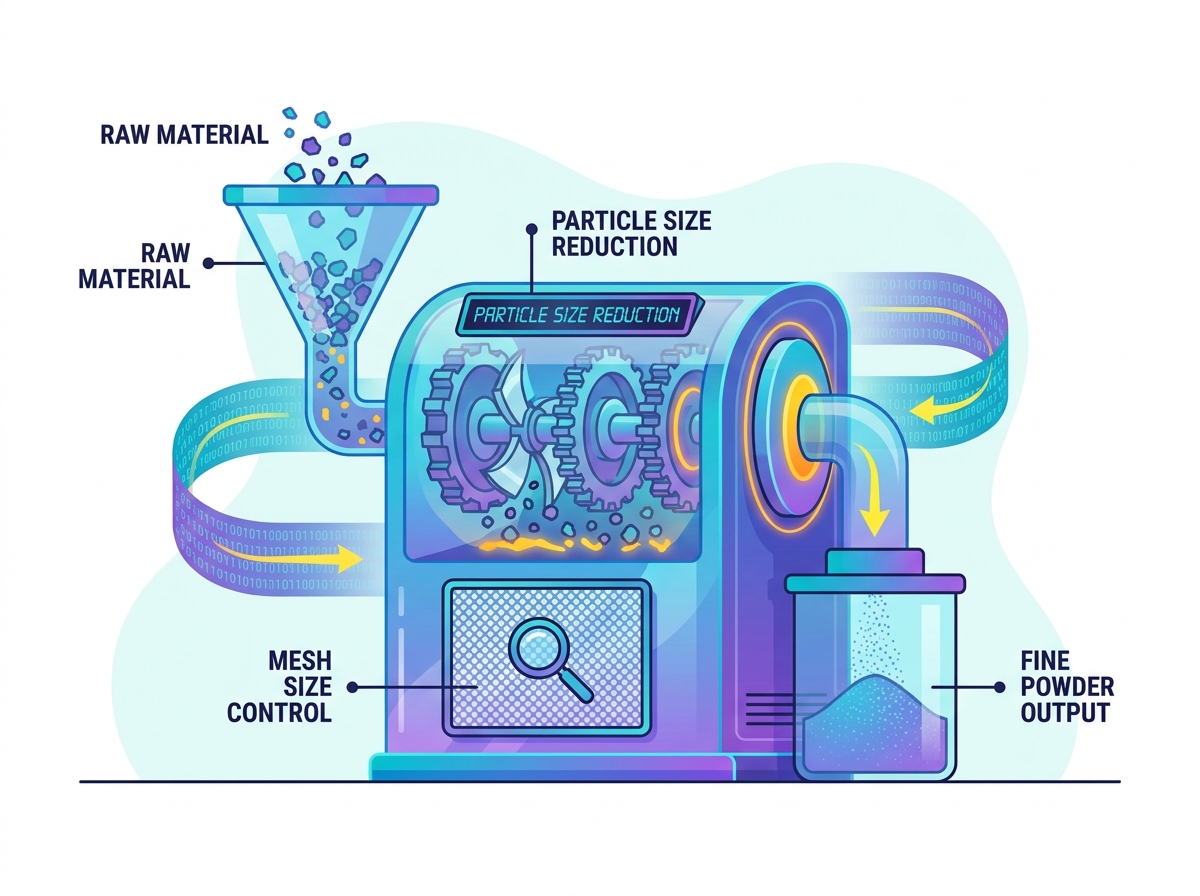
The physical and chemical properties of the input material dictate the milling strategy. Ignoring these properties leads to equipment failure, material loss, or compromised drug efficacy. You cannot treat a waxy excipient the same way you treat a brittle, crystalline API.
Mechanical energy naturally converts to heat during the milling process. Processing low-melting-point or thermolabile compounds carries significant risk. Excessive heat can alter the polymorphic state of the API, rendering it inactive or unstable. It can also cause severe thermal degradation, leading to failed assays and discarded batches. You must evaluate equipment based on its ability to dissipate heat or operate at low temperatures to protect the active compound. Monitoring the exhaust temperature of the mill is a standard practice to ensure the material remains within safe limits.
The Mohs hardness of the excipient or API dictates the required mechanical force. It also determines the necessary wear-resistance of the milling media. Abrasive materials require hardened stainless steel or specialized coatings to prevent metal contamination in the powder. Moisture content heavily impacts powder cohesiveness. High moisture leads to blinding of screens and equipment blockages, forcing operators to halt production for cleaning.
Highly cohesive materials may require cryogenic milling or strictly conditioned environments with low relative humidity. To mitigate cohesive powder properties, implement specific pre- and post-processing methodologies. These include adding glidants like colloidal silicon dioxide prior to milling or utilizing vibration-assisted discharge systems on the collection vessels.
Selecting the right pharmaceutical pulverizer machines requires understanding how different equipment applies mechanical force to the material. The wrong machine will destroy your product yield.
Machines utilize four fundamental mechanical forces for size reduction. Impact involves the high-speed collision of particles against mechanical components, like swinging hammers. Attrition relies on particle-on-particle friction and rubbing wear. Shear works by cleaving particles along weak planes, often seen in conical mills. Compression reduces size by squeezing particles between two solid surfaces.
Hammer mills are evaluated for medium-to-fine size reduction. They utilize primary impact and attrition forces. They offer high throughput and versatility, making them a staple in many facilities. However, there are trade-offs. Hammer mills generate higher heat due to the high rotor speeds (often exceeding 4000 RPM) and produce a broader PSD, increasing the risk of fines. They are best suited for brittle materials that shatter easily upon impact.
Conical mills provide gentle size reduction and deagglomeration. They are ideal for sizing wet or dry granulation utilizing low-velocity shear and attrition. The advantages include low heat generation, tight PSD control, and minimal fines production. They operate at lower RPMs, protecting sensitive materials. The impeller forces the material against a conical screen, shearing it to the exact size of the hole without over-milling.
Jet mills are designed for ultrafine size reduction, often down to the 1-10 micron range. They rely on high-velocity particle-on-particle impact driven by compressed gas (air or nitrogen). A major advantage is the lack of moving parts, resulting in zero mechanical metal-on-metal contamination. The expanding gases also provide a cooling effect, making jet mills ideal for highly heat-sensitive APIs. However, they require significant energy input and specialized dust collection systems.
Choosing equipment goes beyond basic mechanical capabilities. You must evaluate scalability, compliance, and integration into existing facility infrastructure. A machine that works in the lab must work on the production floor.
A machine's results at the bench scale must translate to pilot and commercial scales. Evaluate scalability by looking at constant tip speed and geometric similarity. Equipment that maintains these parameters ensures that a process developed for grams or kilograms will perform identically when scaled to tons. If the lab mill operates at 10 m/s tip speed, the production mill must be capable of the exact same tip speed to replicate the PSD.
Pharmaceutical environments have non-negotiable compliance features. Equipment must feature 316L stainless steel contact parts, FDA-compliant elastomers, and crevice-free geometries with a surface finish of Ra < 0.8 µm. You must evaluate the integration of CIP/SIP systems for automated cleaning, reducing turnaround time between batches. High-containment configurations (OEB/OEL) are mandatory for processing highly potent active pharmaceutical ingredients (HPAPIs) to protect operators and prevent cross-contamination. This often involves split butterfly valves and isolator integration.
Even with the right equipment, operational variables can disrupt the milling process. Identifying risks early allows for proactive mitigation and keeps production schedules on track.
Generating excessive fines presents a major operational risk. Fines are particles significantly smaller than the target mesh. They lead to poor flow, capping, or lamination during tableting because they trap air in the die cavity. To mitigate this, optimize the rotor speed; faster is not always better. Select the correct screen type, choosing between rasping or round hole profiles based on the material. Strictly control feed rates using rotary valves or vibratory feeders to prevent material from lingering in the milling chamber and undergoing secondary impact.
Static electricity causes powder agglomeration and presents severe explosion hazards, especially with fine organic dusts. Thermal degradation ruins API efficacy. Implement active cooling jackets around the milling chamber to manage heat. Utilize chilled process air for temperature-sensitive runs. Ensure proper equipment grounding and use inert gas purging, like nitrogen, to eliminate static and explosion risks. Always verify the minimum ignition energy (MIE) of the powder before processing.
Pharmaceutical particle size reduction is not simply a matter of achieving the smallest possible powder size. The real objective is to create a controlled and repeatable particle size distribution that improves dissolution performance, maintains powder flowability, and supports consistent downstream manufacturing.
The right milling solution depends on the relationship between material characteristics and equipment capabilities. Heat-sensitive APIs, cohesive powders, and abrasive materials require different mechanical approaches to prevent degradation, excessive fines, contamination, or unstable processing behavior. A machine that performs well in laboratory trials must also demonstrate reliable scalability, cleanability, and GMP compliance at production scale.
Successful pharmaceutical milling begins with understanding the formulation rather than selecting equipment based only on throughput or final particle size. Through pilot testing, process validation, and careful equipment evaluation, manufacturers can achieve predictable PSD control while protecting product quality and operational efficiency.
A: The typical range is 12 to 400 U.S. standard mesh, which equates to 1,680 to 37 microns. Coarser meshes (12-40) are used for granulation sizing, while finer meshes (100-400) are reserved for ultrafine API reduction and micronization.
A: Smaller particles significantly increase the specific surface area of the powder. This increased surface area exposes more of the drug to solvent mediums, thereby accelerating dissolution rates and improving absorption, especially for poorly water-soluble APIs.
A: Hammer mills utilize high-impact forces, resulting in high throughput but a broader PSD and higher heat generation. Conical mills operate at low RPMs using shear and attrition, offering low heat, tight PSD control, and minimal fines.
A: Prevent heat degradation by utilizing low-impact equipment like conical mills or jet mills, which offer gas-expansion cooling. Additionally, apply active cooling jackets to the milling chamber, use chilled process air, or employ cryogenic milling techniques.
A: Consistent flowability prevents particle segregation during mixing and ensures uniform die filling during high-speed tableting. This uniformity is critical for maintaining accurate dose uniformity and preventing physical defects in the final tablets.
A: Fines are over-milled dust particles that fall significantly below the target mesh size. They cause cohesive flow issues, lead to tableting defects like capping and lamination, and result in overall product yield losses.
A: Flowability is measured using standardized metrics such as the Angle of Repose, Carr's Compressibility Index, and the Hausner Ratio. These tests evaluate bulk density and cohesiveness to determine if the ground powder is suitable for downstream tableting.


