 English
Views: 0 Author: Site Editor Publish Time: 2026-08-05 Origin: Site


The coating process dictates the final quality of solid dosage manufacturing. It provides the primary barrier for active pharmaceutical ingredients (APIs), blocking oxygen, light, and moisture. Coating also controls modified release profiles and directly impacts patient compliance by improving swallowability, color uniformity, and taste masking. Substandard coating equipment destroys profitability. When machines fail to maintain thermodynamic balance, you get batch rejections from twinning, peeling, or uneven film distribution. These defects ruin yield and trigger Good Manufacturing Practice (GMP) compliance failures.
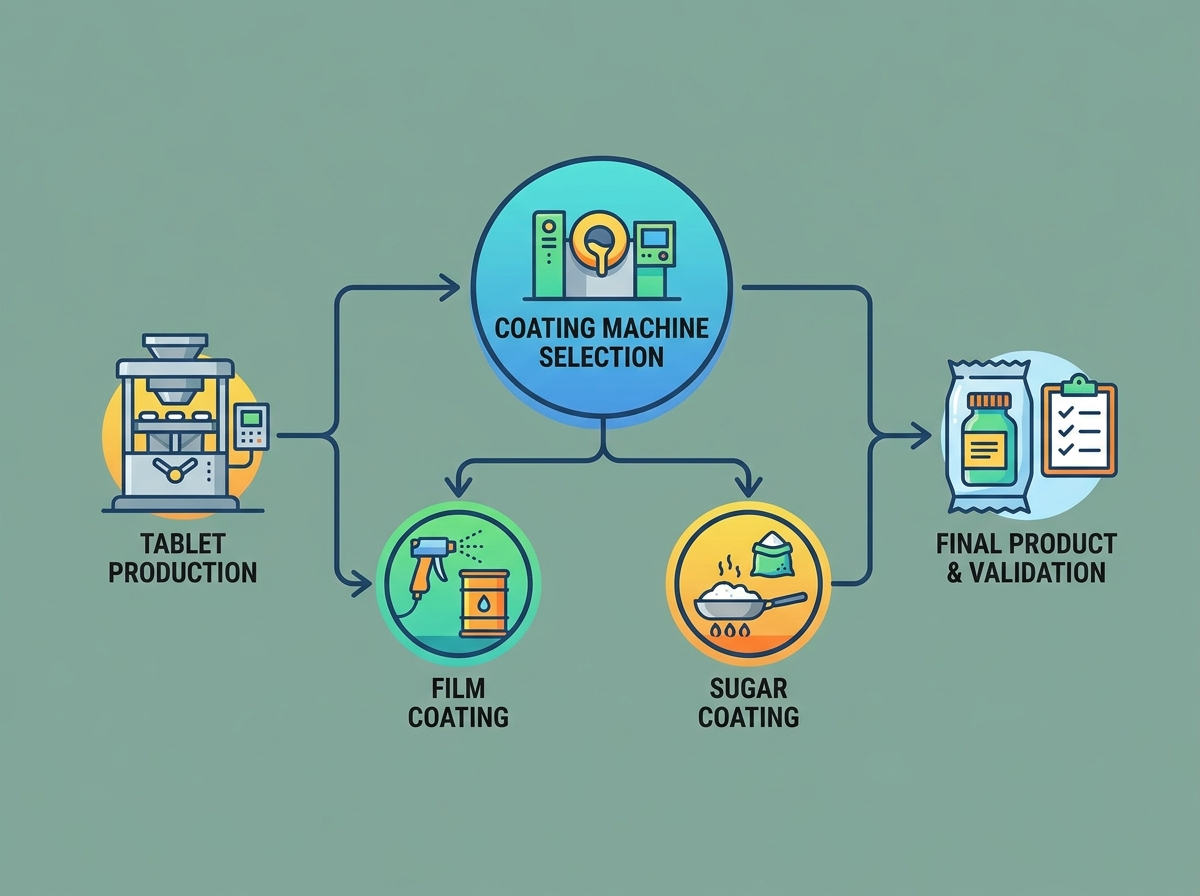
Selecting the right equipment requires a strict technical evaluation of machine thermodynamics, spray precision, batch flexibility, scalability, and validation capabilities. You need a structured framework to evaluate these systems. This ensures your capital expenditure delivers a reliable, compliant, and highly efficient manufacturing process on the production floor.
Match machine thermodynamics and airflow dynamics to the specific types of tablet coating (film, enteric, or sugar) and formulation chemistry (aqueous vs. organic solvents) required for your product portfolio.
Evaluate spray nozzle configurations, fluid delivery pumps, and pan geometry rigorously to mitigate common defects like overwetting, spray drying, or tablet attrition.
Assess batch size flexibility by evaluating minimum and maximum pan working volumes (e.g., 10% to 100% capacity) and multi-pan interchangeable systems.
Prioritize automated Clean-in-Place (CIP) systems and 21 CFR Part 11 compliant controls to reduce changeover downtime and ensure regulatory data integrity.
Leverage manufacturer trial labs and Factory Acceptance Testing (FAT) to validate equipment performance with actual product formulations and tablet geometries prior to procurement.
To master the production floor, you must grasp exactly how a tablet coating machine works. The process relies on a continuous interplay between mechanical tumbling and thermodynamics. The machine rotates a bed of tablets inside a drum. As the tablets cascade down the front face of the bed, atomized coating fluid sprays onto their surfaces. At the exact same time, conditioned drying air pulls through the tablet mass. This air evaporates the solvent or water instantly, leaving a solid polymer film behind.
The moisture balance dictates your success or failure. You must establish a perfect equilibrium between the spray application rate and the thermodynamic drying capacity of the air handling unit. If your spray rate overpowers the drying capacity, the tablets become overwetted. The polymer gets sticky, and tablets glue together in a defect called twinning. If you push too much heat or drop the spray rate too low, the droplets evaporate before they hit the tablet surface. This causes spray drying, leaving a rough, sandpaper-like finish on the cores.
Operators manage several primary process variables to maintain this balance:
Pan Speed: Controls the cascade rate. Too slow causes overwetting; too fast causes edge chipping.
Inlet Air Temperature: Drives the evaporation rate. Must be balanced against the thermal stability of the API.
Exhaust Air Temperature: The primary indicator of the actual tablet bed temperature.
Spray Atomization Pressure: Dictates droplet size. Finer droplets dry faster but risk spray drying.
Gun-to-Bed Distance: Ensures the spray pattern hits the cascading tablets evenly without drying mid-air.
Precise execution of these parameters preserves API stability. Heat-sensitive APIs require high-volume, low-temperature airflows to prevent thermal degradation. Light-sensitive formulations demand perfectly uniform barrier properties. A well-calibrated machine applies a continuous, defect-free film that protects the core tablet under all environmental conditions.
Standard coating pans are the oldest architecture in the industry. They consist of a circular metal pan mounted at an angle. An electric motor rotates the pan while an operator applies the coating solution. Drying air blows across the surface of the tablet bed rather than passing through it.
Manufacturers rarely use these for modern film coating. They remain in service primarily for traditional sugar coating processes or low-budget, non-critical operations. The limitations are severe. Surface-level airflow results in terrible drying efficiency. The process relies entirely on operator skill, which destroys batch-to-batch consistency. Validating the cleaning processes for these older, open designs is nearly impossible under modern GMP standards.
Perforated coating pans are the undisputed industry standard. This architecture dominates modern film and enteric applications. The design features a fully or partially perforated rotating drum housed within a sealed, negative-pressure cabinet. This enclosed system allows for absolute control over the internal environment.
The primary advantage is the airflow dynamics. Perforated pans utilize a through-bed drying mechanism. The air handling unit pushes conditioned air into the drum. The exhaust system pulls this air directly through the cascading tablet mass and out through the perforations. This configuration delivers high-efficiency heat and mass transfer. It allows for aggressive spray rates, massive reductions in cycle times, and highly uniform film distribution.
Fluidized bed coaters abandon mechanical tumbling entirely. They use a high-velocity column of air to lift and suspend the particles in a fluidized state. Spray nozzles apply the coating solution to the suspended particles as they circulate. The fluidizing air stream immediately dries the applied film.
We use these machines for multi-particulate systems. They are ideal for coating pellets, granules, and highly sensitive APIs that shatter in a rotating pan. Fluidized beds eliminate mechanical stress. However, they consume massive amounts of energy to maintain fluidization. Scale-up parameters are notoriously complex, and the high-velocity air can cause particle attrition if the binder is weak.
Different types of tablet coating demand specific equipment capabilities. Film coating requires rapid, uniform drying and tight temperature control. The equipment must prevent moisture from penetrating the tablet core during the initial spray phase. You must assess the machine's ability to handle high-solids formulations. Modern film coatings push 20-30% solids concentrations. The spray system must process these viscous solutions without nozzle clogging to keep cycle times short.
Enteric coating presents stricter mechanical requirements. Enteric polymers protect the API from gastric acid, releasing it only in the intestines. A flawless, continuous polymer layer is mandatory. Even microscopic defects cause premature API release and batch failure. The equipment must provide exceptional spray uniformity and precise thermodynamic control to guarantee acid resistance.
Sugar coating requires a completely different mechanical setup. Machines must handle extremely high-viscosity sucrose solutions. Instead of fine atomization, sugar coating relies on automated dosing tubes or ladling systems. The process takes hours or days. The pan must accommodate heavy tablet beds tumbling for extended durations without causing mechanical damage to the cores.
Formulation chemistry dictates the machine's safety design. Aqueous systems require high CFM drying capacities to evaporate water efficiently. Organic solvent-based coatings demand specialized safety modifications. Machines processing solvents must include nitrogen inerting systems to create closed-loop, oxygen-free environments. All electrical components require explosion-proof ratings. The facility must also integrate solvent recovery units to capture volatile organic compounds before they hit the exhaust stack.
When sourcing a pharmaceutical tablet coating machine, evaluate its turndown ratio immediately. This metric defines the machine's minimum and maximum working capacity. High-end machines offer pan load limits ranging from 10% to 100% of the total volume. Variable-depth pans or interchangeable drum systems support this flexibility. They allow you to execute pilot-scale batches and full-production runs on the exact same base unit, saving floor space and capital.
Scale-up predictive modeling relies on pan geometry. Drum diameter and depth ratios directly affect scale-up calculations. Moving a process from R&D to commercial manufacturing requires consistent linear velocity and bed depth. Equipment that maintains proportional geometry across different scales simplifies validation and drastically reduces development timelines.
Mixing efficiency depends on pan shape and baffle design. Cylindrical pans offer different tumbling dynamics than angular designs. Baffles disrupt the tablet bed, forcing random movement and eliminating dead zones. Common baffle designs include plowshare, rabbit ear, and helical shapes. The correct baffle ensures every tablet passes through the spray zone with equal frequency.
Tablet shape dictates your baffle selection. Deep-concave tablets, flat-faced tablets, oblongs, and caplets interact differently with the pan internals. Poorly matched baffles cause "log-jamming," where tablets slide down the bed rather than tumbling. Sliding leads to severe edge chipping and uneven coating. Analyze your core hardness and shape to select baffles that promote gentle, continuous cascading.
The spray system dictates the final visual and functional quality of the tablet. Scrutinize the atomization and nozzle design. Look for anti-bearding nozzle designs that prevent polymer buildup on the air cap. The system must allow independent control of atomization air and pattern air. Maintaining a consistent gun-to-bed distance across all nozzles prevents localized overwetting.
Pump technologies control fluid delivery. Different formulations require different pumping mechanisms. The table below compares common pump types used in coating operations.
Pump Technology | Primary Advantages | Ideal Applications | Limitations |
|---|---|---|---|
Peristaltic Pumps | Easy to clean, low shear, disposable tubing | Standard aqueous film coatings, shear-sensitive fluids | Pulsation issues at low speeds, tube wear |
Gear Pumps | High precision, smooth continuous flow | Highly viscous solutions, solvent-based coatings | Difficult to clean, high shear can damage some polymers |
Lobe Pumps | Handles high-solids suspensions, low shear | Heavy enteric coatings, sugar syrups | Higher initial cost, complex maintenance |
The Air Handling Unit (AHU) and Exhaust Unit (EXU) are the lungs of the coating machine. Define strict requirements for inlet and exhaust air volume, measured in cubic feet per minute (CFM). Precise humidity control is mandatory. The AHU must control the dew point to ensure consistent drying regardless of ambient weather conditions. Cleanroom integration requires H13 or H14 HEPA filtration on both inlet and exhaust streams.
Energy efficiency impacts your operational expenditure heavily. Heating and cooling large volumes of air consumes massive amounts of electricity and steam. Evaluate energy recovery systems carefully. Heat wheels or run-around coils capture thermal energy from the exhaust air and transfer it to the incoming air. These systems reduce long-term utility costs significantly.
Regulatory compliance demands sophisticated control architecture. Modern machines require Supervisory Control and Data Acquisition (SCADA) integration. Automated recipe management ensures operators run validated parameters consistently without manual overrides. Strict adherence to 21 CFR Part 11 is non-negotiable. The system must secure electronic records, track audit trails, and manage electronic signatures to satisfy FDA auditors.
Real-time monitoring elevates process control. Integrating Process Analytical Technology (PAT) tools allows you to monitor Critical Process Parameters (CPPs) continuously. Sensors track exhaust temperature, air moisture content, and real-time spray rates. Advanced systems automatically adjust inlet temperatures or spray speeds to maintain the thermodynamic equilibrium dynamically.
Cleaning validation remains a major bottleneck in solid dosage manufacturing. Assess the effectiveness of built-in Clean-in-Place (CIP) and Wash-in-Place (WIP) systems. Look for multi-zone spray ball coverage that reaches all internal surfaces, including behind the baffles and inside the exhaust plenum. The machine should feature automated wash recipes to eliminate operator variability. Demand riboflavin coverage test validation during the Factory Acceptance Testing (FAT) to prove cleaning efficacy.
Sanitary design prevents cross-contamination. Identify the risk of dead legs and inaccessible crevices in the ductwork and pan housing. All product contact parts must utilize 316L stainless steel. The surfaces require a highly polished finish, typically Ra < 0.4 µm, to prevent coating buildup and facilitate rapid cleaning.
Scaling up from pilot to production involves non-linear thermodynamic discrepancies. Bed depth increases, altering the pressure drop across the tablet mass. The linear velocity of the drum changes, impacting the cascading dynamics. Drying efficiency often decreases as the batch size grows. You cannot simply multiply pilot parameters to achieve commercial success.
Mitigate these risks via trial labs. Utilize vendor trial labs extensively prior to purchase. Define critical trial milestones before testing begins. Test suspension viscosity limits through the proposed spray nozzles. Verify spray rate boundaries to find the overwetting threshold. Assess tablet core survival rates under mechanical stress in the commercial-sized pan. Evaluate weight gain uniformity across the entire batch.
Infrastructure constraints often derail equipment installation. Outline the physical footprint requirements early in the project. Verify ceiling height clearances for AHU and EXU ducting. Ensure adequate maintenance access clearance around the main cabinet. Confirm your facility can supply the necessary utilities, including clean compressed air, industrial steam, and chilled water at the required flow rates.
Safety ratings require strict attention for specific processes. If the process involves solvent-based coatings, address the requirement for explosion-proof ratings. The equipment must meet ATEX or NEC standards depending on your region. You must also allocate space and utilities for the required solvent recovery systems.
The optimal coating machine balances immediate formulation requirements with long-term scalability, energy efficiency, batch size flexibility, and strict GMP compliance. Selecting the right equipment protects your product and ensures profitable manufacturing yields on the production floor.
Filter potential vendors first by required coating type, solvent compatibility, and batch size range.
Differentiate shortlisted manufacturers based on their spray precision, CIP efficiency, and the availability of robust local technical support.
Compile a comprehensive User Requirement Specification (URS) document detailing all thermodynamic and mechanical needs.
Schedule trial lab testing with your actual tablet cores and coating formulations to validate performance before issuing a purchase order.
A: Ideal pan speed depends on the drum diameter and tablet geometry. Typically, speeds range from 4 to 15 RPM. The goal is to achieve a continuous, smooth cascade without causing tablets to slide or chip. Operators adjust the speed to ensure the tablet bed passes through the spray zone frequently enough to achieve uniform weight gain.
A: Twinning occurs when tablets stick together due to overwetting. To prevent this, increase the inlet air temperature or air volume to enhance drying capacity. Alternatively, reduce the spray rate. Ensuring proper pan speed also helps pull tablets apart before the coating polymer dries completely.
A: Yes, but it requires specific modifications. Sugar coating uses highly viscous syrups that clog standard spray nozzles and pan perforations. You must use specialized dosing tubes instead of atomizing nozzles and ensure the exhaust system can handle the heavy moisture load without clogging the drum perforations.
A: Wash-in-Place (WIP) systems automate the initial wetting and rinsing phases but still require manual intervention for final scrubbing and validation. Clean-in-Place (CIP) systems are fully automated, utilizing high-pressure spray balls, heated detergents, and purified water rinses to clean the equipment to a validated state without manual scrubbing.
A: Gun-to-bed distance determines droplet impact. If the guns are too close, the spray footprint is too narrow, leading to localized overwetting. If the guns are too far, the atomized droplets dry in the heated air before hitting the tablets, causing spray drying and a rough tablet surface.


