 English
Views: 0 Author: Site Editor Publish Time: 2026-08-10 Origin: Site


Tablet coating defects represent a massive operational risk in pharmaceutical manufacturing facilities. A single compromised batch leads to severe material loss, immediate regulatory scrutiny, and extended production downtime. Isolating the root cause of these failures is notoriously difficult on the shop floor. Operators must distinguish between formulation incompatibilities, human error, and the mechanical limitations of the coating equipment itself. Systematic troubleshooting requires a deep understanding of equipment mechanics rather than guesswork. This guide provides a technical framework for diagnosing defects, adjusting process parameters, and evaluating whether your current equipment meets production demands. By mastering the interaction between thermodynamics and mechanical calibration, operators can minimize defects, reduce waste, and ensure consistent batch quality across all production runs.
Thermodynamic Balance is Critical: Most visual and structural defects stem from an imbalance between the spray application rate and the drying capacity (airflow and temperature) of the equipment.
Mechanical Calibration Overrides Formulation: Even optimized coating formulations will fail if pan speed, baffle configuration, and spray gun geometry are not precisely calibrated to the batch size and tablet shape.
Data-Driven Troubleshooting: Resolving defects requires tracking Critical Process Parameters (CPPs) rather than relying on trial and error, ensuring corrective actions are repeatable and compliant.
Equipment Viability: Persistent defects despite process optimization often indicate the need for equipment upgrades, specifically targeting advanced atomization control and automated thermodynamic regulation.
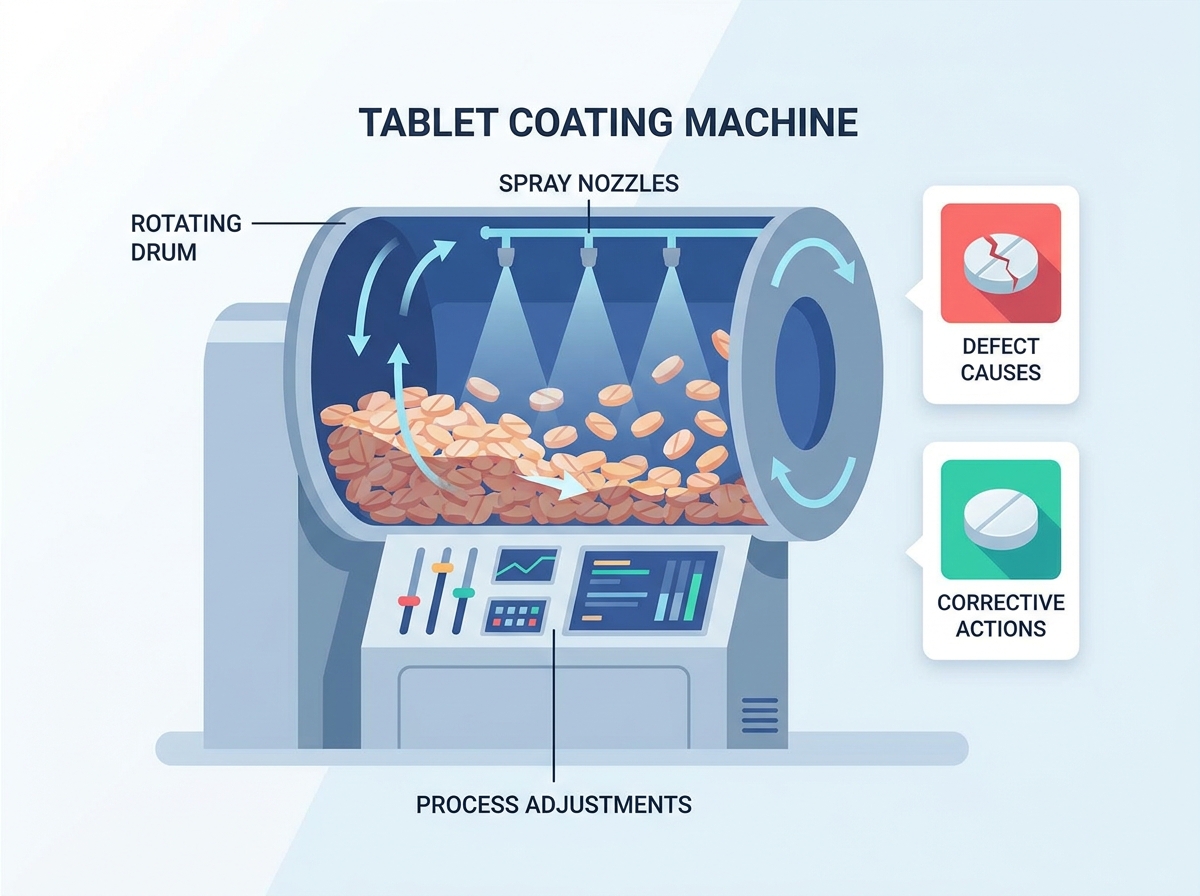
The foundation of defect prevention lies in understanding the tablet coating machine working principle. The core mechanics involve the continuous rotation of the tablet bed within a perforated or solid pan. This rotation is synchronized with the controlled application of a coating solution and concurrent heated airflow. This precise coordination ensures uniform film application across the entire batch. When you operate these machines, you are managing a complex physical environment where fluid dynamics and thermodynamics intersect.
Thermodynamic exchange is central to the process. The machine must balance inlet air temperature, exhaust air humidity, and spray atomization to achieve instantaneous film formation. If the balance shifts even slightly, tablets risk over-wetting or premature drying. Over-wetting leads to sticking and structural degradation, while premature drying causes rough surfaces and poor adhesion. You must monitor the exhaust temperature closely, as it provides the most accurate representation of the actual conditions within the tablet bed.
Spray zone dynamics dictate how the coating adheres to the substrate. Tablet movement velocity impacts the dwell time within the spray zone. A faster pan speed reduces the dwell time per pass. This prevents localized over-wetting but demands highly precise thermodynamic coordination to ensure the thinner layers dry adequately before the next pass. Additionally, inadequate spreading dynamics compromise film integrity. If droplet velocity, surface tension, or machine temperature prevents complete spreading across the tablet face, the resulting film will be uneven and prone to failure.
Critical Process Parameters (CPPs) are the primary machine-controlled variables that dictate batch success. Establishing success criteria requires monitoring these parameters to achieve uniform weight gain, zero visual defects, acceptable friability, and adherence to dissolution profiles. Relying on visual inspection alone is insufficient; you need hard data from the machine's sensors.
Critical Process Parameter (CPP) | Primary Function | Defect Risk if Uncalibrated |
|---|---|---|
Pan RPM (Speed) | Controls bed turnover and dwell time in the spray zone. | Twinning, edge wear, uneven coating thickness. |
Spray Rate | Determines the volume of coating solution applied over time. | Sticking, picking, prolonged batch times. |
Atomizing Air Pressure | Controls droplet size of the coating solution. | Orange peel, spray drying, bridging. |
Inlet Air Temperature | Provides the thermal energy required for solvent evaporation. | Blistering, cracking, over-wetting. |
Airflow Volume (CFM) | Removes evaporated solvent and maintains bed temperature. | High humidity in pan, poor film formation. |
Sticking and picking occur when tablets adhere to each other or the pan walls, resulting in missing film fragments upon separation. On the production floor, you will notice small craters or divots on the tablet surface. This defect is typically caused by localized over-wetting due to an excessive spray rate, inadequate inlet air temperature, or insufficient atomization pressure. When the liquid application exceeds the drying capacity, the tablet surface remains tacky for too long.
Decrease the fluid delivery rate at the spray pump to reduce the volume of liquid hitting the bed.
Increase atomizing air pressure to reduce droplet size, allowing for faster evaporation.
Elevate the drying air temperature to accelerate the thermodynamic drying phase.
Verify that the exhaust airflow is not restricted, ensuring moisture is actively pulled from the pan.
Twinning involves two or more tablets permanently adhering to one another. This problem is most common with flat-faced or capsule-shaped tablets that have large flat surface areas. The root cause is often an inappropriate pan speed that fails to separate the tablets during the tacky phase of film formation. Suboptimal spray gun positioning can also cause localized pooling of the coating solution, acting as an adhesive between tablets.
Increase pan speed to enhance mechanical separation and force the tablets to tumble more aggressively.
Adjust the spray angle to prevent pooling and ensure an even distribution across the bed surface.
Evaluate the tablet punch design for convexity; adding a slight curve to the tablet face significantly reduces twinning risk.
An orange peel defect presents as a bumpy, uneven coating texture that resembles the skin of an orange. It is caused by poor droplet coalescence and inadequate spreading of the coating solution before drying. This happens when droplets dry prematurely before striking the tablet bed, or when excessively high atomization pressure causes rapid evaporation of the solvent in mid-air.
Decrease atomization pressure to create slightly larger droplets that retain moisture longer.
Lower the inlet air temperature to slow down the evaporation rate upon contact.
Slightly increase the spray rate to provide more liquid volume, aiding in droplet spreading.
Decrease the distance between the spray nozzle and the tablet bed to reduce mid-air travel time.
Spray drying results in the physical loss of coating material as dried polymer dust in the exhaust system or on the tablet bed. This leads to a dull, rough finish and incorrect weight gain. Excessively high atomizing air pressure, excessive gun-to-bed distance, or over-efficient heating that evaporates the solvent before droplet contact are the primary culprits. You will often see a fine dust coating the inside of the pan housing.
Decrease atomization pressure immediately to stop the formation of ultra-fine droplets.
Move the spray gun closer to the tablet bed, ensuring the spray pattern hits the target zone directly.
Optimize the balance of inlet temperature versus spray rate to ensure droplets remain liquid until impact.
Blistering and cratering manifest as film detachment, localized bubbles, or crater-like ruptures on the tablet surface. These defects result from the entrapment of gases or moisture due to excessively high drying temperatures. When the exterior film cures too rapidly, internal moisture expands and ruptures the coating. This is a clear sign of thermal imbalance.
Reduce the inlet air temperature to slow the curing process of the outer film layer.
Implement a gradual cooling phase post-coating rather than an abrupt temperature drop.
Ensure the core tablet is adequately dried before the coating process begins, checking moisture content specifications.
Bridging occurs when the film pulls away from the sharp contours of debossed lettering or logos, obscuring regulatory markings. High internal stress in the curing film, an excessive spray rate, or inadequate atomization failing to drive droplets into the recesses cause this defect. The coating essentially forms a bridge over the indentation rather than following its contours.
Increase atomization air pressure to drive smaller droplets deep into the debossed crevices.
Optimize drying temperatures to reduce internal film stress during the curing phase.
Adjust formulation plasticizer ratios if mechanical process calibration fails to relieve film tension.
Cracking and splitting present as visible fractures running across the crown or around the edges of the coated tablet. Internal tensile stress in the film exceeding its tensile strength triggers this. It is often due to mismatched thermal expansion coefficients between the core and coat during rapid heating or cooling cycles. The core expands or contracts at a different rate than the film, causing it to tear.
Implement slower, more gradual heating and cooling ramp rates within the equipment.
Increase the solid concentration of the coating suspension to build a stronger film layer.
Modify formulation elasticity by adjusting the polymer-to-plasticizer ratio.
Mechanical wear, chipped edges, or complete crumbling of the core tablet during pan rotation define this defect category. Excessive mechanical stress from high pan RPM, aggressive baffle designs, soft tablet cores, or initial over-wetting softening the core before film formation are the root causes. You will find excessive dust and broken tablet fragments in the pan.
Reduce pan speed to lower the kinetic energy and impact forces within the tumbling bed.
Optimize baffle configuration for a gentler cascade, avoiding sharp drops.
Apply an initial seal coat at very low spray rates to protect the core before applying the main functional coat.
Ensure core tablets meet strict hardness and friability specifications before loading them into the pan.
Color variation and mottling appear as inconsistent color distribution across a single tablet or throughout the batch. Uneven spray distribution, overlapping spray patterns, or insufficient mixing within the tablet bed cause this issue. If the guns are not aligned properly, some areas of the bed receive more coating than others.
Calibrate spray gun geometry to ensure proper overlap without interference or heavy zones.
Increase pan speed slightly to promote better bed turnover and random mixing.
Verify solid suspension homogeneity in the holding tank, ensuring pigments are not settling.
Assessing equipment capability is essential for long-term defect prevention. Evaluate whether your current equipment allows for independent control of atomizing and pattern air. A lack of this feature severely limits your ability to resolve edge wear, spray drying, and orange peel defects. Older machines often tie these air supplies together, forcing operators to compromise on droplet size and spray width. Upgrading to a tablet coating machine with independent air controls provides the precision needed for complex formulations.
Furthermore, evaluate the airflow design. Compare fully perforated pans versus conventional solid pans. Fully perforated designs pull air directly through the tablet bed, drastically improving thermodynamic efficiency and reducing defect rates associated with over-wetting. If your current machine struggles to maintain exhaust temperatures during high spray rates, the airflow design may be the limiting factor.
Scalability introduces conceptual trade-offs. Increasing the spray rate to shorten batch time inherently increases the risk of sticking and twinning. Analyzing how lab-scale parameters translate to production-scale machines highlights non-linear scaling challenges. What works in a 10-liter pan rarely translates directly to a 300-liter pan without significant adjustments to spray gun distance and airflow volumes. Upgrading equipment to models with advanced automation and precise thermodynamic controls often proves necessary when process adjustments fail to eliminate persistent defects at scale.
Audit your current spray gun calibration, ensuring atomizing and pattern air pressures are independently verified before every batch.
Establish a strict pre-heating protocol to ensure the tablet bed reaches the target thermodynamic state before initiating the spray sequence.
Implement a standardized visual inspection routine at 15-minute intervals during the coating phase to catch early signs of twinning or orange peel.
Review your core tablet hardness data to confirm that mechanical edge wear is a coating process issue rather than an upstream compression failure.
A: Twinning is primarily caused by an inappropriate pan speed that fails to separate tablets during the tacky phase of film formation. Suboptimal spray gun positioning and flat-faced tablet designs also contribute to tablets sticking together permanently.
A: The orange peel effect is caused by inadequate droplet spreading. Fix it by decreasing atomization pressure, lowering the inlet air temperature, slightly increasing the spray rate, or moving the spray nozzle closer to the tablet bed.
A: Cracking results from internal tensile stress exceeding the film's strength, often due to rapid heating or cooling cycles that cause mismatched thermal expansion between the core and the coat. Implement gradual heating and cooling ramp rates to resolve this.
A: Spray drying occurs when coating material evaporates before hitting the tablets, creating polymer dust. This is caused by excessively high atomizing air pressure, too much distance between the gun and the bed, or excessively high inlet temperatures.
A: Bridging happens when the film pulls away from debossed logos. Prevent it by increasing atomization air pressure to drive droplets into crevices, optimizing drying temperatures to reduce film stress, or adjusting the formulation's plasticizer ratio.


