 English
Views: 0 Author: Site Editor Publish Time: 2026-07-30 Origin: Site


Unresolved tableting defects cause severe financial and compliance headaches for pharmaceutical and nutraceutical manufacturers. Batch rejections, failed friability tests, and unexpected machine downtime directly impact profitability and production schedules. Diagnosing defects like capping, sticking, lamination, weight variation, chipping, and cracking during scale-up is notoriously complex. The root cause often hides within the formulation rheology, tooling condition, or specific machine parameters. Operators frequently struggle to identify whether a defect stems from poor powder flow or incorrect mechanical settings.
To solve these issues, operators need a systematic, evidence-based framework for isolating variables on the equipment. By systematically adjusting parameters, you can restore production yield and maintain structural integrity. This methodical approach eliminates guesswork on the production floor. It also helps plant managers determine if immediate process optimization is sufficient or if equipment upgrades are strictly required to meet production demands.
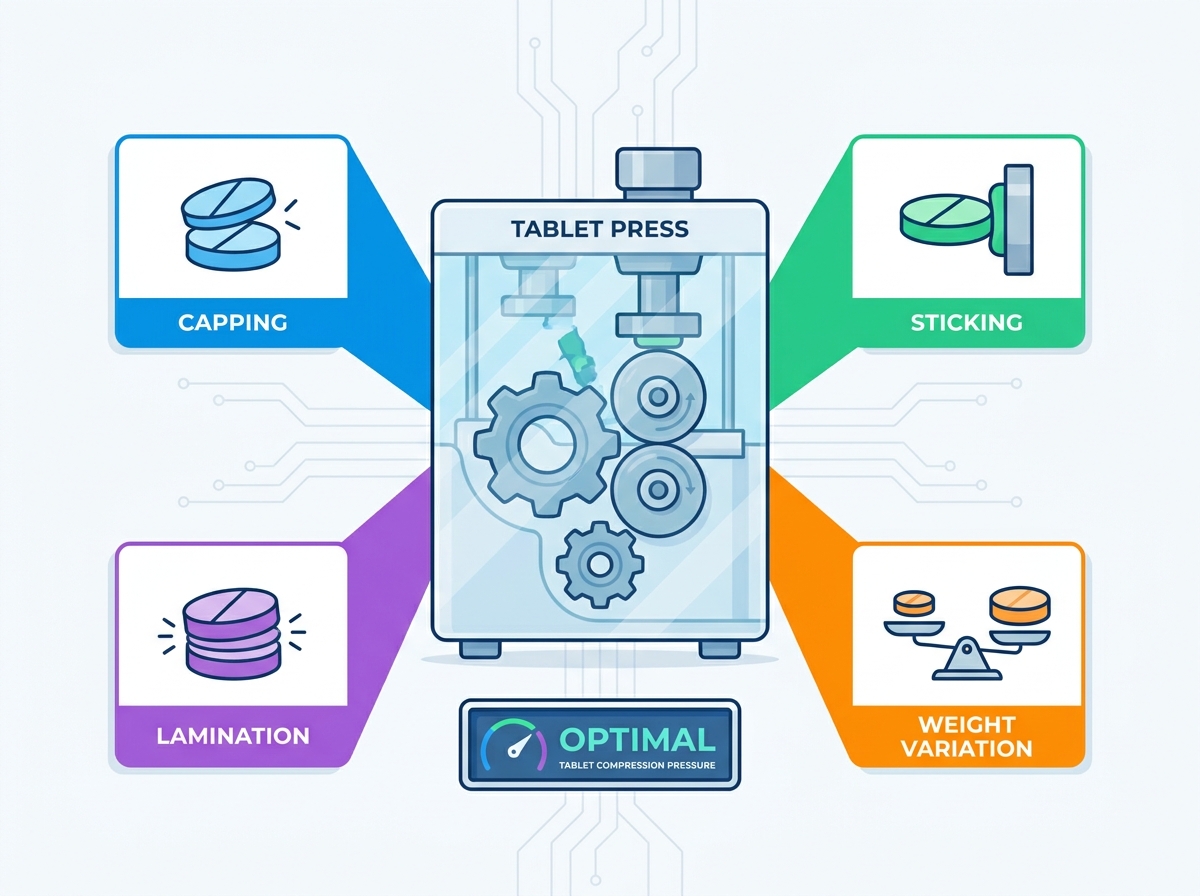
Capping and lamination are frequently driven by entrapped air, insufficient dwell time, and poor interparticle bonding; optimizing pre-compression and main tablet compression pressure is the primary mechanical defense.
Sticking and picking often require a dual approach: managing environmental humidity/granule moisture and evaluating specialized punch tip coatings or polishing protocols.
Weight variation at high operational speeds is typically a flowability or feeder issue, requiring precise calibration of the fill cam and paddle speeds.
Resolving chronic defects requires evaluating the trade-off between continuous formulation tweaks and investing in a modern tablet press with automated force control and advanced ejection monitoring.
High-volume production environments require strict definitions for acceptable tablet defects. Success criteria must align with pharmacopeial standards and internal quality thresholds. Even a minor deviation in tablet integrity can trigger a massive batch rejection. Regulatory bodies mandate rigorous friability and weight uniformity tests. Failing these tests results in immediate quarantine of the product. This halts the supply chain and forces costly investigations into the manufacturing process. You cannot afford to ignore minor defects during the initial compression phase.
Pushing older equipment to maximum rotational speeds exponentially increases defect rates. Operators often increase the turret RPM to meet aggressive production quotas. However, this reduces the die fill time and the compression dwell time. The trade-off between yield and speed becomes apparent when Overall Equipment Effectiveness (OEE) plummets due to constant machine jams and rejected tablets. Operating a machine beyond its optimal kinematic limits generates excessive heat and vibration. This accelerates tooling wear and exacerbates powder flow issues.
Micro-defects lead to catastrophic failures during downstream processes. Minor lamination, micro-cracks, and edge chipping might pass initial visual inspections. However, these structural weaknesses reveal themselves during film coating, dedusting, or blister packaging. In a coating pan, tablets with micro-cracks will split open under the mechanical stress and thermal load. This ruins the entire coating batch and wastes expensive active pharmaceutical ingredients. Ensuring perfect structural integrity at the compression stage is non-negotiable for downstream success.
Visual inspection failure at the press requires immediate sorting and quarantine.
Friability test failures indicate weak interparticle bonding, leading to dust generation in packaging lines.
Coating pan fractures ruin entire batches due to thermal and mechanical stress on compromised tablet cores.
Blister packaging jams occur when chipped tablets fail to seat properly in the formed cavities.
Understanding the physical difference between capping and lamination is the first step in troubleshooting. Capping occurs when the upper or lower crown of the tablet separates from the main body. Lamination refers to horizontal striations or splitting within the tablet body itself. Both defects share similar root causes but manifest differently depending on the punch profile and ejection forces.
Formulation triggers often involve poor powder characteristics. Excessive fines in the granulation trap air easily. Low moisture content reduces the plasticity of the binder. Poor interparticle bonding prevents the granules from locking together under pressure. Insufficient binder active dry weight leaves the tablet without the necessary internal glue to maintain its shape after compression. You must evaluate the particle size distribution before blaming the machine.
Mechanical triggers are equally responsible for these defects. Deep concave punches create a steep density gradient within the tablet, making the edges prone to capping. Worn tooling with hooked edges pulls at the tablet surface during ejection. Improper die setup, where the die is not perfectly flush with the table, causes uneven stress distribution. Isolating whether the issue is the powder or the machine dictates the corrective action.
Defect Type | Primary Formulation Cause | Primary Mechanical Cause | Immediate Action |
|---|---|---|---|
Capping | Excessive fines trapping air | Deep concave punch profiles | Increase pre-compression force |
Lamination | Over-drying of granules | Worn ejection cams | Reduce main compression speed |
Chipping | Lack of adequate binder | Improper punch-to-die clearance | Adjust take-off bar height |
Air entrapment and elastic recovery dictate the success of the compression cycle. As the punches enter the die, they compress the powder bed. If the air cannot escape fast enough, it becomes pressurized within the tablet matrix. Upon ejection, this pressurized air expands, causing the tablet to cap or laminate. Elastic recovery occurs when the particles spring back to their original shape after the compression force is removed.
Insufficient tablet hardness indicates a failure to transition from elastic deformation to plastic deformation. When particles do not plastically deform, they fail to create solid interparticle bonds. This lack of bonding leads directly to capping. Adjusting the tablet compression pressure is required to push the material past its elastic limit. However, sheer force is not always the answer. Over-compressing can shatter the granules.
Pre-compression force consolidates the powder bed and evacuates air before the main compression event. Applying a lighter initial force gently tamps the powder, allowing trapped air to escape around the upper punch tip. The relationship between main pressure, machine speed, and dwell time is delicate. Dwell time is the fraction of a second the punches remain at maximum displacement. Simply increasing pressure can exacerbate capping if the dwell time is too short to allow plastic flow. Slowing the press down increases dwell time, giving the particles time to bond permanently.
Tapered dies significantly reduce radial expansion stress during tablet ejection. A tapered die has a slightly wider diameter at the top. As the lower punch pushes the tablet upward, the taper allows the tablet to expand gradually rather than violently upon exiting the die. This gradual expansion prevents the sudden stress release that causes capping.
Inspecting punch head profiles and ejection cams is vital for smooth operation. Wear on the punch heads alters the dwell time and causes inconsistent compression profiles. Worn ejection cams create a jerky, aggressive ejection motion. This mechanical shock can fracture an otherwise perfect tablet. Regular maintenance and polishing of these mechanical pathways ensure a smooth transition from compression to ejection.
Chipping involves breakage at the tablet edges, while cracking refers to fine fissures on the top or bottom surface. These defects compromise the tablet's structural integrity and aesthetic appeal. They also create weak points that fail during coating or packaging. You will often see chipping when the tablet hits the take-off bar too hard.
Improper clearance between the punch and die wall causes mechanical shear. If the clearance is too tight, air cannot escape. If it is too loose, powder flashes between the punch and die, causing binding and edge chipping. High ejection forces also cause mechanical shear as the tablet scrapes against a rough die wall.
Corrective actions require precise mechanical adjustments. Adjust the take-off bar to ensure it gently guides the tablet off the turret without striking it too hard. Lubricate the formulation adequately to reduce die wall friction. Optimize the upper-punch penetration depth to ensure the compression event happens at the correct height within the die, minimizing the travel distance during ejection.
Sticking occurs when powder adheres to the flat punch face, leaving a dull or pitted tablet surface. Picking is a specific form of sticking where powder adheres within the enclosed areas of embossed letters or logos. Both defects ruin the visual identity of the product and can affect dosage accuracy if significant material is lost.
Evaluating granule moisture content is the first diagnostic step. Overly wet granules act like an adhesive under pressure. Conversely, overly dry granules generate static electricity, which also causes powder to cling to the metal tooling. Binder distribution must be uniform; localized concentrations of binder will stick immediately to the punch face.
The melting point of Active Pharmaceutical Ingredients (APIs) plays a massive role. Compression generates significant friction and heat. Low-melting-point APIs can soften or melt during the compression cycle, fusing directly to the punch tip. Controlling the ambient room temperature and humidity is essential to prevent environmental moisture from exacerbating these rheological issues.
Standard steel tooling often struggles with sticky formulations. Upgrading to specialized anti-stick coatings provides a mechanical barrier. Hard chrome plating offers a smooth, durable surface. Chromium nitride provides excellent wear resistance and anti-stick properties. Specialized polymer coatings offer the lowest coefficient of friction but require careful handling to prevent scratching.
Tooling Surface Type | Primary Advantage | Best Use Case | Maintenance Requirement |
|---|---|---|---|
Standard S7/D2 Steel | Cost-effective, highly durable | Standard, non-sticky formulations | Routine polishing and lubrication |
Hard Chrome Plating | Corrosion resistance, smooth finish | Moderately sticky, abrasive powders | Careful handling to avoid flaking |
Chromium Nitride (CrN) | High hardness, excellent anti-stick | High-volume, sticky API production | Requires specialized recoating |
Polymer/Teflon Coatings | Lowest friction coefficient | Extremely sticky, low-melting APIs | Strictly non-abrasive cleaning only |
Standard operating procedures for punch face polishing are critical. Micro-abrasions on the punch face act as anchor points for powder. Regular polishing using automated drag finishing or manual diamond paste restores the mirror finish. Proper maintenance prevents the gradual buildup of material that eventually leads to severe sticking and picking.
Inspect punch faces under magnification for micro-abrasions.
Apply diamond polishing paste using a soft felt bob.
Use an automated drag finishing machine for consistent surface restoration.
Clean tooling thoroughly with isopropyl alcohol to remove polishing residue.
Store tooling in a climate-controlled environment with rust-preventative oil.
Altering compression parameters impacts localized heat generation. High speeds and high pressures generate more heat. If sticking occurs, reducing the machine speed lowers the operating temperature of the tooling. Decreasing the main compression force slightly can also reduce the heat generated by friction, preventing low-melting-point APIs from fusing to the metal.
Specialized punch designs minimize picking risks. Adjusting the embossing draft angle makes the letters wider at the surface and narrower at the base. This taper allows the powder to release easily from the logo cavity. Modifying the font style to eliminate enclosed spaces drastically reduces picking occurrences.
Weight variation predominantly occurs during scale-up or at higher press speeds due to insufficient die fill time. As the turret spins faster, the die spends less time under the feeder. If the powder does not flow perfectly, the die will not fill completely or consistently. This results in tablets with varying weights, which directly translates to varying dosage strengths.
Evaluating the feeder system is required for maintaining consistent weights. Gravity feeders rely entirely on the powder's natural flowability. They work well for highly flowable, dense granules at moderate speeds. Force feeders, or paddle feeders, use rotating paddles to actively push powder into the dies. They are essential for high-speed production and poorly flowing powders.
Matching paddle speed to powder flow characteristics prevents over-mixing or segregation. If the paddles spin too fast, they can over-lubricate the blend or cause particle size segregation, leading to weight and hardness variations. If they spin too slowly, they fail to fill the dies adequately. Paddle speed must be calibrated specifically for each formulation.
Mechanical inspection of the fill cam size dictates the initial volume of powder drawn into the die. The fill cam pulls the lower punch down, creating a vacuum that sucks powder in. If the fill cam is too shallow, the die will not receive enough powder, regardless of the feeder's efficiency. Ensure the correct fill cam is installed for the target tablet weight.
Scraper blade tension ensures excess powder is cleanly removed from the die table. A worn or improperly tensioned scraper blade leaves a film of powder on the table. This powder is then compressed into the tablet, causing weight spikes. Worn tail over die covers or improper clearance allows powder to splash out of the die before compression, leading to low tablet weights.
Manual weight checks are insufficient for modern high-speed production. Relying on an operator to weigh a sample every fifteen minutes leaves thousands of tablets unverified. Automated presses equipped with strain gauges and compression force monitoring evaluate every single tablet. They measure the force required to compress the powder, which correlates directly to the tablet weight.
Modern presses use main compression force variance to automatically reject out-of-spec tablets. If the force is too high, the tablet is too heavy. If the force is too low, the tablet is too light. The machine's software tracks these variances and adjusts the fill depth in real-time. This closed-loop feedback system guarantees weight uniformity without requiring constant manual intervention.
Production managers need a clear decision framework to evaluate overall value influencing factors. If defects persist after replacing worn tooling, optimizing paddle speeds, and adjusting pre-compression, the limitation is likely mechanical. Outdated feeder designs, lack of pre-compression capabilities, or poor structural rigidity cannot be fixed with formulation tweaks.
Compare the ROI of retrofitting older machines against investing in a modern tablet press. Aftermarket instrumentation can add force monitoring to older equipment. However, it cannot add physical pre-compression stations or increase the turret's pitch circle diameter to improve dwell time. A modern machine with built-in instrumentation, longer dwell-time capabilities, and automated force control often provides a faster return on investment through increased yield and reduced downtime.
Changing tooling coatings, altering compression parameters, or installing new equipment involves strict validation hurdles. Risk mitigation requires executing thorough Installation Qualification (IQ), Operational Qualification (OQ), and Performance Qualification (PQ) protocols. You must prove that the new parameters or equipment consistently produce tablets that meet all quality specifications.
Conducting scale-up trials on a pilot press is vital. The pilot press must accurately mimic the kinematics of the production-scale machine. Testing a formulation on a slow, single-station eccentric press provides zero useful data for a high-speed rotary press. Ensure the pilot equipment matches the turret speed, punch head profile, and feeder design of your main production line to guarantee seamless scale-up.
Execute IQ to verify the machine is installed according to manufacturer specifications.
Perform OQ to test the machine's operational limits, including maximum turret speed and force control accuracy.
Complete PQ by running three consecutive commercial-scale batches to prove process stability.
Document all parameter changes in the batch record to maintain regulatory compliance.
Tablet compression defects are rarely caused by a single machine setting. Problems such as capping, lamination, sticking, chipping, and weight variation usually result from the interaction between formulation characteristics, powder behavior, tooling condition, environmental factors, and compression parameters.
The most effective troubleshooting approach is to identify the true source of the defect before making adjustments. Improving powder flow, optimizing pre-compression and dwell time, maintaining punch and die quality, and monitoring compression forces can often restore tablet quality without unnecessary equipment changes. However, when recurring defects exceed the capabilities of existing machinery, investing in modern presses with better force control, monitoring systems, and improved mechanical design may provide greater long-term value.
Consistent tablet production requires a balance between process optimization and equipment capability. By using data-driven evaluation rather than trial-and-error adjustments, manufacturers can improve yield, reduce downtime, and maintain reliable product quality.
A: Capping occurs when the top or bottom crown of the tablet separates from the main body during or immediately after ejection. Lamination is the separation of the tablet into two or more distinct horizontal layers within the main body. Both are typically caused by entrapped air or insufficient plastic deformation.
A: Insufficient pressure fails to create solid interparticle bonds, leading to capping. However, excessive pressure applied too quickly can trap air and cause elastic recovery upon ejection, which also causes capping. Balancing pressure with adequate dwell time is essential.
A: Low hardness indicates that the powder particles have not plastically deformed enough to lock together. Without these strong internal bonds, the tablet cannot withstand the mechanical stress of ejection or the expansion of trapped air, causing it to split or cap.
A: Chipping and cracking are primarily caused by mechanical shear. This results from worn tooling, improper punch-to-die clearance, rough die walls, or excessive ejection force. Improper take-off bar adjustment can also physically strike the tablet and cause edge chipping.
A: Higher speeds reduce the time the die spends under the feeder. If the powder flowability is poor or the paddle feeder is not calibrated correctly, the die will not fill completely or consistently in that shortened timeframe, resulting in erratic tablet weights.
A: You can prevent sticking by polishing punch faces to a mirror finish, upgrading to anti-stick tooling coatings like Chromium Nitride, controlling room humidity, and reducing press speed to lower the frictional heat generated during compression.


