 English
Views: 0 Author: Site Editor Publish Time: 2026-08-21 Origin: Site


The pharmaceutical packaging process carries zero margin for error; equipment failure or integration bottlenecks directly impact product integrity, regulatory compliance, and market availability. Scaling production requires transitioning from isolated machines to cohesive systems, but evaluating the vast array of machinery—from precision counters to high-speed cartoners—presents significant capital and operational risks. This guide breaks down the essential components of packaging systems, providing a technical evaluation framework to help procurement and engineering teams shortlist machinery based on GMP design, throughput, and integration capabilities.
System Integration is Critical: Building complete packaging production lines requires seamless pneumatic, electrical, and software (SCADA/MES) compatibility between primary filling and secondary cartoning stages.
Compliance Drives Design: Equipment must meet stringent GMP standards, featuring tool-less changeovers, 316L stainless steel contact parts, and FDA 21 CFR Part 11 compliant data management.
Cartoning Complexity: Secondary packaging often dictates line speed; selecting the right cartoning equipment (vertical, horizontal, or top-load) depends heavily on the primary container type (vials, blisters, or bottles).
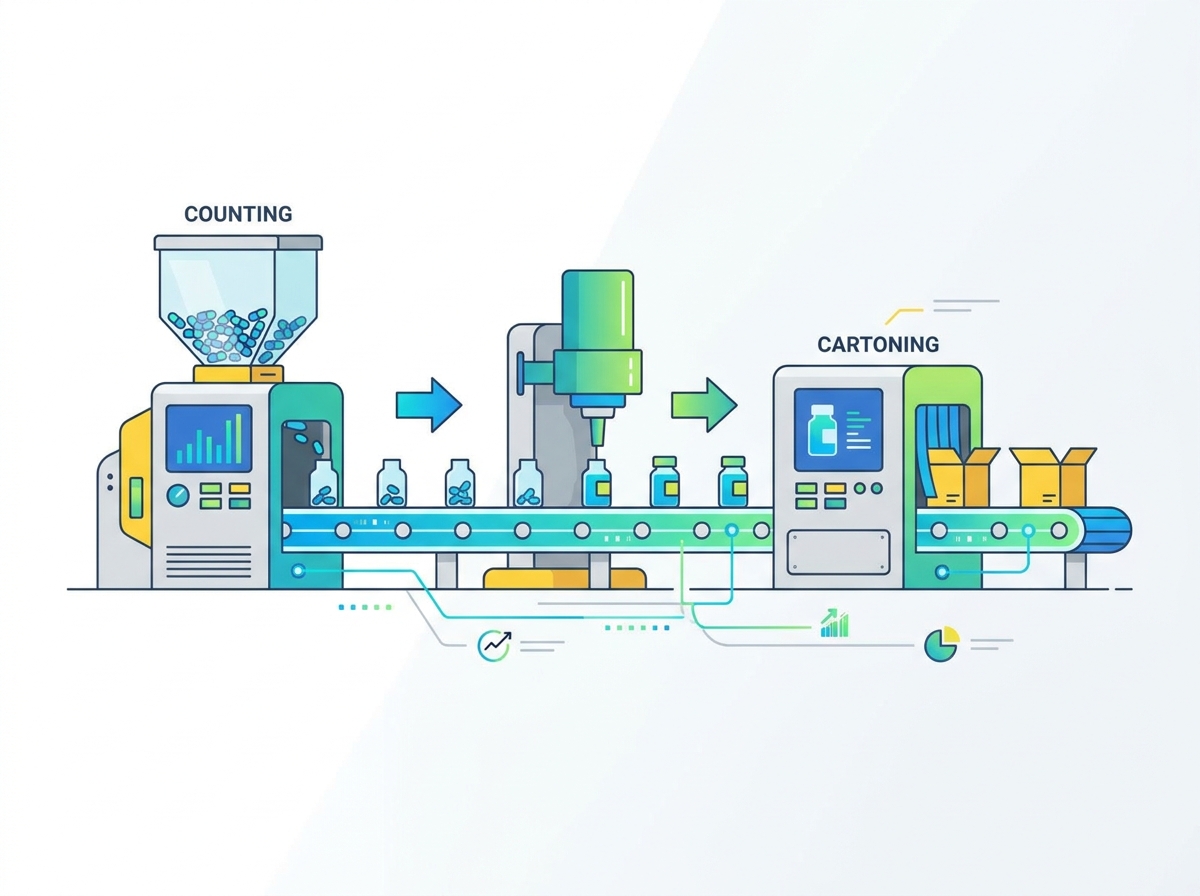
Understanding the workflow is the first step in line design. You must clearly delineate between primary packaging and secondary or tertiary packaging. Primary packaging involves direct product contact. This includes counting, filling, and blister packing. Secondary and tertiary packaging handle the outside containers. This covers cartoning, bundling, and case packing. The physical separation of these zones is often mandated by cleanroom classifications, requiring pass-through mechanisms and strict environmental controls.
Establishing baseline metrics ensures successful line integration. Overall Equipment Effectiveness (OEE) is your primary success criterion, measuring availability, performance, and quality. You must also evaluate footprint constraints and cross-machine synchronization. Buffering systems, or accumulators, play a massive role here. They prevent minor faults on one machine from stopping the entire line. A well-designed accumulator table between a filler and a cartoner can absorb three to five minutes of production, allowing operators to clear a downstream jam without halting the upstream filling process.
You face a choice between modular and turnkey systems. Sourcing best-of-breed individual machines offers specialized performance for highly specific product types. However, purchasing pre-integrated complete packaging production lines from a single OEM reduces integration risks. Single-source lines often feature unified control panels, standardized spare parts, and a single point of accountability during the Factory Acceptance Test (FAT).
System Approach | Advantages | Disadvantages | Best Application |
|---|---|---|---|
Modular (Best-of-Breed) | Maximum performance for specific tasks; highly customizable. | Complex integration; multiple vendor interfaces; higher risk of communication faults. | Specialized products requiring unique handling (e.g., complex auto-injectors). |
Turnkey (Single OEM) | Seamless integration; unified HMI; single point of contact for support. | May compromise on absolute top speed for specific individual stations. | Standard solid dose or liquid filling lines requiring rapid deployment. |
Counting accuracy defines solid dose packaging success. Modern machines use optical sensor technology. Multichannel infrared counters detect falling products and ignore dust. These systems use advanced algorithms to calculate the exact mass and shape of the product as it passes through the sensor window, ensuring that broken tablets or overlapping capsules are correctly identified and rejected. Older or simpler systems use mechanical slat counting mechanisms, which are robust but require extensive format parts for different product sizes.
Evaluate these machines on strict dimensions. Target a 100% accuracy rate. Dust extraction capabilities are non-negotiable for uncoated tablets, as excessive dust will blind optical sensors and cause false counts. Active bottle rejection systems must catch any miscounts before they proceed to the capper. The equipment must handle difficult formats easily. This includes translucent softgels, which can confuse standard optical sensors, and heavily dusting tablets that require continuous vacuum extraction.
Liquid and powder machinery handles vials, ampoules, syringes, and bottles. The application scope dictates the technology. You must match the pump type to the product characteristics. Aseptic filling requires strict adherence to laminar airflow and isolator integration to maintain sterility.
Peristaltic pumps work best for shear-sensitive liquids and biological products. They keep the product inside the tubing, ensuring high sterility and making changeovers as simple as swapping a disposable tube set. Piston pumps offer high precision for viscous liquids, syrups, and creams, utilizing stainless steel cylinders to drive exact volumes. Powder filling often relies on auger systems or vacuum-dosing wheels to maintain accurate fill weights, requiring sophisticated dust control and humidity management to prevent clumping.
Blister lines protect individual doses from moisture, light, and contamination. Thermoforming equipment uses heat to form cavities in PVC, PVDC, or similar plastics. This method is cost-effective and allows for transparent cavities, making visual inspection easier. Cold forming equipment uses mechanical pressure to form cavities in Alu/Alu foil. Cold forming offers maximum barrier protection against moisture and oxygen but requires a larger footprint and yields fewer blisters per square meter of material.
Scalability depends on the sealing mechanism. Platen sealing uses flat plates and operates intermittently. It suits medium speeds and complex cavity shapes, providing a longer dwell time for the seal. Rotary sealing uses heated rollers for continuous motion. This is the standard for high-speed production requirements, allowing for rapid throughput but requiring precise tension control of the web materials.
Once filled, containers require immediate and secure closure to maintain product integrity. Chuck cappers grip the cap and apply rotational force, offering precise torque control for individual bottles. Spindle cappers use spinning discs to tighten caps as bottles move down the conveyor, which is excellent for continuous high-speed operations. Induction sealers apply a hermetic foil seal across the bottle opening using an electromagnetic field, providing tamper evidence and extending shelf life.
Quality control integration is mandatory at this stage. Torque monitoring systems ensure caps are neither too loose (risking leaks) nor too tight (making it difficult for patients to open). Reject mechanisms must immediately remove improperly sealed, cross-threaded, or missing-cap containers from the line. These reject stations typically use high-speed pneumatic pushers to divert faulty bottles into a locked bin for quality assurance review.
Labeling carries heavy regulatory weight. You must integrate Track & Trace and serialization modules directly into the labeling station. Print engines, whether thermal transfer or laser, apply unique 2D datamatrix codes, lot numbers, and expiration dates. These codes ensure supply chain visibility and anti-counterfeiting compliance, requiring seamless communication with site-level MES software.
Application precision determines label quality. Wrap-around labeling suits round bottles, utilizing a motorized belt to spin the bottle against the label web. Front-and-back labeling applies to flat or oval containers, requiring precise alignment modules to center the bottle before application. The system must achieve zero-defect application at high speeds. Optical verification cameras confirm label presence, placement accuracy, and printed data legibility, rejecting any container that fails the vision inspection.
Secondary packaging often dictates the overall speed of your line. Choosing the right cartoner prevents bottlenecks and ensures smooth downstream operations.
Vertical Cartoners: These are best for gravity-fed products like bottles, jars, and vials. They often accommodate manual or semi-automatic insertion for shorter runs and clinical trials.
Horizontal Cartoners: These systems are optimal for high-speed, fully automated insertion. They handle blister stacks, vials, and tubes using continuous or intermittent motion, pushing the product horizontally into the open carton.
Top-Load Cartoners: Ideal for complex multi-component kits, auto-injectors, and medical devices. They use robotic pick-and-place arms to load fragile products into flat blanks that are erected into trays or cartons.
Cartoner Type | Best For | Insertion Method | Typical Speed |
|---|---|---|---|
Vertical | Bottles, Jars, Vials | Gravity / Manual | Low to Medium (50-150 cpm) |
Horizontal | Blisters, Tubes, Trays | Automated Pusher | High (150-400+ cpm) |
Top-Load | Kits, Devices, Fragile Items | Robotic Pick-and-Place | Medium (80-200 cpm) |
A cartoner is a complex assembly of synchronized mechanisms. Understanding these parts helps in troubleshooting, maintenance, and specifying requirements during procurement.
Rotary/Vacuum Carton Feeders: This section pulls flat blanks from the magazine using vacuum cups. It prepares them for erection into a 3D shape, requiring precise timing to prevent misfeeds.
Conveyor Chains and Guide Rails: These components transport the formed cartons and products through the machine. High pitch accuracy is required to maintain alignment during the insertion phase.
Folding & Creasing Mechanisms: These tools pre-break and shape the carton. This ensures the flaps fold cleanly before product insertion, reducing the risk of jams.
Product Feed/Infeed Pushers: This mechanism seamlessly inserts the product into the open carton. It uses mechanical or servo-driven pushers synchronized with the conveyor speed.
Leaflet/Insert Folder & Feeder (GUK): This unit automates the folding and insertion of patient information leaflets (PILs). It must perfectly synchronize with product movement to ensure every carton receives a leaflet.
Carton Sealing System: You can choose mechanical tuck-in closures or hot-melt glue application systems. Tamper-evident seals are often applied here using specialized labeling heads.
Pneumatic and Mechanical Drive Systems: The cylinders, valves, and servo motors drive all synchronous mechanical movements. Precision here reduces vibration, wear, and maintenance intervals.
PLC Control System & HMI Panel: This is the master control interface. Operators use it for recipe management, speed synchronization, alarm handling, and performance diagnostics.
Defect Reject Gate: Integrated sensors detect errors throughout the process. The gate rejects cartons containing missing leaflets, incorrect bar codes, or incomplete fills, ensuring only perfect products reach the end of the line.
Vial packaging requires specialized handling to prevent cosmetic damage and breakage. You need infeed scroll systems to prevent glass-to-glass contact. This eliminates friction and breakage during the cartoning process. Blister packaging requires integration with blister collation magazines. Counting systems and robotic pick-and-place transfers ensure the correct number of blisters enter each carton, often requiring sophisticated servo controls to manage the stack height.
Individual cartons must be grouped for distribution and wholesale handling. Shrink wrappers and bundlers group cartons into manageable units, applying a tight polymer film that provides tamper evidence and stability. Automated case packers then load these bundles into corrugated shipping cases. You can choose side-load or top-load case packers based on your floor plan, speed requirements, and the structural integrity of the primary cartons.
Palletizing is the final step in the physical packaging process. Robotic palletizers offer end-of-line automation, utilizing multi-axis arms to pick up sealed cases. They stack sealed cases onto pallets according to programmed patterns, ready for warehouse storage. These systems often integrate with stretch wrappers to secure the pallet load for transport.
Quality assurance continues through the end of the line, acting as the final gatekeeper before product release. Checkweighers verify complete carton contents. They detect missing leaflets, empty blisters, or underfilled vials by measuring minute weight deviations against a strict tolerance window. Any carton falling outside this window is automatically rejected.
Vision systems perform OCR/OCV (Optical Character Recognition/Verification). They verify lot codes, expiration dates, and 2D datamatrix serialization codes on every single carton. Contaminant detection relies on inline metal detectors and X-ray inspection systems to catch foreign materials before shipping. X-ray systems are particularly useful for detecting glass shards in liquid vials or missing tablets inside sealed aluminum blisters.
Strict sanitary design is mandatory for pharmaceutical packaging equipment. Look for crevice-free construction, sloped surfaces to prevent liquid pooling, and washdown capabilities for primary filling zones. Clean-in-place (CIP) and Sterilize-in-place (SIP) compatibility is essential for liquid filling lines to prevent cross-contamination between batches. Data integrity is equally important. The machine's software must comply with FDA 21 CFR Part 11 and EU Annex 11. This ensures secure electronic records, audit trails, and electronic signatures, preventing unauthorized parameter changes.
Evaluate the time required for format changes, as downtime directly impacts profitability. Prioritize tool-less adjustments, quick-release mechanisms, and standardized format parts. Recipe-driven servo motors support SMED (Single-Minute Exchange of Dies) principles, drastically reducing downtime by automatically adjusting guide rails and pusher positions at the push of a button. Balance your current batch sizes against future high-speed volume requirements. A machine that runs fast but takes hours to change over will ruin your OEE on short runs, making flexibility just as critical as raw speed.
Assess vendor implementation realities before signing a contract. Check their lead times, manufacturing capacity, and the availability of local spare parts. Robust remote and on-site technical support infrastructure is critical to minimize unplanned downtime. Evaluate the vendor's capability to provide comprehensive validation documentation. They must supply detailed IQ/OQ/PQ (Installation, Operational, and Performance Qualification) protocols and support you during FAT/SAT, ensuring the equipment meets all regulatory and operational requirements before entering production.
Integrating complex machinery involves inherent risks. Anticipating these issues prevents costly delays and ensures a smooth ramp-up to full production.
Risk: Integration bottlenecks between machines from different manufacturers.
Mitigation: Appoint a lead integrator. Specify standardized communication protocols like OPC UA or PackML in your equipment contracts to ensure seamless data exchange between PLCs.
Risk: Extended downtime during format changeovers.
Mitigation: Require detailed changeover matrices during the design phase. Demand color-coded tooling, dedicated format part carts, and practical SMED demonstrations during the Factory Acceptance Test.
Risk: Operator knowledge gaps leading to machine faults and lower OEE.
Mitigation: Mandate comprehensive, hands-on training. Include operator, maintenance, and PLC troubleshooting training as a strict condition of the procurement contract, ideally conducted both at the vendor facility and on-site.
Selecting the right machinery is about creating a synchronized, compliant, and flexible production line. Begin by auditing your current throughput bottlenecks. Define your exact primary container specifications and map your secondary packaging requirements, paying close attention to serialization and aggregation needs.
Draft a rigorous User Requirement Specification (URS) document detailing every mechanical, electrical, and software requirement.
Solicit bids from vendors with proven pharma-specific integration experience and request reference site visits.
Schedule comprehensive Factory Acceptance Tests (FAT) using actual production materials to verify performance before shipment.
Establish a clear preventative maintenance schedule and spare parts inventory plan prior to the Site Acceptance Test (SAT).
A: Primary equipment handles materials that directly contact the drug, such as filling vials, counting tablets, or forming blisters. Secondary equipment packages these primary containers into outer boxes or cartons, ensuring physical protection, providing labeling space, and facilitating serialization.
A: Base your choice on the primary container type, required line speed, and floor space. Use vertical cartoners for bottles and jars, horizontal cartoners for high-speed blisters and tubes, and top-load cartoners for complex medical kits and fragile auto-injectors.
A: Key components include the rotary carton feeder, conveyor chains, folding mechanisms, product pushers, leaflet folders (GUK), sealing systems, pneumatic drives, the PLC control panel, and the defect reject gate.
A: Serialization requires integrating high-speed printers and vision systems to apply and verify unique 2D codes on every carton. This ensures traceability but requires precise carton handling to avoid printing errors, camera misreads, or line stoppages.
A: Lead times typically range from 6 to 12 months. This depends heavily on machine complexity, the level of customization required, the integration of third-party modules, and the vendor's current manufacturing backlog.
A: Equipment must feature 316L stainless steel contact parts, crevice-free sanitary design, tool-less changeovers, sloped surfaces for drainage, and software that complies with FDA 21 CFR Part 11 for data integrity and audit trails.
A: They integrate via synchronized servo drives and PLC communication. Accumulation buffers, such as bi-directional tables or serpentine conveyors, are placed between the filler and the cartoner to manage speed differences and prevent line jams.


