 English
Views: 0 Author: Site Editor Publish Time: 2026-07-25 Origin: Site


The selection of compression equipment dictates a facility's production bottlenecks, product consistency, and time-to-market for solid dose manufacturing. Facilities struggle to balance the need for agile, low-waste research environments with the demand for high-speed, scalable commercial production. This conflict frequently leads to mismatched equipment investments, causing operational delays and material waste. Objectively evaluating a single-punch versus a rotary tablet press requires analyzing operational scale, tooling compatibility, and compression mechanics. You must align machinery with specific lifecycle stages of pharmaceutical and nutraceutical products. Understanding these mechanical differences ensures your production line remains efficient, compliant, and capable of meeting target yields without compromising structural integrity.
Single-punch systems (single station tablet press machines) are optimized for R&D, clinical trials, and compounding, offering rapid changeovers, single-tablet cycles, and minimal API waste.
Rotary presses are the industry standard for commercial-scale pharmaceutical manufacturing, utilizing multi-station turrets to achieve exponential increases in production capacity.
The mechanical differences in how each machine applies tablet compression pressure directly influence dwell time, tablet hardness, and the risk of capping or lamination.
Establish baseline requirements for batch sizes, target yield per hour, and anticipated product lifecycle stages. Phase I clinical trials demand flexibility and strict material conservation. You might only have a few hundred grams of an active pharmaceutical ingredient (API) available. Full commercial launches require continuous, high-volume output running across multiple shifts. You must map your equipment capabilities directly to these production targets to avoid severe bottlenecks. A machine perfectly suited for small-batch testing will fail to meet commercial supply chain demands. Conversely, running a massive multi-station turret for a 5,000-tablet pilot batch wastes hours on setup and cleaning.
Evaluate how powder flowability, bulk density, and moisture content dictate the need for specific feeding mechanisms and compression profiles. Granular materials with excellent flow properties adapt easily to high-speed turrets. Cohesive or fluffy powders often require forced feeders and extended dwell times to prevent air entrapment. You need to analyze the Carr's Index and Hausner Ratio of your blends. Understanding your formulation's physical properties prevents capping, lamination, and inconsistent weight variations during the compression cycle. If a powder bridges in the hopper, the die cavities will not fill evenly, leading to immediate batch rejection.
Outline the necessity for data logging, audit trails, and cleanability standards required by GMP guidelines for pharmaceutical tablet press machines. Modern production environments require strict adherence to CFR 21 Part 11 for electronic records. Equipment must feature accessible product contact parts to facilitate rapid, verifiable cleaning procedures. Cross-contamination risks demand smooth surfaces, minimal dead spaces, and easily removable turrets or tooling stations. Operators need clear access to the compression zone to swab for residue limits during changeovers. Without these features, cleaning validation becomes a massive drain on labor hours.
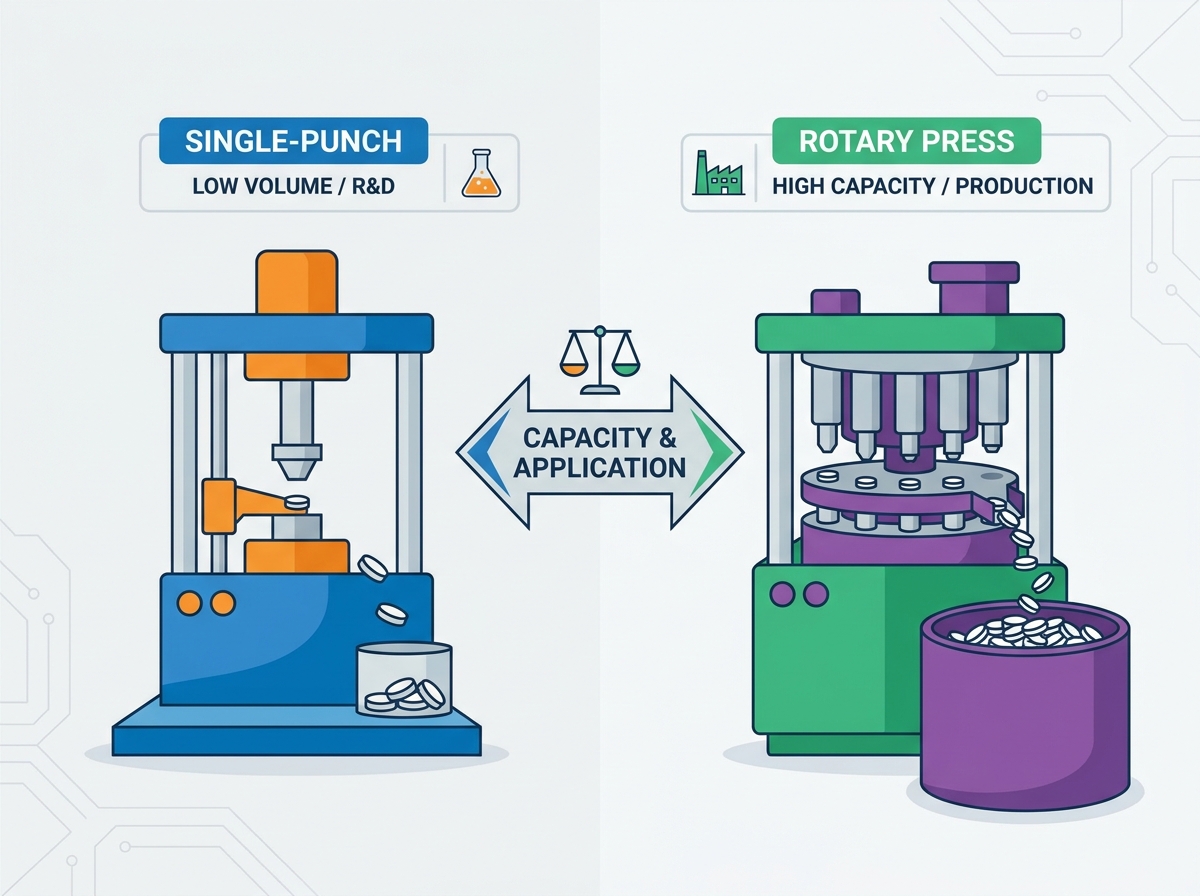
The eccentric stamping process defines the single station machine. It uses one upper punch, one lower punch, and a single die to execute a complete compression cycle. The hopper feeds powder into the die cavity via a feed shoe. The upper punch descends into the die, compacting the powder into a solid mass. Finally, the lower punch rises to eject the finished product. This sequential, one-at-a-time operation makes the mechanics straightforward and highly observable. Technicians can easily watch the entire cycle, making it an excellent tool for training and initial formulation adjustments.
In this eccentric design, tablet compression pressure is typically applied only by the upper punch. This unilateral force means the lower punch remains stationary during the actual compaction phase. Consequently, density distribution within the tablet can vary, often resulting in a slightly harder top surface compared to the bottom. Operators must carefully calibrate the punch depth to ensure adequate hardness without fracturing the material. You adjust the lower punch strictly to control the fill volume and the ejection height, not to apply active compaction force.
These machines excel in formulation development, material characterization, and small-batch nutraceuticals. Compounding pharmacies rely on them for custom dosages. When working with expensive APIs, the minimal dead volume in the feed mechanism prevents costly waste. Researchers use these presses to determine the baseline compaction profiles of new chemical entities before scaling up to larger turrets. You can run a handful of powder through the machine, test the resulting tablets for hardness and friability, and immediately adjust the formulation.
Throughput strictly caps at roughly 60 to 85 tablets per minute. This linear output cannot support large-scale manufacturing. The unilateral compression mechanism creates potential for uneven density in thicker profiles. Furthermore, these machines generally lack automated weight control feedback loops. Operators must manually sample and adjust fill depths to maintain uniform weights, increasing the risk of batch variations during extended runs. If the powder flow changes due to humidity or segregation in the hopper, the machine will not automatically correct the fill volume.
The continuous rotating turret design defines modern high-speed production. It features sequential stages of powder filling, pre-compression, main compression, and ejection across multiple stations simultaneously. As the turret spins, upper and lower punches ride along stationary cam tracks. These tracks guide the punches up and down, precisely controlling the fill depth and ejection height while the die table rotates under the powder feeder. A forced feeder uses rotating paddles to drive powder into the dies, ensuring consistent fill weights even at high rotational speeds.
Both upper and lower punches actively apply pressure between heavy steel rollers. This bilateral compression squeezes the powder from both directions simultaneously. It forces trapped air out more effectively and results in uniform density throughout the solid dose. This dual-action mechanism significantly improves structural integrity, reducing the likelihood of capping or lamination during subsequent coating or packaging processes. The lower punch moves upward while the upper punch moves downward, meeting in the middle of the die bore to form the tablet.
The number of stations exponentially multiplies output. A turret with 16, 32, or 45 stations can produce hundreds of thousands of units per hour. Double-sided rotary presses feature two powder feeders and two discharge chutes, effectively doubling the output per revolution. This continuous motion eliminates the stop-and-start inefficiency of eccentric machines, maximizing the yield for every minute of operation. You can achieve massive economies of scale, turning tons of blended powder into finished product within a single shift.
Commercial pharmaceutical manufacturing relies entirely on rotary architecture. High-yield continuous production lines and large-scale contract manufacturing organizations utilize these machines to meet global supply demands. They are indispensable for producing high-volume over-the-counter medications, generic drugs, and widely distributed dietary supplements where output speed directly dictates market availability. If you need to produce millions of tablets per month, a rotary press is the only viable mechanical solution.
Setup complexity requires highly trained operators. Changeover times stretch into hours, as technicians must remove, clean, and inspect dozens of punch and die sets. Initial material waste during calibration is higher because the machine must run at speed to dial in the automated weight controls. Facility requirements are demanding, requiring reinforced floors and substantial power supplies to drive the heavy turrets and compression rollers. You also need robust dust extraction systems to handle the airborne particulate generated by high-speed operation.
Single-punch machines offer linear, single-tablet-per-cycle output. They top out at negligible volumes compared to commercial needs. Rotary systems provide continuous, multi-station throughput. Upgrading from a 16-station to a 45-station turret drastically scales production without fundamentally changing the floor space required. You must match the machine's theoretical maximum output to your facility's downstream packaging capabilities. A high-speed press will quickly overwhelm a slow blister packaging line, creating a massive bottleneck on the production floor.
The mechanical application of force differs completely. Unilateral compression relies on upper-punch movement against a passive lower punch, suitable for thin profiles and simple formulations. Bilateral compression utilizes rotary double-punch action where both punches actively compress powder within the die. This bilateral action is mandatory for complex, thick, or difficult-to-compress formulations requiring uniform density. It ensures the core of the tablet is just as solid as the outer surfaces, which is critical for modified-release formulations.
Single-punch machines often use proprietary or simplified eccentric tooling. Rotary presses require standardized EU or TSM punch and die configurations, such as B, D, BB, or DB tooling. Standardized tooling allows facilities to source punches from multiple vendors and share tooling sets across different machines of the same standard. This interchangeability is crucial for maintaining continuous operations during tooling maintenance. You can keep spare sets of standard D-tooling in the tool room, ready to deploy immediately if a punch gets damaged.
The high speed of a rotary turret reduces dwell time—the exact millisecond the punches remain at maximum compression. Short dwell times can trap air, requiring pre-compression stages to gently consolidate the powder before main compression. Single-punch presses naturally operate slower, offering longer dwell times. This makes them inherently better at handling difficult-to-compress materials that require sustained pressure to form strong bonds. If a formulation caps on a high-speed rotary press, slowing the turret down to increase dwell time is often the first troubleshooting step.
Eccentric presses are compact, often fitting on sturdy benchtops or occupying minimal floor space. They require standard electrical connections. Rotary presses are massive industrial assets. They demand significant floor load-bearing capacity, three-phase power, compressed air for pneumatic tensioning systems, and integrated dust extraction units to handle the high volume of airborne particles generated during continuous operation. You must plan your facility layout carefully to accommodate the machine's footprint, the operator workspace, and the material handling equipment needed to load the hoppers.
Feature | Single-Punch Press | Rotary Press |
|---|---|---|
Output Capacity | 60 - 85 tablets per minute | 100,000 to 1,000,000+ per hour |
Compression Type | Unilateral (Upper punch only) | Bilateral (Upper and lower punches) |
Tooling Standard | Often proprietary eccentric | Standardized EU / TSM (B, D, etc.) |
Dwell Time | Naturally longer | Short (requires pre-compression) |
Primary Application | R&D, Clinical Trials, Compounding | Commercial Manufacturing, Scale-up |
Weight Control | Manual adjustment | Automated feedback loops |
Changeover Time | Minutes | Hours to full shifts |
Calculate efficiency based on machine utilization rates, labor hours per batch, and overall yield metrics. A high-speed turret running at 80% capacity delivers massive yields, but frequent stops for powder bridging or tooling wear destroy that efficiency. Implement automated powder handling systems to keep hoppers full without manual intervention. Train operators to monitor ejection forces and punch tightness to prevent catastrophic tooling failures during high-speed runs. You need a dedicated team to manage the logistics of moving bulk powder to the press and finished tablets to the quarantine area.
Contrast the simple, rapid teardown of an eccentric machine with the labor-intensive cleaning validation required for a multi-station turret. Single-station teardowns take minutes. Rotary changeovers require removing dozens of punches, cleaning the die table, swabbing cam tracks, and verifying residue limits. Invest in secondary exchangeable turrets to perform offline cleaning, drastically reducing machine downtime between product changes. You can swap a dirty turret for a clean one in under an hour, allowing the press to resume production while the washroom handles the dirty components.
Remove the hopper, feed frame, and scraper blades.
Extract the upper punches, lower punches, and dies sequentially.
Vacuum the die table and cam tracks to remove loose powder.
Wipe down all product contact surfaces with approved solvents.
Swab critical areas for cleaning validation testing.
Execute strict Factory Acceptance Testing (FAT) and Site Acceptance Testing (SAT) before full deployment. Verify that the equipment meets all specified tolerances using your actual formulation, not just placebo powder. Establish preventative maintenance schedules targeting cam track wear, roller bearing lubrication, and punch head degradation. Routine inspection of tooling prevents premature wear and ensures consistent tablet dimensions across millions of cycles. Use a polishing kit to maintain the punch tips, preventing sticking and picking issues during production runs.
The choice between a single-punch and rotary architecture is not a matter of superior technology, but of strict alignment with production volume and formulation maturity. Default to single-station machines for R&D, material testing, and micro-batches to conserve expensive APIs. Mandate rotary presses for scale-up, commercial manufacturing, and high-speed continuous output where unit volume dictates success.
Conduct material flow trials to determine if your powder requires the forced feeding and pre-compression capabilities of a rotary system.
Audit your facility's tooling inventory to ensure compatibility with either TSM or EU standards before purchasing new equipment.
Request detailed FAT documentation and performance guarantees from equipment vendors based on your specific formulation characteristics.
Implement a strict tooling inspection and maintenance protocol to maximize the lifespan of your punches and dies.
A: It is a machine that uses a single set of tooling—one upper punch, one lower punch, and a die. It produces one tablet per compression cycle using an eccentric stamping motion, making it ideal for small batches and R&D.
A: Single-punch machines typically produce 60 to 85 tablets per minute. Rotary presses utilize multi-station turrets to produce hundreds of thousands to over a million tablets per hour, depending on the number of stations and turret speed.
A: Single-station machines use unilateral stamping, where only the upper punch applies force. Rotary presses use bilateral roller compression, where both upper and lower punches actively squeeze the powder, ensuring uniform density.
A: Generally, no. Single-punch machines often require specific eccentric tooling. Rotary presses use standardized multi-station tooling configurations, strictly adhering to either EU or TSM standards.
A: Single-punch presses naturally offer longer dwell times, aiding difficult materials. However, modern rotary presses mitigate high-speed air entrapment issues by incorporating pre-compression stations to gently consolidate powder before main compaction.
A: A single-punch press can be torn down and cleaned in minutes. A complex rotary press changeover can take an entire shift due to the necessity of removing, cleaning, and validating dozens of individual punches and dies.
A: Fast turret speeds reduce dwell time. If dwell time is too short, air remains trapped in the powder bed. Upon ejection, this trapped air expands, causing the tablet to cap or laminate, destroying its structural integrity.


