 English

Views: 0 Author: Site Editor Publish Time: 2026-10-24 Origin: Site


Bottlenecks in modern packaging facilities rarely stem from the wrapper's maximum operational speed. Instead, the true constraint often lies in the reliability and consistency of the upstream infeed system. Operators frequently face a frustrating reality. Misaligned or poorly specified feeding modules cause micro-stops across the production line. They damage delicate products and waste expensive packaging film. Ultimately, these issues destroy Overall Equipment Effectiveness (OEE).
Moving from manual loading to fully automated feeding demands careful planning. You cannot simply drop a new conveyor into an existing line. You must rigorously evaluate your product's unique physics, your facility's spatial constraints, and your chosen vendor's technical capabilities. In this guide, we will explore exactly how to specify product feeding systems. You will learn how to match feeding technology to product type, assess technical dimensions, and successfully integrate these systems to achieve a highly predictable packaging operation.
Automated feeding dictates the true operational speed and OEE of your packaging line.
Feeding technology must be matched directly to product fragility, friction, and size variations.
Integrating a feeding system requires precise User Requirement Specifications (URS) covering hygiene, footprint, and changeover times.
Partnering with experienced integrators mitigates the risks of custom engineering and ensures proper Factory Acceptance Testing (FAT).
Many plant managers fixate on the top speed of their wrapping equipment. However, high speeds mean nothing if the infeed system fails to deliver products consistently. A poorly specified infeed mechanism disrupts your entire operation.
Manual feeding relies entirely on human endurance and precision. Operators naturally experience fatigue throughout a shift. This fatigue leads to irregular product spacing. Mismatched automatic feeds produce similar results. Irregular spacing causes empty bags. It also triggers product jams when items enter the sealing jaw at the wrong moment. Every single jam requires an operator to stop the machine, clear the blockage, and reset the film. These micro-stops rapidly accumulate. They waste massive amounts of packaging material and drastically reduce daily output.
Automating your feeding process provides a clear financial justification. By shifting away from manual loading, you can reallocate labor to higher-value tasks. You also reduce physical strain and ergonomic risks among your workforce. Automated systems operate at a predictable, continuous pace. They do not take breaks, and their throughput remains perfectly stable. This predictability drives a rapid return on investment. The financial benefits come from increased output, eliminated film waste, and reduced reliance on manual labor.
You must define what successful integration looks like before contacting vendors. A well-specified feeding system should meet strict performance benchmarks. Consider these standard targets:
Uptime: The system must sustain 98% or higher operational uptime.
Reject Rate: Improperly fed products should account for less than 1% of total volume.
Throughput: The system must consistently hit specific Parts Per Minute (PPM) targets without surging or starving the wrapper.
You must select a feeding technology based on the physical characteristics of your product. Friction, fragility, and shape uniformity dictate the ideal mechanism. A mismatch here guarantees operational failure.
Gravity and magazine feeders offer robust, straightforward solutions. They excel at handling uniformly shaped, rigid, and stackable products. Typical applications include biscuits, trading cards, or rigid trays. These feeders use gravity to drop products sequentially onto the wrapping conveyor. However, they possess strict limitations regarding product fragility. Delicate items can easily chip or crack during the dropping process. High-friction products may also stick inside the magazine channel.
Smart belts utilize multi-stage timing belts to separate and align randomly spaced products. They receive a bulk flow of items and gently adjust their spacing to match the wrapper's pitch. This technology is ideal for baked goods, granola bars, and non-uniform items. The gentle handling prevents damage, while the dynamic speed adjustments ensure perfect synchronization.
Delta robots represent the premium solution for challenging applications. They provide high-speed, precise orientation for highly delicate or irregularly shaped products. Vision systems guide the robots. They identify product position, rotation, and quality. The robot then picks the item and places it flawlessly onto the wrapper's flighted conveyor. You should specify robotics when handling fragile pastries, sticky confections, or mixed assortments.
Vibratory systems work best for small, rigid items. Hardware, hard candies, and small molded parts feed well through vibratory bowls. These systems use targeted vibrations to orient and singulate parts along a track. When specifying vibratory feeders, you must manage noise levels. You also need to account for surface abrasion. Prolonged vibration can scuff polished parts or degrade sugar coatings on candies.
Feeding System Comparison Chart
Feeding Technology | Ideal Product Types | Fragility Handling | Speed & Synchronization |
|---|---|---|---|
Gravity / Magazine Feeders | Biscuits, cards, rigid stacks | Poor (Risk of chipping/cracking) | Moderate (Relies on gravity drop) |
Smart Belt Conveyors | Baked goods, bars, soft items | Excellent (Gentle separation) | High (Dynamic servo tracking) |
Robotic Pick-and-Place | Irregular, highly delicate items | Premium (Zero friction lifting) | Very High (Vision-guided accuracy) |
Vibratory Bowls | Hardware, hard candies, pills | Moderate (Risk of surface abrasion) | High (Continuous flow rate) |
Once you select the core technology, you must evaluate the technical integration. The feeding system does not operate in isolation. It must communicate flawlessly with downstream equipment.
Modern packaging requires absolute precision between upstream flow and downstream wrapping. You need servo-driven communication between the feeding line and your horizontal pillow packing machines. Relying on basic variable frequency drives (VFDs) often leads to timing crashes. Servo motors provide instant, micro-second adjustments. If the infeed detects a gap in product flow, the wrapper can dynamically slow down. This prevents empty packages and keeps the system running smoothly.
No product bakes or molds perfectly every single time. Tolerances in product dimensions heavily dictate your technical specifications. High variance requires adjustable guide rails and heightened sensor sensitivity. If your product occasionally runs slightly wider than normal, rigid guides will cause jams. Dynamic belt speeds must compensate for length variances to ensure the product centers perfectly within the film tube.
Product weight and infeed momentum directly affect film tracking. Heavy products entering the wrapper at high speeds can stretch the packaging film. This alters the tension. Poor tension compromises the sealing integrity at the wrapping jaw. Your infeed system must transfer the product onto the film web smoothly, matching the film's exact linear speed to avoid tearing or wrinkling.
Even the best systems occasionally encounter misaligned or deformed products. You must specify inline rejection mechanisms before the product reaches the wrapping jaw. Rejecting a bad product upstream saves film and prevents a machine stoppage. Additionally, you need buffering zones. Buffers act as holding areas. They accumulate product during minor upstream delays, keeping the wrapper running without starvation.
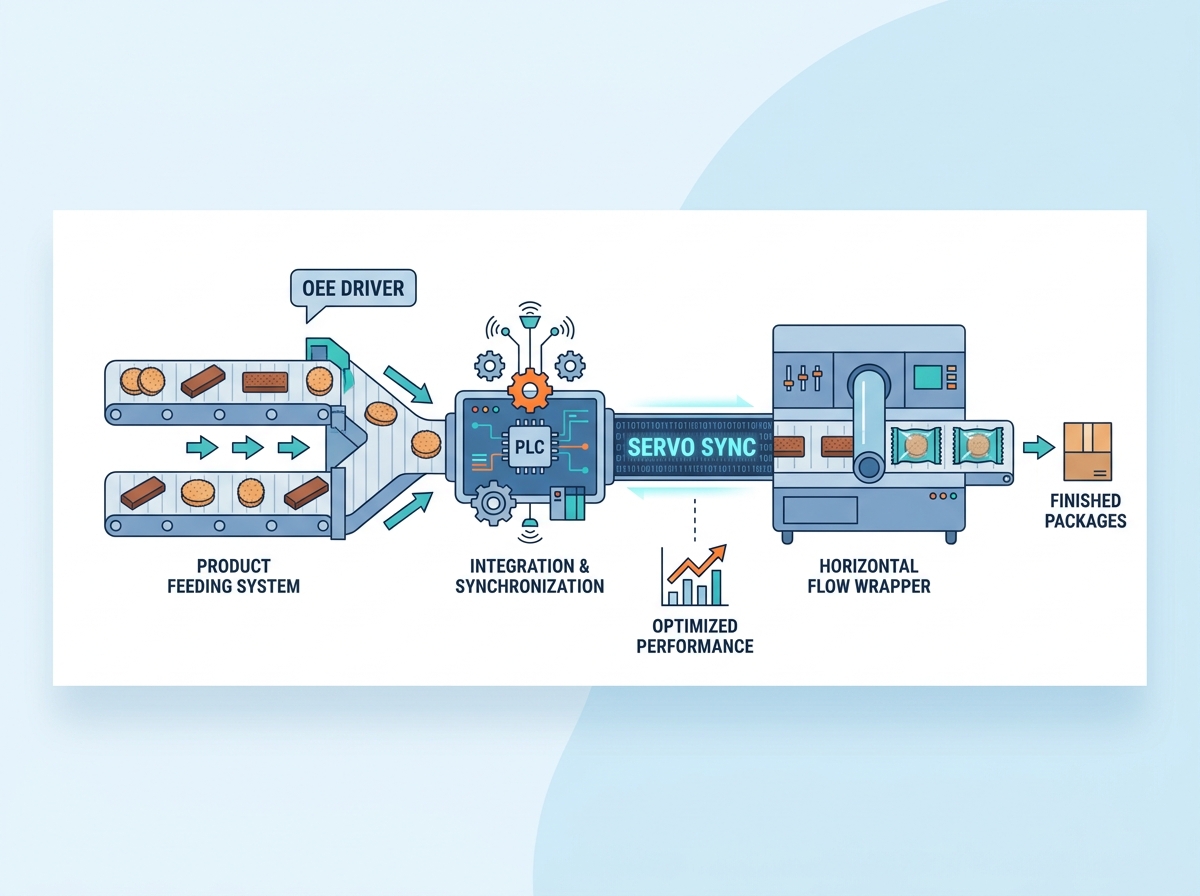
Physical plant conditions often dictate equipment success. You must address facility constraints, cleaning protocols, and operator readiness when planning your integration. Ignorance of these factors leads to delayed launches and frustrated teams.
If you operate in the food or pharmaceutical industry, hygiene is non-negotiable. You must highlight the necessity for specific IP washdown ratings. Systems requiring aggressive cleaning need IP65 or IP69K ratings to protect internal electronics from high-pressure water jets. Specify tool-less belt removal to encourage thorough daily sanitation. Ensure the entire framework meets FDA or CE compliance standards, eliminating crevices where bacteria could hide.
Retrofitting feeding systems into existing floor plans presents a major physical challenge. Many facilities lack the linear space required for long smart-belt infeeds. Address this physical reality early. You may need to specify L-shape configurations or 90-degree transfer modules instead of traditional inline setups. Integrating these turns requires careful engineering to maintain product orientation as it enters your automatic flow wrapping lines.
High-mix facilities run multiple product SKUs daily. Long changeover times kill productivity. Emphasize the importance of Single-Minute Exchange of Dies (SMED) principles. Specify recipe-driven servo adjustments. When an operator selects a new product on the screen, the guide rails and belt speeds should adjust automatically. Demand color-coded, tool-less changeover parts. This allows operators to swap pushers or guides in minutes without searching for wrenches.
Complex automation introduces adoption risks. Highly engineered Human-Machine Interfaces (HMIs) confuse untrained staff. Discuss the risk of overly complex controls with your vendor. Demand standardized, intuitive operator training. Minor faults—like a slightly misaligned sensor—can escalate into major downtime if operators do not understand the troubleshooting steps.
Purchasing standalone machines from different vendors often creates integration nightmares. Taking a systematic approach to procurement protects your investment.
A successful project begins with a comprehensive User Requirement Specification. Do not let vendors guess your needs. Provide a clear framework documenting your expectations.
Product States: Detail the minimum, maximum, and average dimensions of your products, including weight and fragility.
Environmental Conditions: State the temperature, humidity, and washdown requirements of your facility.
Performance Expectations: Clearly list your target PPM, acceptable reject rates, and required uptime percentages.
Piecing together a feeding conveyor from Vendor A and a flow wrapper from Vendor B introduces massive risk. When the system fails to sync, both vendors will blame each other. Utilizing comprehensive custom packaging line services is often safer. Working with a single integrator ensures single-source liability. The integrator takes full responsibility for ensuring the upstream sensors communicate perfectly with the downstream sealing jaws.
Never approve shipment until you complete a rigorous Factory Acceptance Test (FAT). Insist on testing the feeding system and wrapper together as a unified line.
Common Mistake: Many buyers send "ideal" or artificial product samples for the FAT. This is a critical error. You must test using actual production-grade products and your specific film structure. Real-world variations in product shape and film stretch will expose design flaws. Identifying these flaws on the vendor's floor saves thousands of dollars compared to finding them during installation.
Specifying product feeding for a packaging line is fundamentally an exercise in risk management and physics, not just a standard machinery purchase. Your wrapper's output relies entirely on the consistency of the products entering it. By matching the mechanical handling method to your product's unique physical traits, you eliminate the root cause of jams and micro-stops.
We advise buyers to prioritize vendors who demonstrate a clear, proven integration plan. Look for partners who are completely transparent about the physical limitations of handling your specific items. If a vendor claims their standard belt can handle highly sticky, variable products without modification, treat it as a red flag.
As a crucial next step, audit your current manual loading speeds. Monitor your existing waste metrics over a full shift. Define your required PPM baseline, maximum allowable footprint, and sanitation needs. Armed with this data, you can approach vendors confidently and secure an automated feeding system that truly elevates your operational performance.
A: Focus on product consistency in shape and weight. Assess surface friction—sticky products behave very differently from dry ones. Also, evaluate fragility. High variance in size or extreme delicacy requires advanced, often costlier, sensing and handling technologies like robotics.
A: You can realistically expect a return on investment within 12 to 24 months. This rapid timeframe stems primarily from displacing manual labor—often two to three operators per shift—while simultaneously slashing film waste and increasing overall daily throughput.
A: Yes, retrofitting is possible, but it demands control system compatibility. You usually need updated servo motors and PLCs. Upgrading both the feeder and wrapper simultaneously via custom packaging line services often proves more cost-effective than bridging outdated, proprietary software systems.
A: Sticky products require specialized handling. You must specify specific belt materials like polyurethane or dimpled surfaces to minimize contact area. Additionally, you will need active scraper mechanisms and strict environmental controls for temperature and humidity to prevent chronic jamming.


