 English
Views: 0 Author: Site Editor Publish Time: 2026-03-23 Origin: Site


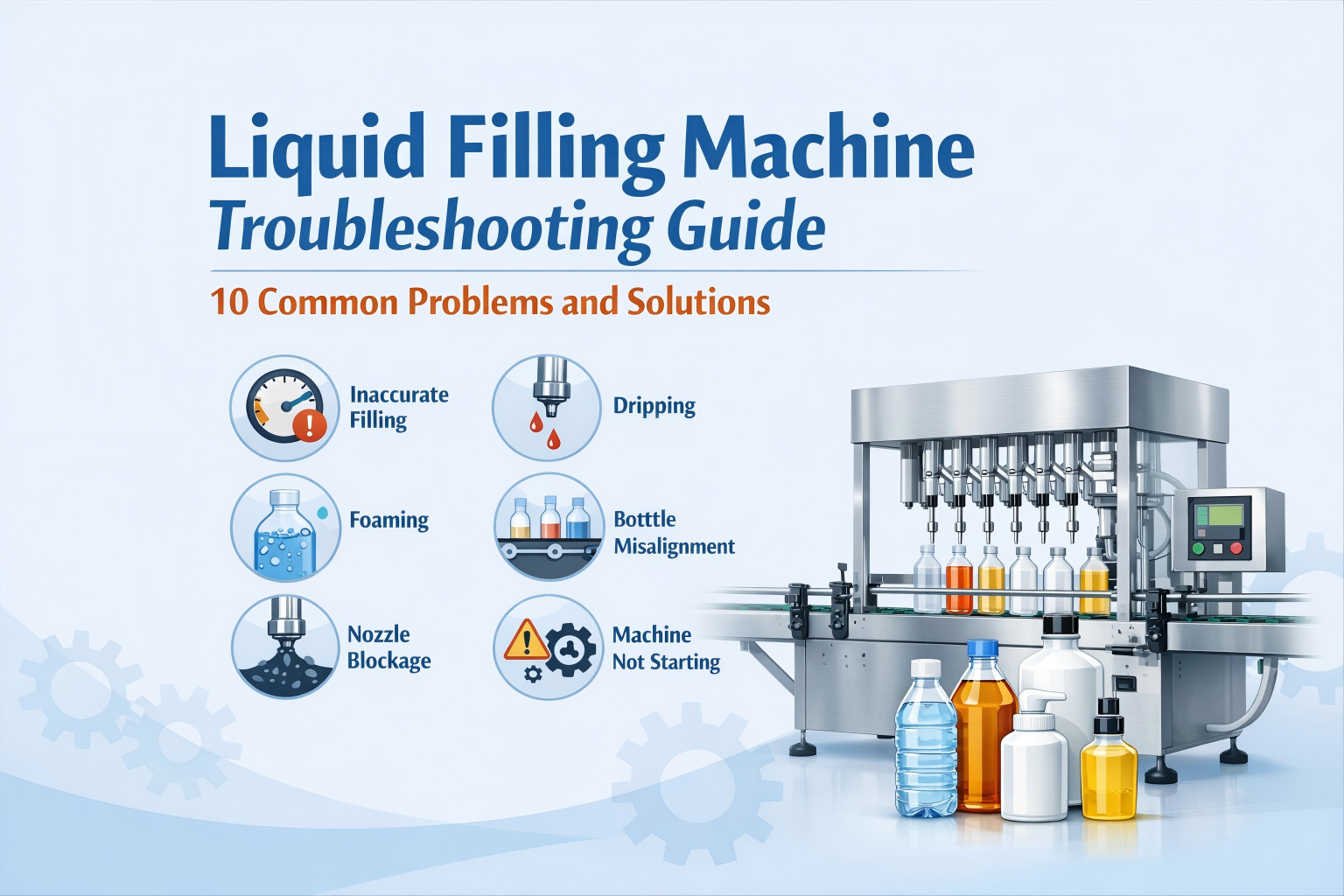
A liquid filling machine plays a critical role in product packaging. Whether you are filling water, oil, syrup, detergent, lotion, shampoo, or chemical liquids, the machine must work accurately and consistently to maintain production efficiency and product quality.
However, even a well-designed filling machine may experience problems during daily operation. Inaccurate filling, dripping, foaming, nozzle blockage, sensor failure, and unstable conveyor speed are among the most common issues found in liquid filling lines. If these problems are not identified and corrected early, they can lead to wasted product, lower output, inconsistent packaging quality, and unexpected downtime.
This troubleshooting guide explains why liquid filling machine problems happen, what to check first, and how to solve 10 common issues in a practical and structured way.
Before jumping into repairs, remember these three principles:
Many liquid filling machine problems come from product changes, worn parts, incorrect settings, or poor maintenance
A quick inspection of power, air supply, nozzles, valves, sensors, and product condition can often identify the cause
Preventive maintenance is the best way to reduce repeat problems and keep filling performance stable
In many cases, troubleshooting is not about one major failure. It is about finding small issues before they become costly production problems.
Liquid filling machines are designed for controlled, repeatable production, but real operating conditions are not always stable. Different products behave differently, machine parts wear over time, and settings may change from one production run to another.
The most common causes of filling machine problems include:
Product viscosity changes
Thick or thin liquids may flow differently depending on temperature or formulation
Incorrect machine settings
Filling time, speed, delay, and sensor settings may not match the product or bottle format
Worn parts
Nozzles, valves, seals, hoses, and piston components may gradually lose performance
Insufficient cleaning
Product residue can block nozzles, slow valves, or affect sensors
Unstable utilities
Air pressure, electricity, or conveyor movement may fluctuate
Bottle or container inconsistency
Different bottle shapes, heights, or neck sizes may cause positioning or filling problems
| Root Cause | Typical Result |
|---|---|
| Product change | Volume inconsistency, foaming, dripping |
| Parameter error | Underfill, overfill, unstable cycle |
| Worn component | Leakage, poor cutoff, inaccurate filling |
| Poor cleaning | Nozzle blockage, sticky valves, sensor failure |
| Conveyor issue | Bottle positioning errors, skipped fills |
| Utility instability | Machine not starting, irregular operation |
Understanding these root causes makes troubleshooting much faster and more effective.
Before taking the machine apart or changing multiple parameters, start with a few quick checks. Many common problems can be found in minutes.
Make sure the machine is connected properly, powered on, and not stopped by an emergency switch or control system alarm.
For pneumatic filling machines, unstable or insufficient air pressure can affect valves, cylinders, and general machine operation.
Confirm that the product is at the correct temperature, viscosity, and supply level. Product behavior changes can directly affect filling performance.
Look for clogs, residue, leaks, or visible product buildup.
Make sure bottles are aligned correctly and sensors are clean and responding normally.
Is the machine powered on?
Is the emergency stop released?
Is air pressure stable?
Is the product feeding correctly?
Are nozzles clean?
Are bottles aligned?
Are sensors detecting bottles?
If all five checks are normal, move on to issue-specific troubleshooting.
Below are 10 common liquid filling machine problems with likely causes and practical solutions.
This is one of the most common problems in liquid filling operations. Bottles may be underfilled or overfilled, and the fill amount may vary from bottle to bottle.
Possible causes:
Incorrect filling parameter setting
Pump or piston calibration error
Product viscosity change
Worn seals or internal leakage
Unstable air pressure
Solutions:
Recheck filling volume settings
Recalibrate the pump or piston system
Confirm product temperature and viscosity
Inspect seals, pistons, and valves for wear
Stabilize air pressure if the system is pneumatic
Product continues to drip from the nozzle after the filling cycle ends. This causes mess, waste, and poor bottle appearance.
Possible causes:
Worn or dirty nozzle
Valve not shutting off completely
Product stringing due to viscosity
Incorrect nozzle position
Poor anti-drip design for the product type
Solutions:
Clean the nozzle thoroughly
Inspect valve sealing condition
Replace worn nozzle tips or seals
Adjust nozzle height and fill cutoff timing
Use a more suitable anti-drip nozzle for the product
Foaming is common when filling certain liquids such as detergents, cleaning liquids, and some personal care products.
Possible causes:
Filling speed too high
Product entering the bottle too aggressively
Nozzle too far above liquid level
Product naturally foams during agitation
Solutions:
Reduce filling speed
Use bottom-up filling if possible
Adjust nozzle position deeper into the bottle
Select a nozzle design suitable for foamy liquids
Review whether overflow or a different filling principle is more appropriate
Bottles do not align correctly under the filling nozzles, causing off-center filling, missed fills, or spills.
Possible causes:
Conveyor guide rails are not adjusted correctly
Bottle spacing is inconsistent
Sensors are misaligned
Conveyor speed is unstable
Solutions:
Adjust bottle guides and side rails
Check bottle spacing devices
Reposition or clean bottle-detection sensors
Confirm conveyor speed is stable and synchronized with the filling cycle
When a nozzle becomes partially or fully blocked, filling volume drops, flow becomes uneven, or product splashes unpredictably.
Possible causes:
Product residue buildup
Insufficient cleaning
Thick or particle-containing liquid
Dried product inside nozzle passages
Solutions:
Stop production and clean the blocked nozzle
Review cleaning frequency and methods
Check whether the nozzle design fits the product
Use filters or improved product preparation if needed
The machine fails to begin operation or respond when the operator attempts to start it.
Possible causes:
Power supply issue
Emergency stop activated
Air supply too low
Safety interlock not satisfied
Control panel or PLC issue
Solutions:
Confirm power connection and breaker status
Release emergency stop button
Verify air pressure is at the required level
Check alarms or warning messages on the control panel
Inspect safety switches and interlock conditions
The conveyor moves too fast, too slowly, or irregularly, affecting bottle timing and filling consistency.
Possible causes:
Motor or drive control issue
Worn conveyor belt
Mechanical friction or obstruction
Incorrect speed setting
Solutions:
Inspect motor and speed controller
Check the conveyor belt for wear or damage
Remove obstructions and inspect moving parts
Reset speed parameters to match filling output
Leaks around valves, connectors, or seals can result in pressure loss, dripping, contamination risk, and unstable filling.
Possible causes:
Seal wear
Loose fittings
Corrosion or chemical damage
Product buildup affecting valve sealing
Solutions:
Tighten fittings and connectors
Replace worn O-rings or seals
Clean valve surfaces thoroughly
Use compatible materials for aggressive products
The machine may fail to detect bottles, stop unexpectedly, or trigger the filling cycle at the wrong moment.
Possible causes:
Dirty sensor surface
Misalignment
Wiring issue
Incompatible sensor sensitivity for the bottle type
Solutions:
Clean the sensor lens or surface
Realign the sensor position
Inspect cables and connections
Adjust sensor sensitivity or use a more suitable sensor type
The machine works well with one product but poorly with another, especially when switching from thin liquids to thick or foamy products.
Possible causes:
Machine settings not updated for the new product
Nozzle or pump type not suitable
Product viscosity or temperature difference
Incomplete cleaning between production runs
Solutions:
Save and use separate parameter recipes for each product
Recheck nozzle and filling method suitability
Confirm product condition before startup
Clean the system fully when changing products
| Problem | Common Cause | Typical Solution |
|---|---|---|
| Inaccurate filling volume | Calibration drift, viscosity change | Recalibrate, check product condition |
| Dripping after filling | Valve wear, nozzle issue | Clean or replace nozzle and valve parts |
| Foaming during filling | Filling too fast, poor nozzle position | Reduce speed, adjust nozzle position |
| Bottle positioning errors | Conveyor or sensor misalignment | Adjust guides and sensors |
| Nozzle blockage | Residue buildup, poor cleaning | Clean nozzle and review cleaning method |
| Machine does not start | Power, air, safety interlock | Check utilities and alarms |
| Unstable conveyor speed | Motor, belt, speed setting | Inspect drive system and reset speed |
| Leaking valves or seals | Worn seal, loose fitting | Replace seals and tighten connections |
| Sensor detection failure | Dirt, misalignment, wiring | Clean, align, and inspect connections |
| Inconsistent performance between products | Recipe mismatch, product difference | Update settings and clean thoroughly |
The best troubleshooting strategy is to prevent problems before they happen. Preventive maintenance reduces downtime, extends machine life, and helps maintain filling accuracy.
Clean nozzles and product contact parts
Check for visible leaks
Confirm bottle detection is stable
Verify starting accuracy at the beginning of the shift
Remove product residue from exposed surfaces
Inspect valves, seals, and hoses
Check pump or piston performance
Confirm conveyor alignment and smooth movement
Review machine settings for abnormal changes
Replace wear parts before failure
Recalibrate filling volume regularly
Inspect electrical and pneumatic connections
Test sensors and control responses
Keep maintenance records for recurring issues
Clean regularly
Inspect wear parts
Recalibrate on schedule
Record repeated problems
Replace components before breakdown
Good maintenance is usually more cost-effective than emergency repair.
Some problems can be solved with routine inspection and adjustment, but others require professional technical support.
You should contact technical support when:
The same problem continues after basic troubleshooting
Calibration cannot be stabilized
PLC alarms or control issues are unclear
Product leakage continues after seal replacement
The machine shows repeated sensor or electrical failures
A product change requires different nozzles, valves, or filling methods
Major components such as pumps, pistons, or controllers need repair or replacement
Technical support is especially important when the problem affects safety, product quality, or repeated downtime.
Liquid filling machine problems usually do not happen without a reason. In most cases, they are caused by a combination of product changes, worn parts, incorrect settings, cleaning issues, or unstable utilities. A structured troubleshooting approach makes it much easier to identify the cause and restore stable production.
Start with basic checks such as power, air supply, product condition, nozzle cleanliness, and sensor alignment. Then move step by step through the most likely causes of inaccurate filling, dripping, foaming, bottle positioning problems, valve leakage, and other common issues.
With regular maintenance, proper setup, and timely replacement of wear parts, many filling machine problems can be prevented before they interrupt production.
Having trouble with inaccurate filling, dripping, foaming, or unstable machine performance? Contact us for technical support and a suitable liquid filling solution for your product.
Inaccurate filling can be caused by incorrect settings, calibration drift, product viscosity changes, worn seals, or unstable air pressure.
Dripping usually happens because of valve wear, nozzle contamination, product stringing, or improper cutoff timing.
Foaming may be caused by filling too quickly, poor nozzle positioning, or the natural foaming behavior of the product.
Common signs include missed bottles, false detection, irregular machine stops, or filling cycles that start at the wrong time.
Basic cleaning and checks should be done daily, while inspection, recalibration, and replacement of wear parts should be done on a regular preventive schedule.
You should contact technical support when repeated problems continue after routine troubleshooting or when the issue involves control systems, major components, or safety-related failures.


