 English
Views: 0 Author: Site Editor Publish Time: 2026-07-14 Origin: Site


Particle size reduction dictates drug efficacy, stability, and downstream processability. Milling is never merely a mechanical step. It directly alters how active ingredients perform in the human body. Improper grinding equipment leads to broad Particle Size Distribution (PSD). It causes thermal degradation of sensitive Active Pharmaceutical Ingredients (APIs). Poor excipient flowability often follows, ultimately resulting in batch rejection or failed dissolution profiles.
Selecting a pharmaceutical powder grinder requires careful alignment between material science, regulatory compliance, and production scalability. You must balance the physical properties of the powder with the mechanical forces of the mill. This decision impacts everything from blend uniformity to final tablet hardness. We will examine how to match specific milling technologies to your exact material requirements and process goals.
Material Properties Dictate Technology: The choice between impact, attrition, or fluid energy milling depends entirely on the material’s heat sensitivity, hardness, and target micron size.
API vs. Excipient Requirements Differ: APIs often require ultra-fine, low-heat micronization (e.g., jet milling) for bioavailability, while excipients typically need controlled deagglomeration (e.g., conical milling) to ensure blend uniformity.
Containment and Cleanability are Non-Negotiable: Equipment selection is heavily influenced by Clean-in-Place (CIP) capabilities and Occupational Exposure Band (OEB) containment ratings.
Process Integration Matters: Grinding performance must be evaluated in tandem with integrated industrial sieving and security screening to prevent electrostatic hazards and ensure final batch purity.
Scalability Requires Early Validation: Equipment must demonstrate linear scalability from R&D benchtop trials to commercial-scale production without shifting the PSD curve.
Reducing particle size exponentially increases the available surface area of a powder. This physical change directly accelerates dissolution rates. For poorly water-soluble APIs, specifically those in BCS Class II and IV, milling is often the primary method to achieve target bioavailability. A smaller particle dissolves faster in gastrointestinal fluids. If the grinder generates too much heat or fails to reach the required micron range, the therapeutic effect of the drug diminishes. Operators must constantly monitor the feed rate and rotor speed to ensure the mechanical energy applied translates directly into size reduction rather than heat generation. In practical applications, a shift from a D90 of 50 microns to a D90 of 10 microns can mean the difference between a passing and failing dissolution test.
Excipients require different handling than active ingredients. The success criteria for excipient milling focus on achieving a uniform PSD. Uniformity prevents segregation during the blending phase. Particle shape, bulk density, and tapped density play critical roles in downstream processes. Irregularly milled excipients bridge in hoppers and cause erratic flow into tablet presses or capsule fillers. Controlled deagglomeration ensures the excipient matrix supports the API evenly throughout the final dosage form. When setting up a milling circuit for excipients like microcrystalline cellulose or lactose, the screen size and impeller shape must be chosen to shear agglomerates without fracturing individual crystals.
You cannot manage what you cannot measure. A narrow, predictable PSD curve is essential. We rely on D10, D50, and D90 metrics to define this curve. D50 represents the median particle size. D10 and D90 indicate the fine and coarse tails of the distribution. Generating excessive fines leads to dusting and poor flow. Oversized granules cause content uniformity failures. The right mill controls these extremes, keeping the entire batch within tight specification limits. Regular sampling and laser diffraction analysis during the milling run provide the necessary feedback loop to adjust machine parameters on the fly.
Mechanical milling generates friction. Friction creates heat. Low-melting-point APIs degrade rapidly under these conditions. You must identify the thermal threshold of your material before selecting a mill. Standard impact mills often exceed these thresholds during continuous operation. Heat-sensitive compounds necessitate cryogenic cooling systems or air-swept milling designs. These modifications dissipate heat immediately, preserving the chemical integrity of the active ingredient. For example, injecting liquid nitrogen directly into the milling chamber can maintain temperatures well below the glass transition point of sensitive polymers.
Materials behave differently under mechanical stress. Brittle solids fracture easily upon impact. Fibrous materials resist impact and require shearing forces to break apart. Moisture content complicates the process further. Hygroscopic materials absorb moisture from the air, becoming sticky and blinding mill screens. Processing these powders demands humidity-controlled environments and specialized rotor designs that prevent material buildup on contact surfaces. Operators often need to condition the room air to below 30% relative humidity when handling highly hygroscopic extracts.
The initial state of the powder dictates how it feeds into the grinding chamber. Irregular particle shapes and low-density cohesive powders resist gravity feeding. They bridge in the feed throat and starve the mill. This erratic feeding causes inconsistent particle size reduction. Processing low-density materials often requires active force-feeders. These mechanisms push the powder into the milling zone at a controlled, continuous rate. Twin-screw feeders are commonly deployed to maintain a steady volumetric flow into the milling chamber.
Highly potent active pharmaceutical ingredients (HPAPIs) introduce severe operator safety risks. You must map the material toxicity directly to the equipment design. Standard open-discharge mills are unacceptable for HPAPIs. These compounds require closed-loop systems. High-containment isolators and split-butterfly valves become mandatory. The mill must operate under negative pressure to guarantee that hazardous dust never breaches the processing environment. Wash-in-place (WIP) nozzles must be integrated to wet down the powder before the isolator is ever opened.
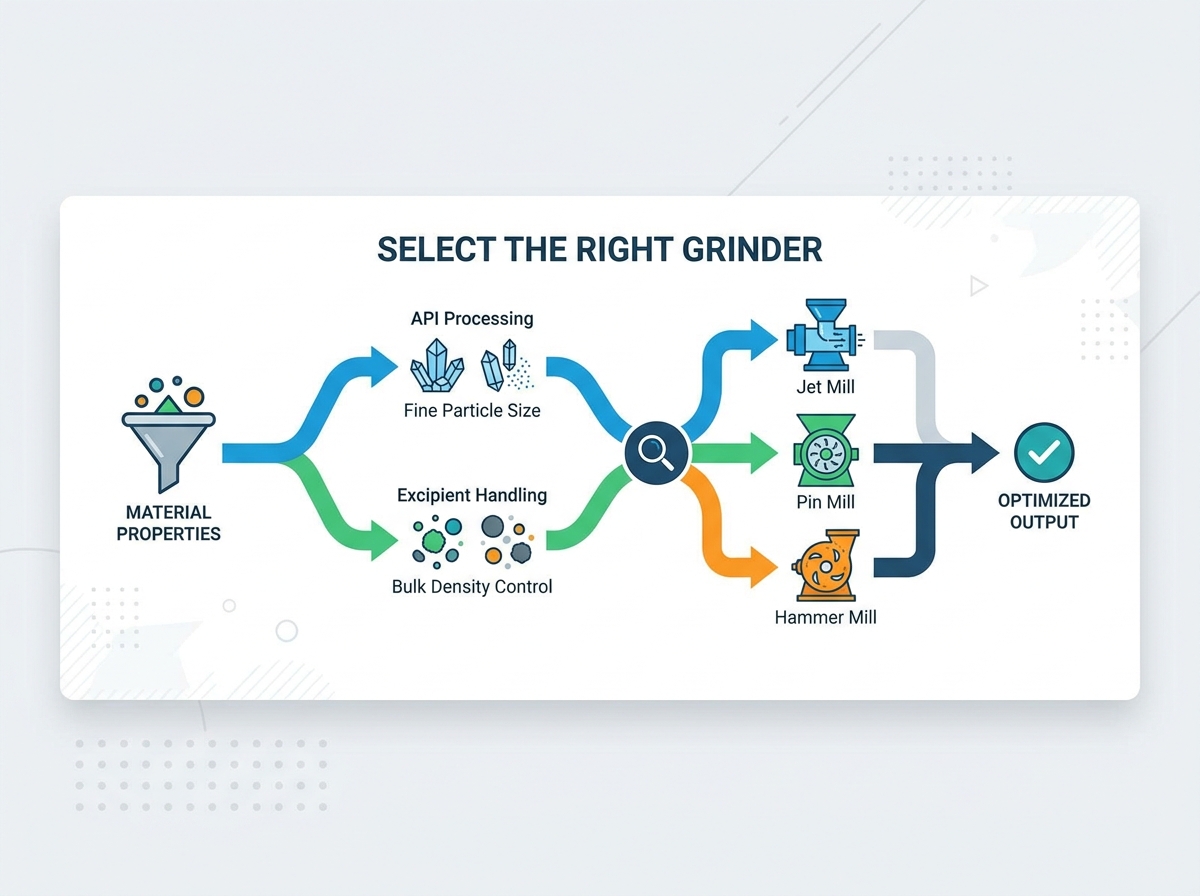
Hammer mills operate using high-speed rotating hammers that force material through a sizing screen. They offer significant flexibility through dual-faced rotors. You can use the knife edge for chopping fibrous materials or the impact edge for pulverizing crystalline solids. Variable screen types, such as perforated plates or wire mesh, further control the output. They provide versatile, high-throughput processing for bulk excipients. However, they generate localized heat and produce a wider PSD compared to specialized micronizers. Proper screen tensioning is critical; a loose screen will flex and eventually tear under the impact load.
Jet mills utilize high-velocity compressed air or inert gas to cause particle-on-particle collisions. They excel at ultra-fine micronization, typically reaching 1-10 microns. Because they have no moving parts, they generate zero mechanical heat and eliminate metal contamination risks. This makes them ideal for heat-sensitive APIs. The trade-offs include high energy consumption, lower throughput rates, and the necessity for complex gas handling and filtration systems. The grinding pressure and feed rate must be perfectly balanced to maintain the internal classification vortex.
Conical mills use a low-RPM impeller to push material through a conical sieve. They provide gentle excipient conditioning and break down agglomerates with minimal fines generation. They are highly effective for post-granulation sizing in both wet and dry granulation pipelines. They are not suitable for primary micronization or processing highly abrasive materials. Their low-speed operation preserves the morphology of the particles. Adjusting the gap between the impeller and the screen allows operators to fine-tune the output size without changing parts.
Universal mills feature interchangeable rotor designs within a single housing. You can swap between pin, beater, and turbine configurations based on the batch requirements. Contract manufacturing organizations favor them for rapid changeovers across diverse product lines. While highly flexible, this jack-of-all-trades design rarely matches the peak efficiency or tight PSD control of a dedicated, specialized mill. The ability to switch from a pin disc for brittle materials to a turbine rotor for fibrous materials makes them highly adaptable.
Milling lines require integrated vibratory, centrifugal, or ultrasonic screening technologies. Safety screening removes foreign contaminants before the powder enters the mill, protecting the rotor and screens from damage. Post-grinding classification ensures oversized particles do not proceed to blending. Operating these sieves requires careful calibration of screen mesh tension. Ultrasonic deblinding systems are often necessary to prevent cohesive APIs from clogging the mesh apertures. A properly tuned ultrasonic probe can increase throughput by up to 300% on sticky powders.
Comparison of Pharmaceutical Milling Technologies | |||
Mill Type | Primary Mechanism | Best Application | Key Limitation |
|---|---|---|---|
Hammer Mill | Mechanical Impact | Bulk excipients, robust APIs | Generates heat, broad PSD |
Jet Mill | Fluid Energy / Collision | Ultra-fine, heat-sensitive APIs | High energy use, low throughput |
Conical Mill | Low-shear Attrition | Deagglomeration, wet/dry sizing | Cannot achieve micronization |
Universal Mill | Interchangeable Rotors | Multi-product facilities | Lower peak efficiency per product |
Equipment must demonstrate geometric and kinematic scalability. Moving from a 1kg/hr benchtop unit to a 500kg/hr production mill introduces severe risks of PSD variations. The physics of the grinding chamber change as the diameter increases. You must maintain constant tip speed and identical chamber geometries across the scale-up pipeline. Vendors must provide empirical data proving their lab-scale mills replicate the exact particle dynamics of their commercial units. Scale-up calculations must account for the residence time of the powder in the milling zone.
You must evaluate where the milling stage sits within your workflow. Intermediate sizing of wet mass requires different screen types and rotor speeds than the final dry milling of active ingredients. Wet milling handles cohesive, damp granules and prevents them from clumping before fluid bed drying. Dry milling focuses on strict particle size reduction and classification. The equipment must integrate seamlessly with upstream granulators and downstream blenders. Using a square-hole screen for wet milling often prevents the smearing that occurs with round-hole screens.
Sanitary design is a strict regulatory requirement. All contact parts must utilize 316L stainless steel. Surface finishes must meet Ra <0.4 µm standards to prevent powder adhesion. Crevice-free designs eliminate areas where microbial growth or cross-contamination can occur. Automated Clean-in-Place (CIP) and Sterilize-in-Place (SIP) capabilities are essential. These automated systems minimize manual intervention, reduce cleaning validation cycles, and ensure repeatable sanitation between batches. Riboflavin testing is standard practice to verify the coverage of CIP spray balls.
Fine pharmaceutical powders are highly combustible. The grinding process inherently generates friction and electrostatic charges. This combination creates a severe explosion risk. You must specify equipment with ATEX or NFPA certified explosion-proof designs. The mill housing should feature 10-bar pressure shock resistance. Implement inert gas blanketing, such as nitrogen purging, to remove oxygen from the milling chamber. Robust grounding and earthing systems for all conductive components will dissipate static buildup safely. Operators must verify grounding continuity before every batch.
Carryover of active substances leads to adulterated batches and severe regulatory penalties. Multi-product facilities face the highest risk of cross-contamination. Require tool-free dismantling for all milling equipment. This allows operators to break down the machine completely for inspection. Utilize disposable polymer product contact parts where applicable to eliminate cleaning entirely. Implement rigorous cleanability swabbing validation protocols to verify that no residue remains after the CIP cycle. Dedicated filter bags for each product line are a simple but effective mitigation strategy.
Incomplete or poorly documented equipment commissioning causes massive delays in regulatory approval. You cannot operate a mill without proper validation. Partner with vendors who provide comprehensive documentation. Installation Qualification (IQ) verifies the machine is built and installed correctly. Operational Qualification (OQ) tests the machine against its functional specifications. Performance Qualification (PQ) proves the machine consistently produces the target PSD under normal operating conditions. Executing these protocols with placebo batches saves valuable API during the commissioning phase.
Review the IQ documentation to ensure all materials of construction match the required specifications.
Execute OQ tests to verify rotor speeds, feed rates, and safety interlocks function as designed.
Perform PQ runs using the actual product to confirm the PSD meets the required D10, D50, and D90 metrics.
There is no universal milling solution. The optimal choice remains a strict function of the material's thermal limits, target PSD, density, and your facility's containment requirements. Selecting the wrong technology compromises drug efficacy and halts production.
Narrow your shortlist by first defining the required micron range. Determine if you need primary micronization or gentle deagglomeration. Next, evaluate the heat sensitivity and electrostatic characteristics of your specific powder. Finally, match the equipment to your required Occupational Exposure Band (OEB) levels.
Take the following actions to finalize your equipment selection:
Conduct empirical material trials at the vendor’s testing facility using representative material.
Analyze both the milling performance and the integrated sieving behaviors before finalizing any investment.
Consult a pharmaceutical powder grinder specialist to review your process parameters and ensure seamless integration.
A: Fluid energy jet mills are highly effective due to the cooling effect of expanding gas streams. They generate no mechanical heat. Alternatively, specialized cryogenic hammer mills utilizing liquid nitrogen dosing can keep temperatures well below the degradation threshold during impact milling.
A: Particle size reduction exponentially increases the surface area of the powder. This greater surface area allows gastrointestinal fluids to interact with the drug faster, accelerating dissolution rates. This is especially critical for poorly water-soluble BCS Class II and IV drugs.
A: Hammer mills use mechanical impact from high-speed rotating blades and size the output through a physical screen. Jet mills use fluid energy, relying on high-velocity gas to cause particle-on-particle collisions. Jet mills achieve much finer micronization without generating mechanical heat.
A: PSD is controlled by adjusting several mechanical variables. These include rotor speed (RPM), blade configuration (impact vs. knife edge), screen hole geometry, powder feed rate, and in the case of jet mills, gas pressure dynamics.
A: Integrated sieving serves two distinct purposes. Safety screening eliminates foreign contamination before the powder enters the mill, protecting the equipment. Post-mill classification ensures zero oversized particles enter the final blending phase, maintaining content uniformity.
A: Static is mitigated through comprehensive electrical grounding of all machine components. Using conductive materials of construction, implementing inert gas blanketing, and utilizing ultrasonic sieve vibration also help dissipate electrostatic charges safely during operation.


