 English
Views: 0 Author: Site Editor Publish Time: 2026-07-03 Origin: Site


Scaling pharmaceutical manufacturing requires balancing high-throughput production targets with zero-tolerance regulatory compliance. Selecting the wrong machinery leads to costly validation delays, batch rejections, cross-contamination risks, and facility bottlenecks. Procurement decisions for both specialized and general pharmaceutical equipment must account for immediate operational needs and long-term facility integration. You cannot afford missteps when patient safety and regulatory approvals are on the line.
This guide provides a systematic breakdown of essential pharmaceutical production equipment across the entire production lifecycle. We will explore everything from raw material handling to serialized packaging. You will learn technical evaluation frameworks to guide capital expenditure decisions and ensure seamless facility integration.
Regulatory Validation is Non-Negotiable: Equipment must come with comprehensive documentation for Installation, Operational, and Performance Qualification (IQ/OQ/PQ) to meet cGMP standards.
Containment and Cleaning Dictate Design: Prioritize systems with advanced Clean-in-Place (CIP) and Sterilize-in-Place (SIP) capabilities to mitigate cross-contamination and minimize changeover downtime.
Scalability Requires Systems Thinking: Transitioning from R&D to commercial-scale pharmaceutical production equipment necessitates units that integrate seamlessly into existing facility utilities (HVAC, cleanrooms, water-for-injection systems).
In-Process Quality Controls Prevent Waste: Implementing real-time PAT (Process Analytical Technology) and IPC (In-Process Control) testing ensures batches pass quality criteria before reaching the final packaging lines.
Serialization Drives Packaging Choices: Final packaging machinery must natively support track-and-trace compliance to meet global supply chain mandates.
Defining the User Requirement Specification (URS) before vendor selection ensures equipment aligns with specific dosage forms, batch sizes, and facility constraints. You must outline exact success criteria early in the procurement cycle. This prevents costly retrofits and ensures the machinery performs exactly as required under actual production loads. A well-drafted URS serves as the foundational document for all subsequent validation activities.
Evaluating vendor-supplied validation packages is a mandatory first step. You need comprehensive Factory Acceptance Testing (FAT) and Site Acceptance Testing (SAT) protocols. Material certificates and weld logs prove the equipment meets sanitary design standards. Assessing 21 CFR Part 11 compliance is equally vital for electronic records. Automated systems must feature secure audit trails, role-based access controls, and robust data integrity controls to pass regulatory inspections without generating observations.
Scaling up introduces severe mechanical and thermodynamic bottlenecks. Moving from clinical scale to high-throughput commercial machinery changes how materials behave. You must maintain constant shear rates in mixing and consistent heat transfer rates in drying. Dwell times in tablet compression must also remain stable across different machine sizes. Failing to account for these variables often results in failed commercial batches, capping issues, or inconsistent dissolution profiles.
Comparing manufacturing paradigms requires evaluating physical footprints and control systems. Continuous manufacturing offers high throughput but requires complex Process Analytical Technology (PAT) control systems. Traditional batch processing has a larger physical footprint and longer cycle times but is easier to validate. Retrofitting continuous systems into legacy batch-oriented facilities presents significant integration challenges regarding material feeding and real-time release testing.
Manufacturing Type | Footprint | Cycle Time | Control Complexity | Integration Difficulty |
|---|---|---|---|---|
Batch Processing | Large | Long | Moderate | Low (Standard) |
Continuous Manufacturing | Compact | Short | High (Requires PAT) | High (Retrofit challenges) |
Machinery required to condition bulk active pharmaceutical ingredients (APIs) and excipients prior to formulation forms the foundation of the line. Proper material preparation ensures downstream processes function correctly and prevents costly rework later in the manufacturing cycle.
Hammer mills, conical mills, and jet micronizers handle size reduction tasks. Achieving precise particle size distribution (PSD) ensures uniform dissolution rates. Target bioavailability depends entirely on this initial milling step. Proper size reduction also guarantees optimal downstream powder flow, preventing blockages in hoppers and feeders. Selecting the right screen size and impeller speed dictates the final particle characteristics.
V-blenders, bin (IBC) blenders, double-cone blenders, and high-shear mixers combine raw materials. Assessing blend uniformity capabilities is a primary concern. You must eliminate dead-spots where unmixed powders accumulate. Material containment during transfer using split-valve technologies protects operators and prevents cross-contamination between batches. IBC blenders offer the advantage of mixing directly in the transport container, eliminating a transfer step.
Dust generation and electrostatic buildup pose severe risks during material handling. Operator exposure limits (OEL compliance) dictate the use of closed-transfer systems. Pneumatic vacuum conveyors and isolators mitigate these risks effectively. Proper grounding and containment strategies keep the cleanroom environment safe and compliant, preventing explosive dust atmospheres and protecting personnel from highly potent APIs.
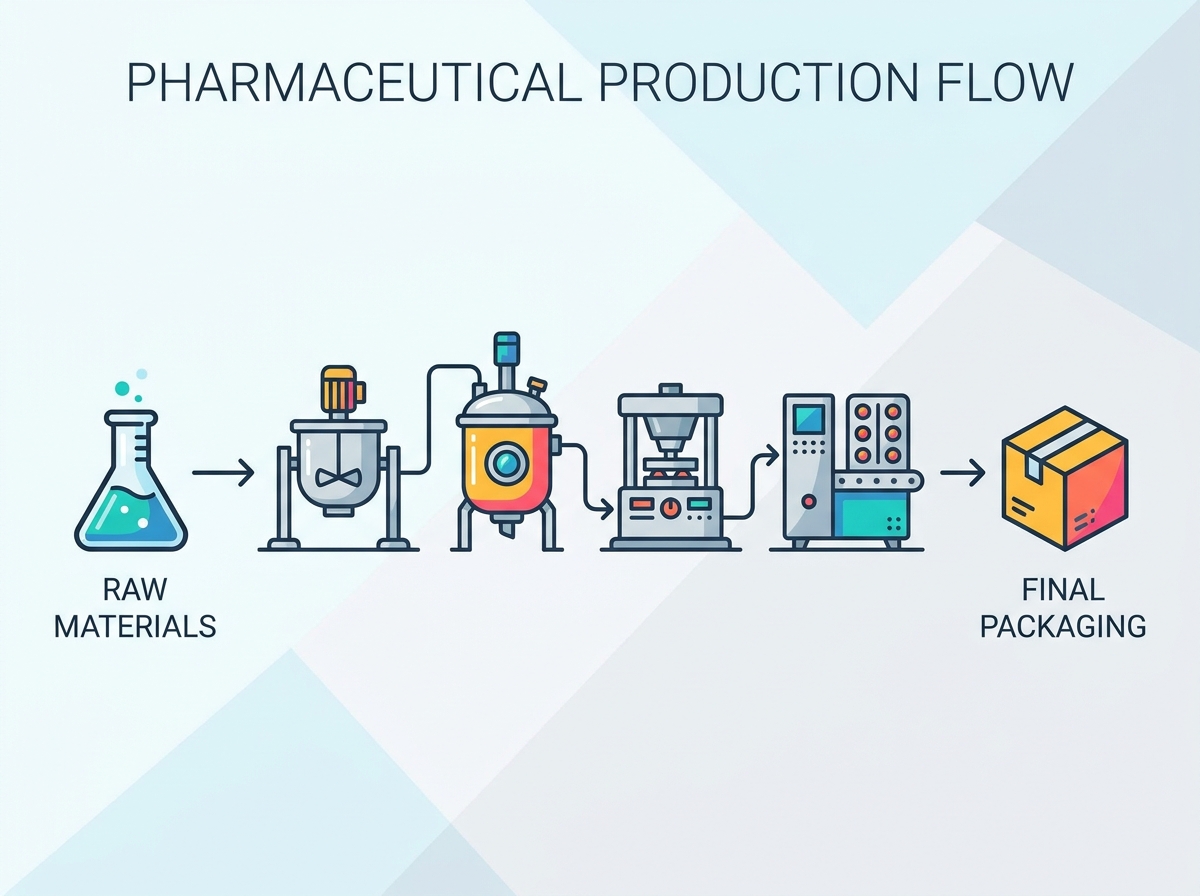
Equipment used to transform raw powder blends into workable pharmaceutical intermediates prepares the product for final dosage formation. This stage dictates the physical characteristics, flowability, and compressibility of the final drug product.
Roller compactors handle dry granulation, while rapid mixer granulators and fluid bed granulators manage wet granulation. You must weigh the moisture and heat sensitivity of the API against the required flowability for downstream tableting. Dry granulation suits moisture-sensitive drugs and requires less floor space. Wet granulation often produces superior compressibility and more uniform granule size distribution, though it requires subsequent drying steps.
Fluid bed dryers, tray dryers, and vacuum dryers remove moisture introduced during wet granulation. Energy consumption and thermodynamic efficiency influence overall operational efficiency. Drying cycle times directly impact batch throughput. Integrated solvent recovery systems safely capture volatile organic compounds (VOCs), ensuring environmental compliance and safety. Monitoring inlet and exhaust air temperatures is critical to prevent API degradation during the drying phase.
High-speed machinery designed for forming discrete oral solid dosage (OSD) units requires extreme precision. These machines operate at high velocities while maintaining strict quality tolerances for weight, hardness, and friability.
Single-station presses serve R&D, while multi-station rotary tablet presses handle commercial production. Maintaining strict weight uniformity and controlling friability are primary success criteria. You must manage ejection and compression forces to prevent capping, lamination, or picking. Selecting between B, D, BB, and DB tooling types depends entirely on tablet size and required production output. Pre-compression stations help evacuate air from the powder bed, reducing capping at high turret speeds.
Tamping pin and dosator technologies provide precise powder, pellet, micro-tablet, or liquid filling. Yield rates and changeover speed for different capsule sizes dictate machine efficiency. Seamless integration with automated weight-checking systems ensures every capsule meets strict fill-weight specifications before moving to packaging. Proper vacuum separation of empty capsules is necessary to prevent machine jams and product loss.
Uniform application of film, enteric, or functional release-modifying coatings happens in perforated coating pans or fluidized bed coater systems. The coating process protects the API, masks taste, and controls drug release profiles in the gastrointestinal tract. Precise airflow, pan speed, and spray rate controls prevent tablet twinning and uneven coating distribution. Monitoring the exhaust air humidity ensures the coating dries at the correct rate without over-wetting the tablet bed.
Specialized equipment for processing syrups, suspensions, ointments, gels, and sterile injectables requires distinct sanitary designs. Liquid systems demand rigorous cleaning protocols, phase stability controls, and strict adherence to sterility assurance levels.
Ensuring phase stability and droplet size reduction is critical for semi-solids and emulsions. Uniform active ingredient dispersion prevents drug settling. High-shear homogenizers break down particles to create stable suspensions that maintain their efficacy throughout the product shelf life. Rotor-stator designs must be evaluated for their ability to handle the specific viscosity of the formulation without generating excessive heat.
Depyrogenation tunnels, autoclaves, and inline sterile filtration assemblies handle sterilization. Maintaining strict sterility assurance levels (SAL) requires rigorous evaluation of isolator technology. Restricted access barrier systems (RABS) and laminar airflow (LAF) hood integration protect the product from human contamination. Volumetric rotary piston pumps and peristaltic pumps fill vials, ampoules, and pre-filled syringes with zero-drip accuracy. Peristaltic pumps offer the advantage of disposable fluid paths, eliminating cross-contamination risks.
Automated Clean-in-Place and Sterilize-in-Place cycles eliminate human error. These systems reduce water and chemical usage significantly. They provide tamper-proof, verifiable cleaning logs essential for regulatory audits. Hard-piped CIP systems ensure consistent cleaning fluid velocity and coverage across all internal machine surfaces. Spray ball design and placement must be validated using riboflavin testing to guarantee complete coverage of all product contact areas.
Metrology and testing equipment integrated directly at the line verify product specifications before transferring batches to final packaging. Catching defects early prevents packaging waste, rework, and potential market recalls.
Automated tablet testing systems measure weight, thickness, diameter, hardness, friability, and disintegration times. These units pull samples at regular intervals, test them autonomously, and feed data back to the central control system. If parameters drift, the system alerts operators before out-of-specification products are manufactured. This closed-loop feedback allows for real-time adjustments to the tablet press fill depth and compression rollers.
Utilizing Near-Infrared (NIR) spectroscopy and Raman probes allows for real-time monitoring. These tools verify blend homogeneity and moisture content during drying. They also confirm active ingredient concentration inline. PAT reduces reliance on slow, post-batch laboratory testing, enabling real-time release testing strategies. Implementing PAT requires significant upfront calibration and chemometric modeling but pays off in reduced cycle times.
High-speed machinery protects the finalized dosage form and prepares it for secure global distribution. Packaging lines must balance speed with delicate product handling to prevent damage to the finished dosage forms.
Thermoforming (PVC/PVDC) and cold-forming (Alu/Alu) blister machines handle solid doses. Bottle and vial filling lines incorporate desiccant inserters, tablet counters, and capping machines with torque monitoring. Aseptic liquid vial sealing requires specialized crimping systems. Barrier protection efficacy against moisture, oxygen, and light is critical. Format changeover flexibility and automated reject-handling mechanisms keep line efficiency high. Pinhole detection systems are mandatory for cold-forming blister lines to ensure seal integrity.
Integrating high-speed cartoners with leaflet folders and booklet inserters streamlines secondary packaging. Case packers group cartons into larger shipping units. These systems must handle various carton sizes and leaflet formats without jamming, ensuring the product information always matches the enclosed drug. Barcode scanners verify that the correct leaflet is inserted into the corresponding carton, preventing misbranding issues.
Implementing high-resolution vision systems and thermal inkjet printers generates and verifies unique 2D matrix codes. Establishing parent-child relationships from unit to carton to case to pallet meets DSCSA, FMD, and global track-and-trace mandates. Serialization ensures supply chain security and prevents counterfeit drugs from reaching patients. The software architecture managing these serial numbers must integrate seamlessly with site-level and enterprise-level repositories.
Non-destructive, high-speed testing equipment integrated directly into the automated packaging line ensures patient safety. These systems act as the final gatekeepers before products leave the facility.
Detecting and automatically rejecting contaminated products is mandatory. These systems identify ferrous, non-ferrous, and stainless steel particles. X-ray systems go further, detecting glass, dense plastic, or missing tablets inside sealed blister packs. Reliable rejection mechanisms ensure contaminated units never reach the packing case. Regular verification using certified test pieces guarantees the detection sensitivity remains within validated limits.
100% inline weight verification of finished packages catches empty cartons or missing leaflets. Vision cameras verify label placement, lot and expiry print legibility, and tamper-evident seal integrity. High-speed cameras capture images of every unit, rejecting any package that fails visual inspection criteria instantly. Optical Character Recognition (OCR) and Optical Character Verification (OCV) algorithms confirm that printed text matches the batch record exactly.
Moving beyond initial capital expenditure requires evaluating long-term operational costs and global compliance durability. You must select vendors capable of supporting the machinery throughout its entire lifecycle, from initial design to decommissioning.
Managing procurement timelines for custom-engineered tooling and complex PLC systems requires strict project management. You must evaluate vendor capacities to execute Factory Acceptance Testing (FAT) and Site Acceptance Testing (SAT) under realistic manufacturing loads. Delays in custom format parts directly impact your product launch schedules. Ensure the vendor has a proven track record of delivering similar equipment on time and within specification.
Unscheduled machine downtime severely impacts production schedules. Evaluating vendor Service Level Agreements (SLAs) and local technician response times is critical. You must verify the availability of OEM versus proprietary parts. Machines utilizing standard, off-the-shelf pneumatic and electrical components are easier and faster to repair. A robust recommended spare parts list should be negotiated and procured alongside the main equipment.
Conducting a structural gap analysis of existing facility utilities prevents installation surprises. You must verify that your HVAC, compressed air, chilled water, and electrical systems can handle the new equipment loads. Upgrading facility utilities retroactively causes massive project delays and budget overruns. Pay special attention to the peak utility demands during SIP cycles, as these often represent the highest load on the facility's clean steam generators.
Selecting pharmaceutical production equipment is not simply a capital investment decision—it is a long-term manufacturing strategy that affects product quality, regulatory compliance, operational efficiency, and future scalability.
From raw material preparation and formulation to filling, inspection, and serialized packaging, every stage of the production process must work as an integrated system. The most advanced individual machine cannot compensate for poor facility integration, insufficient validation support, or unreliable aftermarket service.
Successful equipment selection begins with clearly defined requirements, realistic production goals, and a thorough understanding of regulatory expectations. Beyond the initial purchase price, manufacturers should evaluate documentation quality, maintenance support, spare parts availability, and the supplier’s ability to support the equipment throughout its lifecycle.
By approaching procurement as a complete production solution rather than a single equipment purchase, pharmaceutical companies can build more reliable, compliant, and efficient manufacturing operations.
A: The User Requirement Specification (URS) is the most critical document. It defines exactly what the equipment must do, the operational environment, and the required regulatory compliance standards before any engineering begins.
A: Clean-in-Place (CIP) and Sterilize-in-Place (SIP) systems automate the cleaning process without disassembling the machine. This reduces cross-contamination risks, minimizes changeover times, and provides verifiable data logs for regulatory audits.
A: Wet granulation uses a liquid binder to agglomerate powders, which requires subsequent drying. Dry granulation uses mechanical pressure (roller compaction) to form granules, making it ideal for heat- or moisture-sensitive active ingredients.
A: Process Analytical Technology (PAT) uses inline sensors like NIR spectroscopy to monitor critical quality attributes in real-time. This reduces the need for slow laboratory testing and enables faster batch release.
A: Serialization involves printing a unique, traceable 2D barcode on each saleable unit. This allows the product to be tracked throughout the global supply chain, preventing counterfeiting and ensuring compliance with laws like the DSCSA.
A: Metal detectors only find metallic contaminants. X-ray systems can detect non-metallic foreign objects like glass splinters, dense plastics, or even identify missing tablets inside a sealed blister pack.


